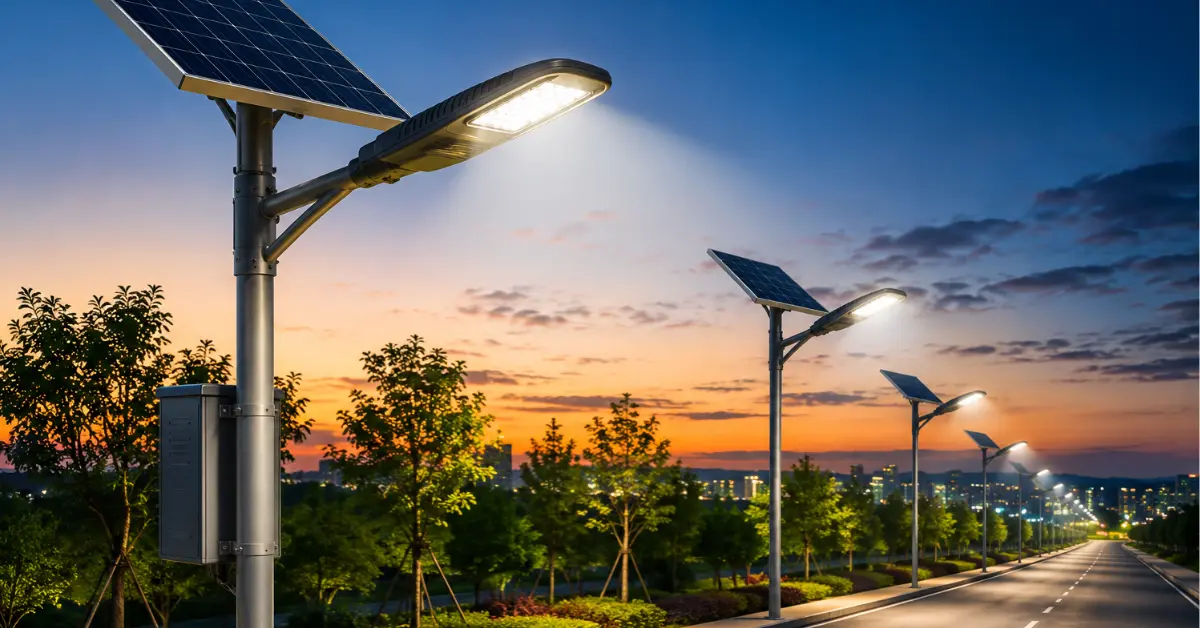
Solar street lights are transforming how cities, businesses, and communities light their roads, parking lots, and pathways. But with so many options on the market, it can be hard to know what to look for — or what questions to ask before you buy.
This guide gives you the full picture: how solar street lights actually work, what separates a great system from a cheap one, how much they cost to run, and what your competitors’ marketing won’t tell you.
What Are Solar Street Lights?
Solar street lights are self-contained outdoor lighting systems that generate their own power from sunlight. Each unit typically combines:
- A solar panel that captures sunlight and converts it to electricity
- A rechargeable battery that stores energy for use at night
- An LED light fixture that delivers bright, efficient illumination
- A charge controller that manages power flow and protects the battery
- A pole and mounting system designed for outdoor durability
Because they operate completely off the utility grid, solar street lights can be installed virtually anywhere — no trenching, no electrical infrastructure, no monthly power bills.
How Do Solar Street Lights Work? (Step by Step)
Understanding the system helps you make smarter buying decisions.
- Daytime charging: The monocrystalline solar panel absorbs sunlight and sends DC electricity to the charge controller.
- Smart charging: The MPPT (Maximum Power Point Tracking) charge controller optimizes the energy harvest and safely charges the battery.
- Automatic switching: At dusk, a light sensor or timer activates the LED fixture, drawing power from the battery.
- Dusk-to-dawn operation: The light runs all night on stored energy, with no dimming (in quality systems).
- Battery recovery: The next day, the cycle repeats.
What most guides don’t tell you: The number of backup days matters as much as a single night’s performance. A quality system should provide 3–5 consecutive days of full operation without any sunlight — critical for regions with cloudy winters or frequent storms.
The Real Costs of Solar Street Lights (What Buyers Actually Want to Know)
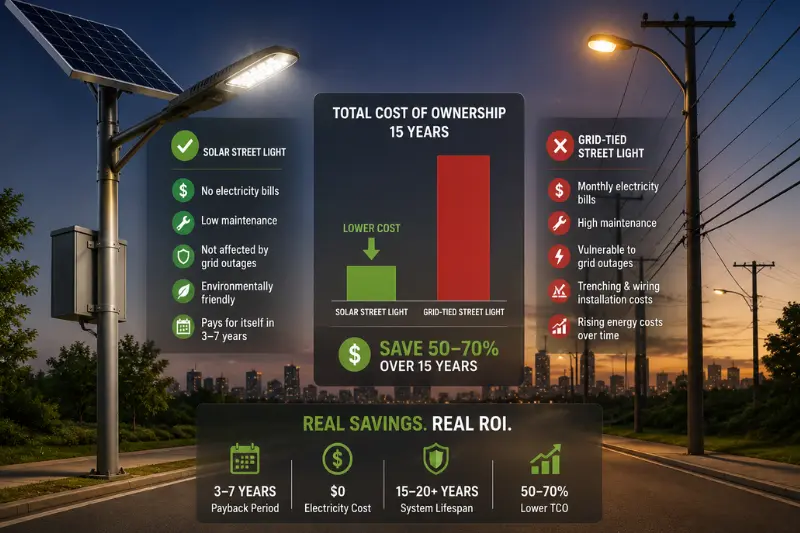
Cost is where most manufacturer articles go silent. Here’s the honest breakdown.
Upfront Cost
| System Type | Typical Price Range (Per Unit) |
|---|---|
| Basic residential (20–40W) | $300 – $700 |
| Commercial mid-range (60–100W) | $800 – $2,000 |
| High-output commercial/highway | $2,000 – $6,000+ |
Prices vary based on lumen output, battery type, pole inclusion, and brand.
Total Cost of Ownership vs. Grid-Tied Lights
This is the number that matters most — and almost no competitor publishes it.
A traditional grid-connected street light costs an average of $100–$250 per year in electricity alone, plus wiring, trenching (often $5–$15 per linear foot), and ongoing utility dependency.
Solar street lights eliminate:
- Trenching and conduit installation costs
- Monthly electricity bills
- Grid outage vulnerability
- Long utility extension runs to remote locations
A well-sized solar street light system typically pays for itself in 3–7 years depending on your electricity rates and installation complexity — then runs at near-zero operating cost for 15–20+ years.
Lumen Output: How Bright Do You Actually Need?
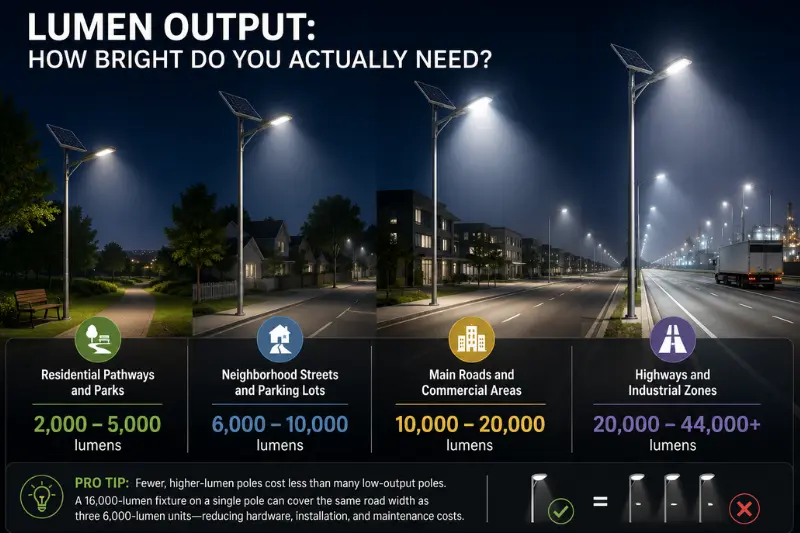
Lumen output is the most important spec to compare — and one most buyers overlook.
| Application | Recommended Lumen Range |
|---|---|
| Residential pathways and parks | 2,000 – 5,000 lm |
| Neighborhood streets and parking lots | 6,000 – 10,000 lm |
| Main roads and commercial areas | 10,000 – 20,000 lm |
| Highways and industrial zones | 20,000 – 44,000+ lm |
Pro tip: Fewer, higher-lumen poles cost less than many low-output poles. A 16,000-lumen fixture on a single pole can cover the same road width as three 6,000-lumen units — reducing hardware, installation, and maintenance costs significantly.
Battery Technology: The Part That Determines Reliability
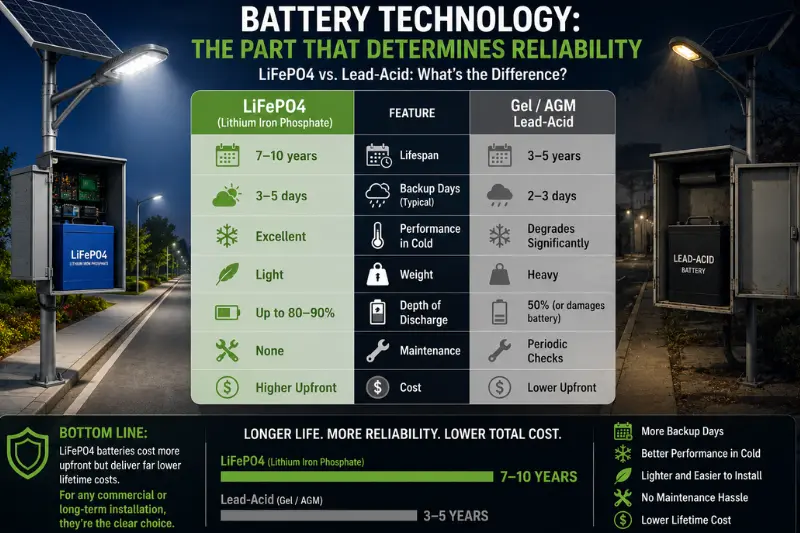
The battery is the most overlooked — and most important — component in any solar street light system.
LiFePO4 vs. Lead-Acid: What’s the Difference?
| Feature | LiFePO4 (Lithium Iron Phosphate) | Gel / AGM Lead-Acid |
|---|---|---|
| Lifespan | 7–10 years | 3–5 years |
| Backup days (typical) | 3–5 days | 2–3 days |
| Performance in cold | Excellent | Degrades significantly |
| Weight | Light | Heavy |
| Depth of discharge | Up to 80–90% | 50% (or damages battery) |
| Maintenance | None | Periodic checks |
| Cost | Higher upfront | Lower upfront |
- Bottom line: LiFePO4 batteries cost more upfront but deliver far lower lifetime costs. For any commercial or long-term installation, they’re the clear choice.
Solar Panel Quality: Monocrystalline vs. Polycrystalline
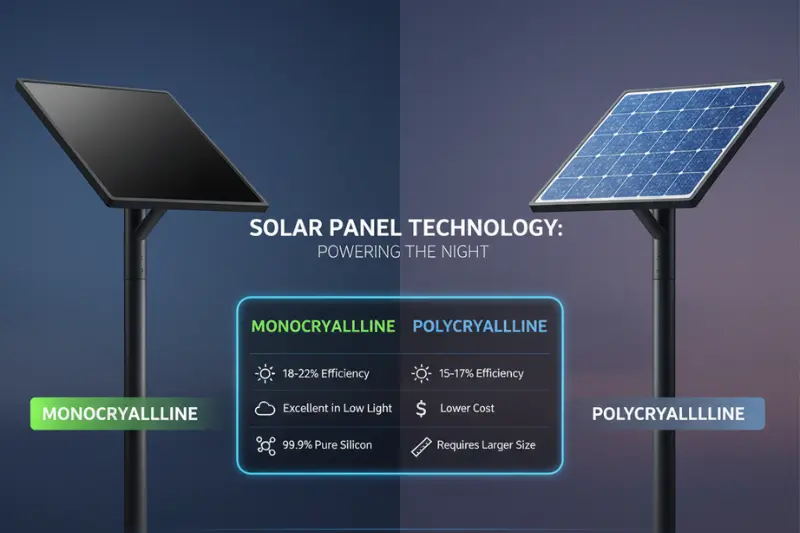
Not all solar panels are equal. Here’s what to know:
- Monocrystalline panels are made from 99.9% pure silicon, offering 18–22% efficiency — the highest available. They perform better in low-light and cloudy conditions.
- Polycrystalline panels are cheaper but less efficient (15–17%), meaning you need a larger panel to generate the same energy.
For street lighting, monocrystalline panels are the standard in quality commercial systems. Always confirm the panel type before purchasing.
7 Features That Separate a Great Solar Street Light From a Cheap One
Not all solar street lights are created equal. Before you buy, check for these:
- MPPT charge controller — More efficient than basic PWM controllers, especially in variable weather.
- LiFePO4 battery — Longer life, better cold-weather performance, safer chemistry.
- IP65 or higher rating — Full protection against dust ingress and water jets. Essential for outdoor use.
- Wind load certification — Important for areas prone to storms. Quality poles are tested to hurricane-force wind ratings.
- Dark Sky compliance — Downward-directed light reduces glare, light trespass, and sky glow — a legal requirement in some jurisdictions.
- Dusk-to-dawn operation without dimming — Some budget systems dim at midnight to save battery. Quality systems run at full brightness all night.
- 3+ days of battery autonomy — The safety margin that keeps lights on through cloudy stretches and bad weather.
Common Applications for Solar Street Lights
Solar street lights work across a huge range of environments:
- Municipal roads and highways — Including DOT-compliant projects for state and federal roads
- Residential developments — New subdivisions without established grid infrastructure
- Parking lots — Commercial properties seeking to cut energy costs
- Parks, pathways, and greenways — Low-disturbance lighting with no trenching
- Industrial sites and ports — Remote or high-security areas where grid access is costly
- Campuses and universities — Sustainable infrastructure with long-term savings
- International and off-grid communities — Reliable lighting where grid power doesn’t reach
- Disaster-prone regions — Lights that keep working when the grid goes down
How to Choose the Right Solar Street Light System
Follow this simple framework before making a decision:
Step 1 — Determine your lumen requirements
Use the lumen table above as a starting point, then ask your supplier for a photometric simulation — a computer-generated lighting layout that shows exactly how much light each fixture delivers to the ground surface.
Step 2 — Assess your location’s solar resource
Your local peak sun hours determine how large the solar panel needs to be. A supplier should ask for your installation location and design accordingly, not sell you a one-size-fits-all system.
Step 3 — Choose your battery type
For any commercial or permanent installation, specify LiFePO4. For temporary or low-budget applications, sealed gel batteries may suffice.
Step 4 — Confirm the backup days
Ask specifically: “How many consecutive days can this system operate without any sunlight charging?” The answer should be at least 3 days for most climates.
Step 5 — Check certifications
Look for: IP65+ rating, wind load testing, Dark Sky compliance if applicable, and any DOT/AASHTO standards if the installation is on a public road.
Step 6 — Ask about warranty and after-sales support
Quality manufacturers offer 2–5 year warranties on components, with clear processes for battery replacement down the line. Make sure local support exists.
Frequently Asked Questions
How long do solar street lights last?
Solar street lights are built for the long haul. The LED fixture lasts 50,000+ hours (roughly 17 years of nightly use). LiFePO4 batteries last 7–10 years, and the solar panel and pole are designed to hold up for 20–25 years.
Do solar street lights work in cloudy or rainy weather?
Yes. Monocrystalline solar panels continue charging even under overcast skies. A properly designed system accounts for your local weather and stores enough battery backup to keep lights running through several consecutive cloudy days.
How many nights can a solar street light run without sunlight?
A quality system provides 3–5 consecutive nights of full operation without any solar charging. Always ask your supplier for the exact backup days before purchasing — cheap systems often only manage one night.
Do solar street lights dim during the night?
Budget systems often dim at midnight to stretch battery life. Quality commercial systems deliver full brightness from dusk to dawn with zero dimming. Always confirm this before you commit to a purchase.
How bright are solar street lights?
Brightness depends on the application. Residential pathways need 2,000–5,000 lumens. Main roads and parking lots require 10,000–20,000 lumens. High-traffic highways can demand 44,000+ lumens. Your supplier should provide a photometric simulation to confirm coverage.
Are solar street lights worth the investment?
Yes — especially long-term. They eliminate trenching costs, monthly electricity bills, and grid dependency. Most commercial systems pay for themselves within 3–7 years and then operate at near-zero cost for another 15–20 years.
What type of battery is best for solar street lights?
LiFePO4 (lithium iron phosphate) is the gold standard. It lasts 7–10 years, handles cold weather well, and discharges up to 90% without damage. Gel and AGM lead-acid batteries cost less upfront but need replacing every 3–5 years.
Can solar street lights handle strong winds and harsh weather?
Yes, when properly rated. Quality poles and panel mounts are tested to hurricane-force wind loads. Look for an IP65 or higher rating for dust and water resistance, and always check the wind load specification for your climate zone.
Can solar street lights be used on public roads?
Yes. Public roads typically require compliance with AASHTO RP-8 lighting standards or your state DOT requirements. Work with a supplier experienced in government projects and confirm compliance before installation.
Do solar street lights qualify for tax credits or incentives?
Many installations in the US may qualify for federal or state energy efficiency incentives. Eligibility depends on your location, project type, and current programs. Check with your state energy office or a qualified tax advisor for up-to-date information.
The Bottom Line
Solar street lights are no longer a compromise — they’re the smarter choice for almost any outdoor lighting project. They eliminate grid dependency, cut long-term costs, install faster, and keep working when the power goes out.
The key is knowing what to look for: LiFePO4 batteries, monocrystalline panels, genuine MPPT charge control, verified lumen output, and a supplier who designs your system for your specific location — not just sells you a catalog product.
Get a photometric layout, ask about battery autonomy, and compare total cost of ownership — not just the sticker price. That’s how you make a lighting investment that pays off for 20 years.