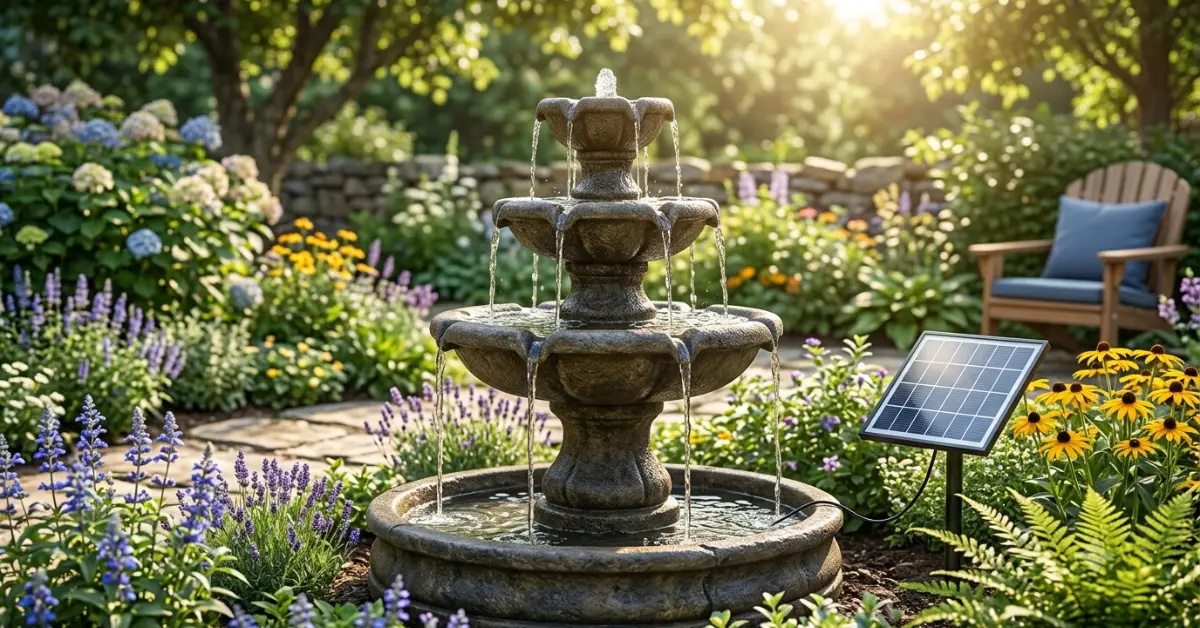
A solar fountain is one of those rare backyard upgrades that looks impressive, costs little to run, and practically takes care of itself. Whether you’re dreaming of a peaceful garden retreat or simply want to add some life to a dull outdoor space, a solar fountain might be exactly what you’ve been missing. The best part? No wiring, no electrician, no complicated setup — just clean, free energy from the sun powering a beautiful water feature right in your own yard.
But here’s where most buyers get stuck — not every solar fountain is built the same, and picking the wrong one can leave you frustrated with weak water flow, poor performance on cloudy days, or a pump that gives up after one season. The difference between a fountain you’ll love for years and one you’ll regret comes down to knowing exactly what to look for before you buy. And that’s precisely what this guide is here to help you with.
From understanding how a solar fountain actually works to comparing the best types, features, and price points available today, this complete buyer’s guide covers everything you need to make a smart, confident decision. Whether you’re a first-time buyer or upgrading an existing setup, you’ll find honest, practical advice that cuts through the noise. Read on — your perfect solar fountain is closer than you think.
What Is a Solar Fountain?
A solar fountain is an outdoor water feature that runs on solar energy. A small solar panel converts sunlight into electricity, which powers a submersible pump. The pump pushes water upward, creating a continuous flow — a spray, a cascade, a bubbling stream, or a tiered waterfall.
The best part? No wiring. No plumbing. No electricity costs. Just sunlight and water doing what they do naturally.
How Does a Solar Fountain Work?
Here’s the simple science behind it:
- Sunlight hits the solar panel — the panel captures UV rays and converts them into DC electricity.
- Electricity powers the pump — the submersible pump draws water from the basin.
- Water flows upward — it travels through a nozzle or pipe and falls back down.
- The cycle repeats — as long as there’s sunlight (or stored battery power), water keeps moving.
Some models include a battery backup, which stores solar energy during the day so the fountain can run at night or on cloudy days. If you want 24/7 operation, always look for this feature.
Types of Solar Fountains
Not all solar fountains are the same. Here’s a breakdown of the main types so you can choose the right one for your space.
1. Floating Solar Fountains
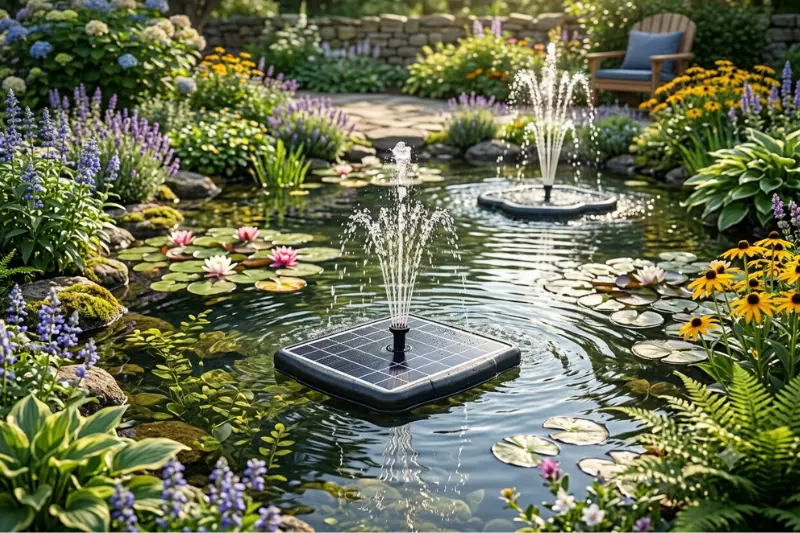
These sit directly on the water’s surface — ideal for ponds, large containers, or bird baths. They’re self-contained and the easiest to set up. Simply place them in water and let the sun do the rest.
Best for: Bird baths, container ponds, small garden ponds.
2. Tiered Solar Fountains
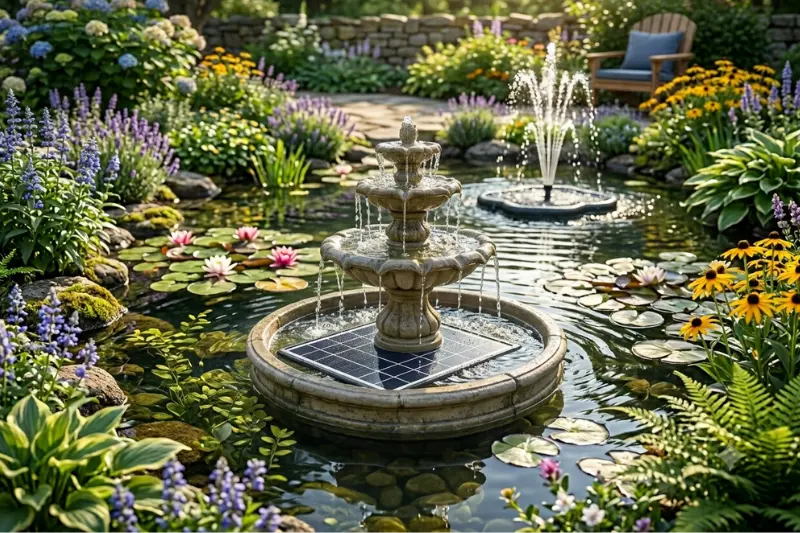
Classic multi-level designs where water cascades from one bowl to the next. They come in stone, resin, or ceramic finishes and make a striking garden centrepiece.
Best for: Patios, garden beds, formal garden designs.
3. Solar Waterfall Fountains
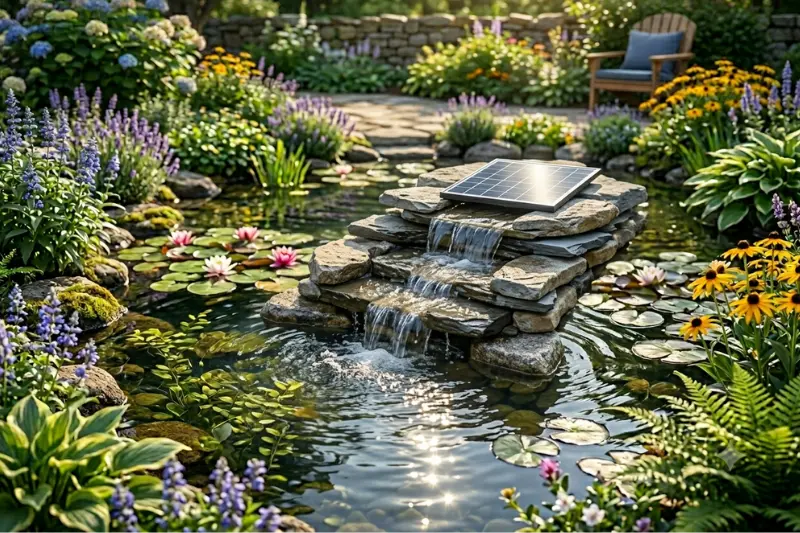
Water flows over rocks or sculpted surfaces, mimicking a natural waterfall. These tend to be larger and work well as a focal point in a landscape design.
Best for: Larger gardens, rockeries, zen-inspired spaces.
4. Solar Bird Bath Fountains
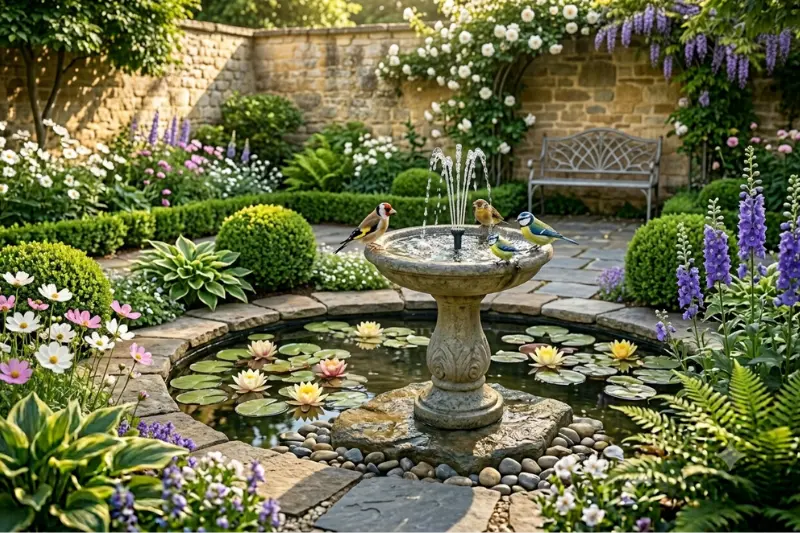
A bird bath with a built-in solar pump. The moving water keeps the bath clean and sanitary — and birds absolutely love it. Moving water signals safety and freshness to birds, so you’ll attract far more wildlife than with a static bath.
Best for: Wildlife gardens, patios, anyone who loves birdwatching.
5. Solar Wall Fountains
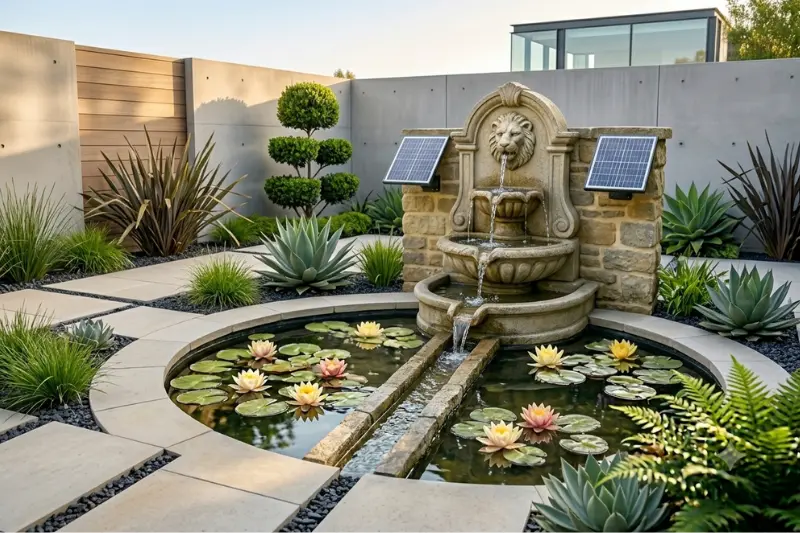
Mounted to a fence or wall, these save floor space while adding sound and movement. Water flows from a spout into a basin below and recirculates.
Best for: Small gardens, courtyards, entryways.
6. Solar Pond Fountains
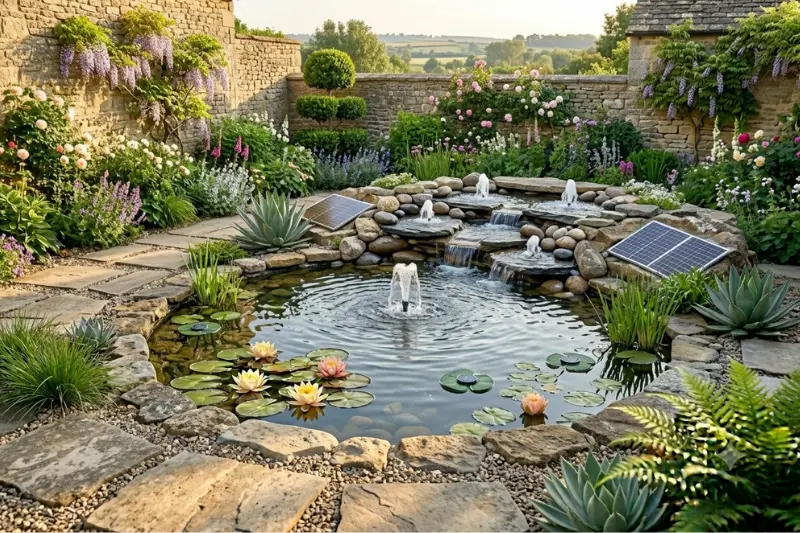
Larger, more powerful units designed for garden ponds. They oxygenate the water, which is vital for fish and pond plants.
Best for: Koi ponds, wildlife ponds, large water features.
Solar Fountain with Battery Backup vs. Direct Solar: Which Is Better?
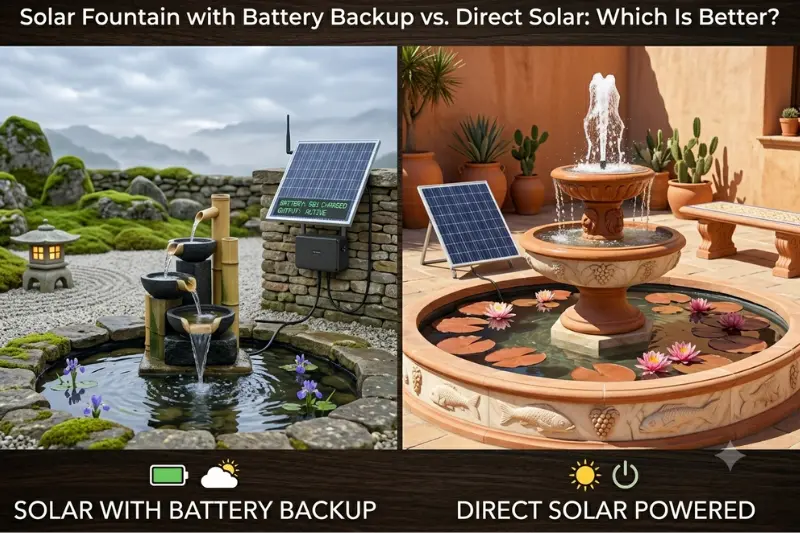
This is one of the most common questions buyers ask — and it’s a great one.
| Feature | Direct Solar | Battery Backup |
|---|---|---|
| Works in full sun | Yes | Yes |
| Works on cloudy days | No | Yes |
| Works at night | No | Yes |
| Price | Lower | Higher |
| Best for | Daytime decoration | All-day/night use |
Bottom line: If you want your fountain running only during the day in a sunny spot, direct solar is fine and more affordable. If you want consistent operation regardless of weather or time of day, invest in a model with battery backup. It’s worth it.
Solar Fountain vs. Electric Fountain: A Honest Comparison
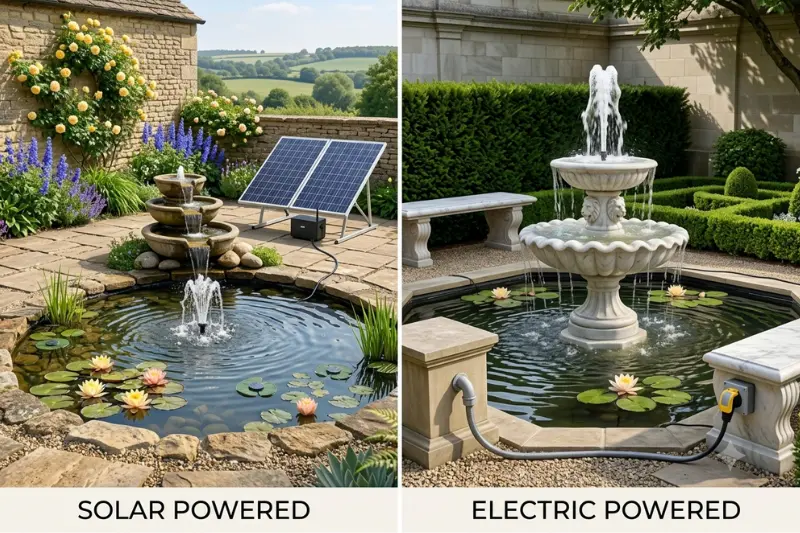
Wondering whether to go solar or stick with a traditional electric fountain? Here’s a side-by-side look:
| Solar Fountain | Electric Fountain | |
|---|---|---|
| Running cost | Free | Ongoing electricity cost |
| Installation | No wiring needed | Requires power outlet nearby |
| Placement flexibility | Very high | Limited by cable reach |
| Performance in shade | Reduced | Consistent |
| Eco-friendliness | High | Lower |
| Upfront cost | Moderate | Can be lower |
Choose solar if: You want flexible placement, zero running costs, and an eco-friendly option.
Choose electric if: Your fountain is in a shaded spot all day or you need high-powered flow that solar can’t match.
How to Choose the Right Solar Fountain
Use these key factors as your checklist before buying.
Sunlight Availability
Solar fountains need direct sunlight to perform well. Before buying, assess how many hours of direct sun your chosen spot receives daily. 4–6 hours is the sweet spot for most models.
- Full sun all day → any direct solar model will work
- Partial shade → choose a model with battery backup or a glass solar panel (more efficient)
- Heavy shade → consider an electric fountain instead
Pump Wattage
The pump’s wattage determines water flow height and volume.
- 1.4W–2W → gentle bubbling, small containers, bird baths
- 2.5W–3.5W → medium spray height (up to 20″), standard garden use
- 4W+ → strong flow, large ponds, tall tiered designs
Solar Panel Type
- Standard plastic panels — affordable, work well in bright sun
- Glass solar panels — more efficient, better in low light and partial shade, longer lifespan
Nozzle Options
More nozzles = more flexibility. Look for models with 6–8 interchangeable nozzles so you can adjust the spray shape and height to suit different moods and seasons.
Water Depth Compatibility
Some pumps need deep water to operate safely — they’ll automatically stop if the water level drops too low to protect the motor. Check the minimum water depth required before choosing your container or pond.
Material and Durability
For the fountain structure itself (not the pump), look for:
- UV-resistant materials — prevents fading and cracking
- Frost-resistant resin or stone composite — if you’re in a cold climate
- Stainless steel or copper accents — for a premium, long-lasting finish
How to Set Up a Solar Fountain (Step-by-Step)
Setting up a solar fountain is simpler than most people expect. Here’s how to do it right.
What you’ll need:
- Your solar fountain kit
- A water container (pond, bird bath, bowl, or planter)
- Water
- Optional: decorative stones, plants, rocks
Steps:
- Choose your location — pick the sunniest spot available. The solar panel needs direct sunlight.
- Fill your container — make sure the water depth meets the pump’s minimum requirement (usually 2–4 inches).
- Place the pump — submerge the pump in the water. Most floating models simply rest on the surface.
- Position the solar panel — if the panel is on a separate cord, angle it toward the sun. Many panels have a long cord (up to 5 metres) so the panel can be in full sun while the fountain sits in a shadier, more decorative spot.
- Attach your chosen nozzle — select the spray pattern you like.
- Test it — let the sun hit the panel. The pump should start within seconds.
- Adjust as needed — reposition the panel or nozzle for the best effect.
Solar Fountain Maintenance: How to Keep It Running Like New
This is the section most competitors skip — and it’s one of the most important. A well-maintained solar fountain lasts years longer than a neglected one.
Weekly Maintenance
- Top up water levels — evaporation and splashing reduce water over time. A low water level can burn out the pump.
- Check for debris — leaves, dirt, and algae can clog the pump intake. Remove any buildup.
Monthly Maintenance
- Clean the pump — remove the pump from the water, disassemble the rotor, and rinse all parts under clean water. Use a soft brush to remove mineral deposits.
- Wipe the solar panel — dust, bird droppings, and pollen reduce efficiency. Wipe with a damp cloth.
- Check the nozzles — rinse them to clear blockages. A blocked nozzle reduces spray height noticeably.
Seasonal Maintenance
- Spring startup: After winter storage, reassemble the pump, check all connections, and clean before refilling.
- Autumn/Winter shutdown (cold climates): Before the first frost, remove the pump, drain all water, clean and dry every component, and store indoors. Freezing water inside the pump cracks the casing permanently.
Algae Prevention Tips
- Add a small amount of white vinegar or a pond-safe algae treatment to the water.
- Place the fountain in partial shade — full sun encourages faster algae growth.
- Use distilled or rainwater instead of tap water when possible. Tap water’s mineral content accelerates scale buildup.
Troubleshooting Common Solar Fountain Problems
Even the best solar fountains can run into issues. Here’s how to fix the most common ones.
Problem: The fountain isn’t running
Possible causes and fixes:
- Not enough sunlight → move the solar panel to a sunnier spot
- Cloudy day → wait for sun, or upgrade to a battery backup model
- Clogged pump → clean the rotor and intake
- Low water level → top up the basin; most pumps have an auto-shutoff for low water
Problem: Weak water flow
- Dirty solar panel → wipe it clean
- Clogged nozzle → rinse and unblock
- Insufficient sunlight angle → reposition the panel to face the sun more directly
Problem: Pump is noisy or rattling
- Debris inside the pump → disassemble and clean
- Pump not fully submerged → push it deeper into the water
- Hard mineral deposits on the rotor → soak in white vinegar for 30 minutes
Problem: Fountain stops working mid-afternoon
- Panel is falling into shade as the sun moves → reposition the panel or use a longer cord to keep it in sun
- Battery overheating (battery backup models) → move the panel to a slightly cooler surface
Creative Solar Fountain Ideas for Any Garden Style
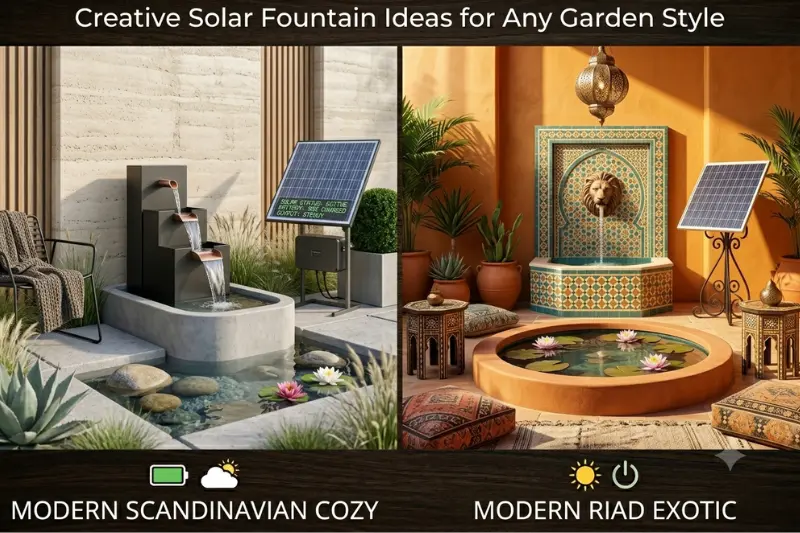
You don’t need a big garden or a big budget to enjoy a solar fountain. Here are some ideas for every type of outdoor space.
- Minimalist modern garden → a sleek, dark-coloured bowl planter with a stone pebble base and a central bubbling fountain
- Cottage garden → a terracotta planter overflowing with water lilies, with a floating solar fountain at the centre
- Wildlife garden → a shallow bee-friendly drinking station made from a wide saucer, half-filled with pebbles for safe landing, with a gentle bubbling fountain
- Tiny balcony or patio → a compact wall-mounted solar fountain on a fence panel
- Dog-friendly garden → a deep plant-pot saucer with a solar fountain — dogs instinctively prefer drinking from moving water
- Upcycled feature → an old metal trough or galvanised bucket repurposed into a container pond with a floating solar fountain
Are Solar Fountains Eco-Friendly?
Yes — genuinely so. Here’s why they’re one of the most sustainable garden features you can buy:
- Zero carbon emissions during operation — powered entirely by the sun
- No electricity consumption — no ongoing demand on the grid
- Support local ecosystems — moving water attracts birds, bees, butterflies, and other wildlife
- Prevent mosquito breeding — mosquitoes lay eggs in still water; a solar fountain keeps water moving, eliminating their preferred conditions
- Long product lifespan — quality solar pumps last 3–5 years with proper maintenance, reducing waste
Pair your solar fountain with a water butt to collect rainwater for topping up the basin, and your water feature becomes almost entirely self-sustaining.
How Much Do Solar Fountains Cost?
Solar fountains are available at a wide range of price points.
| Budget | What You Get |
|---|---|
| Under $20 | Basic floating pump, 1–2W, 6 nozzles, no battery — great for bird baths and small containers |
| $20–$40 | Glass solar panel, battery backup, 3–3.5W, LED lighting options — ideal for most garden uses |
| $40–$100 | Decorative tiered or waterfall fountain with integrated solar pump — a full garden feature |
| $100–$300+ | Large statement fountains, premium materials, high-wattage pumps, full battery systems |
Running cost for all solar fountains: $0 per year.
Frequently Asked Questions About Solar Fountains
Can a solar fountain work in winter?
In mild winters with some sunshine, yes. In cold climates, it’s best to store the pump indoors during freezing temperatures to prevent damage.
Do solar fountains work on cloudy days?
Direct solar models slow down or stop. Models with battery backup continue to run. Glass panel models perform better in low light than standard panels.
How long does a solar fountain pump last?
With regular cleaning and winter storage, a quality pump can last 3 to 5 years, sometimes longer.
Can I use a solar fountain indoors?
Only if the solar panel has a long enough cord to reach a sunny window. The panel must receive direct sunlight to power the pump.
Do I need to add chemicals to the water?
Not necessarily. However, a small amount of pond-safe algae treatment or white vinegar helps keep the water clear and the pump clean.
Can I leave a solar fountain running all day?
Yes. As long as the water level stays adequate and sunlight is available, continuous operation is fine.
Final Thoughts
A solar fountain is one of the most rewarding additions you can make to an outdoor space. It brings sound, movement, and life — and it costs nothing to run. Whether you want a simple floating pump for a bird bath, a dramatic tiered waterfall for your patio, or a DIY container pond for a tiny balcony, there’s a solar fountain that fits.
Buy once, maintain it well, and enjoy years of free, sun-powered tranquillity.