Your solar system sits on your roof every single day — through scorching summers, heavy storms, and freezing winters — quietly generating electricity and saving you money. But when something goes wrong, knowing how to find the right solar repair service quickly can mean the difference between a small fix and months of silent energy loss.
This guide covers everything: what a professional solar repair service actually does, how to spot problems before they get expensive, what each repair costs in 2026, and a topic your competitors almost never talk about — what to do if your original installer has gone out of business.
What Is a Solar Repair Service?
A solar repair service is a certified team of technicians that diagnoses, fixes, and restores underperforming or damaged solar energy systems. Unlike a general electrician or a handyman, a qualified solar repair service has the training, equipment, and manufacturer authorizations to work safely on your specific panels, inverters, and batteries — without voiding your warranties or creating new hazards.
A complete solar repair service typically covers:
- Diagnosing production drops and system outages
- Inverter repair and replacement
- Damaged or cracked panel replacement
- Wiring, connector, and junction box repairs
- Roof leak detection and resealing around panel mounts
- Battery storage system repair and reconfiguration
- Monitoring system reconnection and reconfiguration
- Critter damage repair and pest-proofing installation
- Warranty claim processing with equipment manufacturers
- Post-storm inspections and damage reports
Not every solar company offers all of these services. When you search for a solar repair service, confirm they cover your specific type of repair — especially if you have microinverters, a battery system, or a less common panel brand.
Warning Signs That You Need a Solar Repair Service Right Now
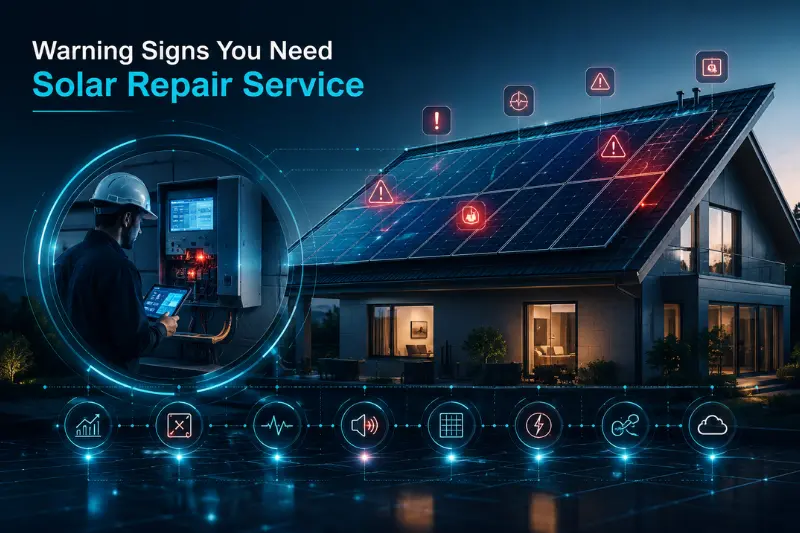
Most solar repair service calls could have been scheduled earlier — and for far less money — if the homeowner had caught the warning signs. Here’s what to watch for:
Monitor your output monthly. The single most powerful thing you can do is compare your system’s current monthly production to the same month last year. A drop of 10% or more — not explained by unusual cloud cover or shade — is a clear signal to contact a solar repair service.
Watch for these specific warning signs:
- Your electric bill rises without any change in usage habits
- Your monitoring app shows a panel or string offline
- The inverter displays error codes — especially ones that appear and clear themselves repeatedly
- You hear unusual buzzing, clicking, or smell burning near the inverter
- Visible damage: cracks, browning, or discoloration on panel surfaces
- The system trips a breaker more than once
- You spot exposed or chewed wiring under or near the panels
- Your monitoring portal stops updating — even if the system appears to run normally
The warning sign most homeowners miss: An inverter error that clears itself. Homeowners see the error disappear and assume everything is fine. A qualified solar repair service knows these self-clearing codes are often the earliest sign of a component approaching failure. Catching it here costs $300–$500. Waiting until it fails completely can cost $1,500–$3,500.
The 6 Most Common Solar Repair Service Calls
1. Inverter Repair and Replacement
Inverter failure is the number one reason homeowners call a solar repair service. Research shows roughly 80% of all solar system failures are inverter-related. The inverter converts the DC power your panels produce into the AC power your home uses — when it fails, the entire system stops producing even if the panels are perfect.
What a solar repair service does:
- Runs diagnostics to confirm the inverter is the actual failure point
- Checks whether the issue is covered under your warranty
- Repairs minor component failures where possible
- Replaces the unit when repair isn’t cost-effective
Solar repair service costs for inverters:
- String inverter repair: $400–$1,500
- String inverter full replacement: $1,000–$3,500
- Microinverter replacement (per unit): $200–$500
Important context: If your inverter is under 10 years old and still within warranty, a legitimate solar repair service should check coverage before billing you for parts. Many homeowners pay out of pocket for repairs that should have been free.
2. Roof Leaks Caused by Solar Mounting
Roof leaks are the third most common solar repair service call — and one of the most damaging if ignored. Every panel on your roof requires penetrations through the roofing material for mounting bolts and wiring. When those penetrations are not properly sealed, or when sealant degrades over time, water finds its way in.
Why this matters beyond solar: A roof leak caused by solar mounting can damage your attic, insulation, drywall, and ceiling — repairs that cost far more than the solar fix itself. A professional solar repair service should inspect all roof penetrations during any service visit.
Signs of mounting-related roof leaks:
- Water stains on your ceiling near where solar wiring enters the home
- Musty smell in your attic after heavy rain
- Visible rust or corrosion on mounting hardware during a ground-level inspection
- Panels that appear slightly shifted or uneven from below
Cost: Roof penetration resealing: $100–$400. If structural damage has occurred from an extended leak: $500–$2,000+.
3. Wiring, Connector, and Animal Damage Repairs
Wiring problems are one of the most underestimated reasons to call a solar repair service. Over time, UV exposure, heat cycling, and physical stress degrade wire insulation and loosen connectors. Add animals to the equation and problems escalate fast.
The animal damage reality most solar blogs skip: Squirrels, birds, and rodents are drawn to solar panels because the space underneath is warm, sheltered, and hidden. They chew through DC cables, build nests that trap heat, and their waste corrodes panel frames. This triggers ground faults and complete system shutdowns — and the problem keeps coming back unless you address the root cause at the same time as the repair.
A reputable solar repair service should:
- Repair all chewed or damaged wiring
- Inspect the full wire run for additional damage not yet visible
- Install critter-proof wire mesh around the panel perimeter to prevent re-nesting
- Document the repair in case it’s needed for a warranty or insurance claim
Signs of wiring problems:
- Ground fault or isolation fault error on your inverter
- System shuts down without warning, especially after rain
- Visible chew marks or nesting materials near panels
Important: If your inverter shows a ground fault error after heavy rain, wait 24 hours before calling a solar repair service — this error often clears once the system dries out. If it persists beyond 24 hours, schedule service immediately as you likely have a hard fault requiring repair.
Cost: Wiring and connection repairs: $100–$500 depending on the extent of damage.
4. Damaged and Cracked Panel Replacement
Physical panel damage from hail, falling branches, or impact events is one of the clearer solar repair service calls — the damage is visible and the fix is straightforward. But micro-level panel problems like internal microcracks and hotspots are trickier because they’re invisible to the naked eye.
Microcracks form from thermal cycling, handling stress, or hail impact. They may not cause obvious issues immediately, but they grow over time, allow moisture inside the panel, and accelerate efficiency loss.
Hotspots form when one section of a panel operates at much higher temperature than the rest — caused by shading, a cracked cell, or poor internal connections. Severe hotspots can damage the panel backsheet and, in rare cases, create fire risk. Modern panels include bypass diodes that limit hotspot severity, but they don’t cure the underlying cause.
What a solar repair service does for panel issues:
- Uses thermal imaging to identify hotspots not visible to the eye
- Reviews panel-level monitoring data to pinpoint underperforming units
- Processes manufacturer warranty claims for covered defects
- Replaces panels that cannot be repaired
Cost: Panel replacement: $200–$600 per panel including labor.
5. Monitoring and Communication Reconnection
One of the most misunderstood solar repair service calls is monitoring reconnection — and it’s often the one with the simplest fix. Many homeowners report their system has “stopped working” when the system itself is producing perfectly. The monitoring portal simply lost its connection after a router change or internet service update.
What a solar repair service does:
- Reconnects the monitoring gateway to your updated home network
- Reconfigures system parameters if they were incorrectly set at installation
- Restores historical production data where possible
- Sets up alert notifications so you’re automatically warned of future issues
Try these steps yourself first before calling:
- Reconnect your monitoring gateway to your current router
- Restart the gateway device
- Check that indicator lights show an active network connection
If reconnection doesn’t restore monitoring within 24 hours, or if errors persist after reconnection, contact your solar repair service.
6. Battery Storage System Repair
As more homeowners add battery storage to their solar systems, battery-related solar repair service calls are becoming increasingly common. Batteries add significant value — especially for backup power and energy savings during peak rate hours — but they also add complexity.
Common battery repair issues:
- Battery not charging or discharging as expected
- Battery showing offline in the monitoring app
- System not switching to battery backup during grid outages
- Degraded capacity after several years of use
What a solar repair service does:
- Diagnoses whether the issue is the battery, the inverter, or the settings
- Checks manufacturer warranty coverage (most lithium batteries carry a 10-year warranty)
- Reconfigures charge/discharge settings for optimized performance
- Replaces cells or the full unit when covered by warranty or when replacement is the most cost-effective path
The Solar Repair Service Issue Nobody Talks About: Orphaned Systems
Here is something your competitors almost never address — and it’s now one of the most urgent solar repair service issues in the country.
The solar installer closure crisis: The solar industry has experienced a wave of major company closures in recent years. SunPower filed for bankruptcy in August 2024. Titan Solar Power closed in June 2024. Sunnova filed in June 2025. Freedom Forever filed Chapter 11 in April 2026. Hundreds of smaller regional installers have also shut down. Data suggests approximately 15% of solar homeowners may now have what the industry calls an “orphaned system” — a solar installation with no active installer to call for service.
What happens when your installer closes:
- Your workmanship warranty disappears — it was tied to the installer, not the equipment
- Your monitoring platform may go offline if it relied on the installer’s servers
- You have no one to call for routine service, repairs, or warranty claims
- Equipment manufacturer warranties for your panels and inverter remain valid — but you now need a new certified technician to process them
What to do if your solar installer has closed:
- Don’t panic — your system is still on your roof and manufacturer warranties are still active
- Locate your original contract and identify your panel and inverter brands and model numbers
- Contact the equipment manufacturers directly to verify warranty status using your serial numbers
- Search for a NABCEP-certified solar repair service in your area that explicitly offers “solar orphan” or “third-party service” support
- Ask your new solar repair service to document a full system inspection — this creates a baseline for future warranty claims
- Ask about monitoring reconnection — many orphaned systems can be reconnected to the manufacturer’s native monitoring platform (such as Enphase Enlighten or SolarEdge monitoring) even without the original installer
Key point: Selecting a solar repair service that explicitly serves orphaned systems is worth prioritizing. They have experience processing warranty claims without the original installer, reconnecting monitoring after company closures, and identifying code violations or installation errors that may have been left behind.
What to Expect from a Professional Solar Repair Service Visit
Many homeowners aren’t sure what actually happens when a solar repair service technician arrives. Here’s the full picture:
Step 1 — Pre-visit preparation (you do this):
- Note down the exact symptoms: what you saw, when it started, and any error codes
- Have your original installation documents, inverter brand, and panel brand available
- Check whether your system is still under any warranty period
Step 2 — Diagnostic assessment (1–2 hours):
- The technician reviews your monitoring data for production history
- Visual inspection of all panels, mounting hardware, and wiring
- Inverter diagnostic scan for fault codes and performance data
- Roof penetration and sealing check
- Animal activity inspection underneath panels
Step 3 — Written estimate:
- A reputable solar repair service provides a written diagnosis and itemized repair estimate before any work begins
- They confirm warranty coverage so you don’t pay for parts you shouldn’t have to
Step 4 — Repair:
- Most standard repairs (inverter replacement, wiring, panel swap) are completed in one visit
- Parts that need ordering extend the timeline by 1–3 weeks depending on availability
Step 5 — Post-repair verification:
- The technician verifies restored production through your monitoring system before leaving
- You receive written documentation of what was repaired — keep this for warranty records
What response times to expect from a quality solar repair service:
- Critical fault (system completely offline): Response within 24 hours, repair within 48–72 hours
- Major fault (significant production loss): Response within 24–48 hours
- Minor fault (monitoring alerts, small performance dip): Response within 3–5 business days
If a solar repair service cannot give you any commitment on response time, that’s a red flag.
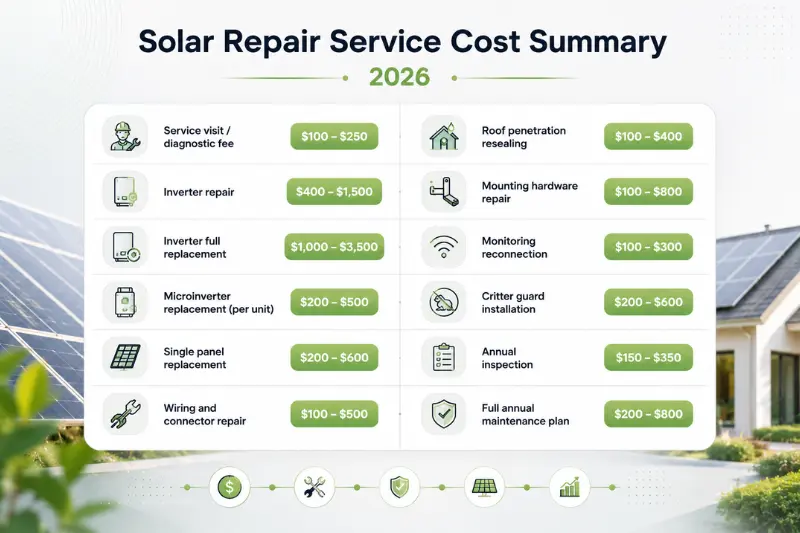
Solar Repair Service Cost Summary — 2026
| Repair Type | Typical Cost |
|---|---|
| Service visit / diagnostic fee | $100 – $250 |
| Inverter repair | $400 – $1,500 |
| Inverter full replacement | $1,000 – $3,500 |
| Microinverter replacement (per unit) | $200 – $500 |
| Single panel replacement | $200 – $600 |
| Wiring and connector repair | $100 – $500 |
| Roof penetration resealing | $100 – $400 |
| Mounting hardware repair | $100 – $800 |
| Monitoring reconnection | $100 – $300 |
| Critter guard installation | $200 – $600 |
| Annual inspection | $150 – $350 |
| Full annual maintenance plan | $200 – $800 |
On homeowner’s insurance: Your policy may cover storm, fire, or hail damage to your solar system, but wind and hail are frequently excluded without a specific add-on rider. Review your policy and contact your insurer before assuming any damage is covered.
How to Choose the Right Solar Repair Service
With the solar industry in transition and many companies having closed, choosing a stable, qualified solar repair service matters more than ever. Here’s what to look for:
1. NABCEP certification. The North American Board of Certified Energy Practitioners credential is the gold standard. Research shows that NABCEP-certified technicians have a 42% higher repair success rate compared to general electricians for solar work.
2. Brand-specific authorization. Inverter brands like Enphase, SolarEdge, and SMA require brand-specific training. Confirm your solar repair service is authorized for your specific equipment — this is also required for warranty claims to be processed correctly.
3. State electrical licensing and insurance. Your solar repair service must carry a valid state electrical contractor license and liability insurance. Always request proof before work begins.
4. Experience with your system type. Ask how many systems they’ve serviced with your specific panel and inverter combination. A technician unfamiliar with your equipment takes longer, costs more, and is more likely to misdiagnose.
5. Written diagnostics and estimates. Never accept verbal-only quotes. A trustworthy solar repair service always provides a written diagnosis and itemized estimate before starting any work.
6. Longevity and stability. Given the wave of solar company closures, ask how long the solar repair service has been in business. A company with 10+ years of operating history is a significantly lower risk than a recently launched operation.
7. Orphan service capability. If your original installer has closed, ask specifically whether they handle orphaned systems — warranty claim coordination, monitoring reconnection, and third-party service documentation.
Can You Prevent Most Solar Repair Service Calls?
Yes — the majority of solar repair service calls are preventable with consistent, proactive care. Here’s what protects your system year-round:
- Annual professional inspection: Catches developing problems before they cause production loss or damage
- Monthly monitoring review: Compare output to the same month last year and act on a 10%+ unexplained drop
- Biannual professional cleaning: Dirty panels lose 15–25% efficiency and can develop hotspots from bird droppings
- Tree and vegetation management: Trim anything that creates new shading as it grows
- Post-storm ground inspection: After hail or severe wind, do a visual check from the ground before your next billing cycle
- Critter guard installation: Wire mesh around panel perimeters prevents the single most recurring wiring damage cause
- Keep all documentation: Service records protect your warranty rights and simplify future solar repair service claims
How much does a solar repair service call cost?
Most solar repair service visits include a diagnostic fee of $100–$250. Actual repair costs depend on what’s wrong: minor wiring fixes start around $100, while full inverter replacement runs $1,000–$3,500. The average homeowner spends $400–$1,000 per repair occurrence.
How do I know if I need a solar repair service or just a cleaning?
If your monitoring shows an output drop, your inverter displays error codes, or your electric bill has risen, you likely need a solar repair service — not just a cleaning. A simple production drop from soiling typically shows up gradually and improves immediately after cleaning. A production drop from a hardware fault is usually sharper and doesn’t improve after rain or cleaning.
What if my solar installer has gone out of business?
Your manufacturer warranties for panels and inverters remain valid even if your installer closed. Contact the equipment manufacturers directly with your serial numbers to verify coverage. Then find a NABCEP-certified solar repair service in your area that explicitly handles orphaned systems and can process manufacturer warranty claims on your behalf.
Will my homeowner’s insurance cover solar repairs?
It depends on your policy and the cause of damage. Storm and fire damage may be covered, but wind and hail are commonly excluded without an add-on rider. Review your policy carefully before assuming coverage, and ask your insurer whether your solar system needs to be separately listed.
How long does a solar repair service visit take?
Standard repairs like inverter replacement, wiring fixes, or panel swaps typically take 2–4 hours. Larger repairs or jobs requiring parts to be ordered can take 1–3 weeks from diagnosis to completion.
Can I do solar repairs myself?
Only very basic tasks are safe for homeowners — clearing surface debris, reconnecting your monitoring gateway to an updated router, and doing visual ground-level inspections. Any electrical repair, roof access, or panel-level work must be handled by a certified solar repair service. DIY electrical work on solar systems is dangerous and will void most warranties.
How do I find a reliable solar repair service near me?
Search for NABCEP-certified technicians in your area. Confirm they are authorized to service your specific panel and inverter brands, carry valid state electrical licenses and insurance, and provide written estimates. Ask specifically whether they service systems they didn’t install — this is a strong indicator of genuine expertise.
What questions should I ask before hiring a solar repair service?
Ask: Are you NABCEP certified? Are you authorized to service my specific inverter brand? Do you handle systems you didn’t install? Can you provide a written estimate before starting work? Do you offer critter-proofing as part of wiring repairs? How long have you been in business? What is your typical response time for a system that’s completely offline?
Final Thoughts
A quality solar repair service is one of the most important resources a solar homeowner can have — and it’s worth finding one before you need it urgently. The homeowners who get the most from their solar investment over 25 years are the ones who monitor consistently, inspect annually, and act on warning signs before small problems become expensive emergencies.
Whether your system is brand new, years old, or orphaned by a closed installer, the right solar repair service keeps your investment producing at full power — and keeps your electricity savings exactly where they belong: in your pocket.