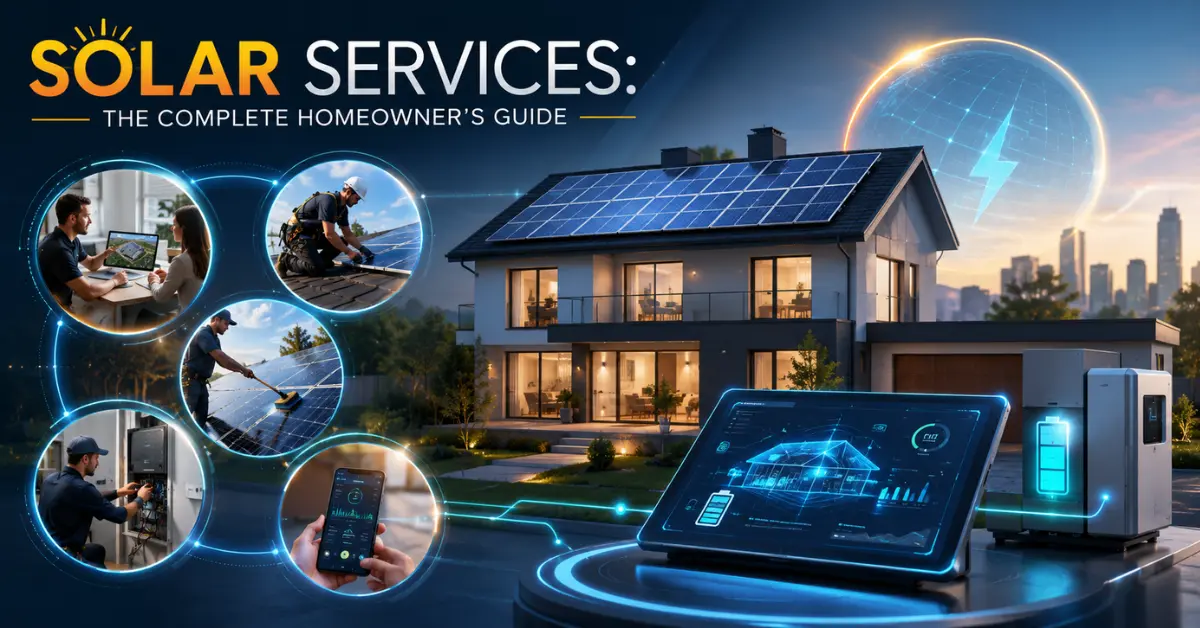
Switching to solar is one of the smartest financial decisions a homeowner can make today. But solar isn’t a one-time transaction — it’s an ongoing relationship with your energy system. Understanding all available solar services helps you protect your investment, maximize savings, and avoid costly mistakes.
This guide covers every solar service you may need — from your very first consultation to system upgrades years down the road — and explains what each service does, what it costs, and when you need it.
What Are Solar Services?
Solar services refer to all the professional support a homeowner needs throughout the life of a solar energy system. This includes the initial design and installation, ongoing maintenance and cleaning, system monitoring, repairs, battery storage integration, and eventual upgrades or removal.
Most homeowners only think about installation. But the truth is, the solar services you use after installation often determine how much money your system actually saves you.
1. Solar Consultation and Site Assessment
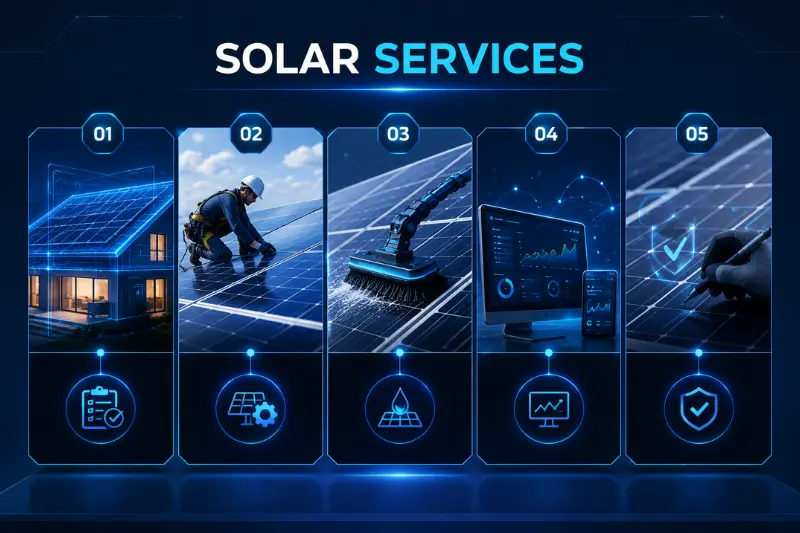
Every strong solar journey begins with a professional consultation. This is the foundation of all solar services — and a good one saves you from expensive mistakes later.
What happens during a site assessment:
- A certified solar advisor visits your home and evaluates your roof’s condition, angle, and available square footage
- They analyze your electricity bills to size the system correctly
- They assess shading from trees, chimneys, and neighboring buildings
- They check your electrical panel to confirm it can support solar
- They walk you through your financing and incentive options
Why this matters: A poorly sized system either underperforms (leaving money on the table) or overproduces (wasting capacity you paid for). Getting the site assessment right makes everything else work.
Pro tip: Always get at least two or three assessments from different companies. Compare not just price, but system size recommendations, equipment brands, and what’s included in the warranty.
2. Solar Panel Installation
Installation is the core of all solar services. It’s what transforms your roof into a power plant. A proper installation involves more than just mounting panels — it’s a multi-step process that must be done correctly for your system to perform and last.
What professional solar installation includes:
- System design and engineering
- Permit applications and utility interconnection paperwork
- Roof mounting hardware installation
- Panel wiring and inverter setup
- Connection to your home’s electrical panel
- Final inspection and utility sign-off
How long it takes:
- Site assessment and design: 1–2 weeks
- Permitting: 1–4 weeks (varies by location)
- Physical installation: 1–3 days
- Utility connection and activation: 1–4 weeks
Typical costs in 2026:
- Residential systems: $2.50–$3.50 per watt installed
- A typical 6–8 kW home system: $15,000–$28,000 before incentives
- Many homeowners reduce costs significantly through solar loans, leases, or Power Purchase Agreements (PPAs)
Important note: Federal solar tax credits for new customer-owned residential systems expired on December 31, 2025. Homeowners who installed solar on or before that date may still qualify when filing taxes. For 2026 installations, the value of solar now comes from long-term energy savings and protection against rising utility rates. Check your state and local programs, as many offer rebates and credits independent of the federal program.
3. Solar Panel Cleaning
Clean panels produce more power — it’s that simple. Dirt, dust, bird droppings, pollen, and grime block sunlight from reaching the solar cells, reducing how much electricity your system generates.
How much does dirt actually cost you?
- Dirty panels lose 15–25% efficiency on average
- In severe cases, efficiency loss reaches 30%
- A system generating $1,800/year in savings can lose $360 annually from skipped cleanings
How often should you clean?
- Moderate climates: 2 times per year
- High-dust or arid areas: Monthly or bi-monthly
- Coastal areas: Every 3 months (salt buildup)
- High-pollen zones: Additional cleanings in spring and fall
- Near farms, construction sites, or industrial areas: Every 3–6 months
What professional cleaning costs:
- Residential systems (5–20 panels): $150–$500 per visit
- Annual maintenance plans: $200–$800 per year
The right way to clean solar panels: Reputable professionals use deionized water systems — water filtered to remove all mineral impurities. This cleans panels more effectively than tap water or soap, dries spot-free, and makes the results last longer. Never allow anyone to use a pressure washer on your panels — it can crack the surface and instantly void your warranty.
4. Solar System Monitoring
This is the most overlooked of all solar services — and one of the most important. Solar monitoring lets you track how much energy your system produces in real time, catch problems before they cost you money, and verify your panels are working as promised.
What good solar monitoring shows you:
- Daily and monthly energy production (kWh)
- Inverter status and health
- Individual panel or string performance
- Alerts for drops in production or offline components
- Historical trends so you can compare performance year over year
Why it matters: Problems with solar systems often develop slowly and silently. An inverter that runs too hot, a loose connector, critter damage, or a shading change from a growing tree can reduce your output for months before you notice it on your electric bill. Good solar services monitoring catches these issues early.
Practical tip: Open your monitoring app at least once a month. Compare your current monthly output to the same month last year. A drop of 10% or more — not explained by weather — is a clear signal that something needs attention.
What to watch for:
- Portal dropouts (often a router or internet issue, not a panel issue)
- Inverter error codes that clear themselves — these often indicate a component under stress
- Gradual production decline over time, which may signal soiling or shading
5. Solar Panel Maintenance and Inspection
Beyond cleaning, your solar system needs periodic professional inspections to stay safe and productive. Think of this as a health check for your entire solar investment.
What a professional solar maintenance inspection covers:
- Visual inspection of all panels for cracks, discoloration, or hotspots
- Check of all mounting hardware and roof penetrations for water intrusion
- Inverter testing and performance review
- Wiring inspection for wear, pests, or loose connections
- Battery system check (if applicable)
- Review of monitoring data for hidden performance issues
- Documentation for warranty purposes
Recommended frequency: Annual professional inspection for all systems, plus monthly self-monitoring through your app.
Cost: $150–$350 for an annual inspection; $200–$800 for a comprehensive annual maintenance plan.
Why documentation matters: Many solar panel manufacturers require documented professional maintenance for warranty claims to be valid. Skipping inspections can leave you unprotected if a component fails.
6. Solar Repair Services
Even the best solar systems occasionally need repairs. Inverters are the most commonly replaced component, but wiring issues, damaged panels, and mounting problems also arise — especially after severe weather.
Common repairs homeowners need:
- Inverter replacement or repair (the most frequent issue)
- Damaged or cracked panel replacement
- Wiring repairs after storm damage or pest activity
- Roof penetration sealing to prevent leaks
- Optimizer or microinverter replacement
Warning signs that your system needs repair:
- Your monitoring app shows one or more panels offline
- Your electric bill has gone up without a change in usage
- You notice physical damage after a storm
- The system produces noticeably less power than it did at installation
- Your inverter displays error codes repeatedly
Tip: Don’t ignore recurring error codes that clear themselves. This is a common pattern before a full inverter failure — and catching it early is far cheaper than an emergency replacement.
7. Battery Storage Installation
Battery storage has become one of the most requested solar services as homeowners seek greater energy independence and protection from power outages.
How solar battery storage works: Your panels generate electricity during the day. Instead of sending excess power back to the grid, a battery stores it. You draw from the battery at night, during peak rate hours, or when the grid goes down.
Why more homeowners are adding batteries:
- Protection from power outages — your home stays powered when neighbors go dark
- Energy independence from grid rate increases
- Greater value in states where net metering credits have been reduced
- Store solar energy and use it during expensive peak rate hours
What batteries cost in 2026:
- Lithium-ion residential systems: $600–$900 per kWh
- A typical 10 kWh home system: $10,000–$13,000 installed
- Lithium Iron Phosphate (LFP) is the most popular chemistry — representing over 85% of new residential installations — due to its safety, 15–20 year lifespan, and reliability
Net metering and batteries: In states where utilities have reduced net metering credits, adding a battery dramatically improves your system’s financial return. Instead of exporting excess power at a low credit rate, you store it and use it yourself at full retail value.
8. Solar System Upgrades and Expansion
As your energy needs grow — or as solar technology improves — upgrading your system is a natural next step. Many homeowners add panels after purchasing an electric vehicle, adding a home addition, or after upgrading appliances.
Common solar upgrade scenarios:
- Adding panels to an existing system to increase capacity
- Upgrading older inverters to newer, more efficient models
- Adding battery storage to a system that was installed without it
- Integrating EV chargers powered by solar
- Replacing underperforming panels with newer, higher-efficiency models
What to know before upgrading: Your existing inverter may or may not support additional panels. A reputable solar service provider will assess your current equipment before recommending an expansion to make sure new components are compatible.
9. Net Metering Setup and Support
Net metering is the billing arrangement between you and your utility company that makes rooftop solar financially worthwhile for most homeowners. When your panels produce more electricity than your home uses, that surplus flows back to the grid — and your utility credits your account.
How credits work:
- Credits offset future electricity use (nights, cloudy days, winter months)
- Most utilities roll credits over month to month
- Many have an annual expiration date — credits reset at the end of the year
- Utilities will not write you a check for surplus power; they only credit your bill
Why net metering support is a solar service: Setting up net metering correctly, ensuring your utility meter is configured for bidirectional flow, and understanding your state’s specific policies requires professional coordination. Your solar installer typically handles this as part of installation — but if you’re having billing issues, a qualified solar services company can review your setup.
Important 2026 update: Net metering rules vary significantly by state and are changing in many markets. Some states have moved to reduced export rates rather than full retail credit. Before installing solar or adding battery storage, verify your utility’s current net metering policy — it directly affects your system’s financial return.
10. Solar Panel Removal and Reinstallation
If you’re replacing your roof, moving to a new home, or need panels removed for any reason, professional removal and reinstallation is an important (and often overlooked) solar service.
When you need this service:
- Before a roof replacement or repair
- When selling your home and the buyer requests removal
- If you’re relocating and want to take your system with you
- When damaged panels need to be replaced
Why you need a professional: Improper removal can damage panels, void warranties, and compromise your roof. A qualified solar services team safely disconnects the electrical system, removes panels without damaging them, and reinstalls everything correctly.
How to Choose the Right Solar Services Company
Not all providers are equal. Here’s how to find a trustworthy solar services partner:
- 1. Verify certifications. Look for NABCEP (North American Board of Certified Energy Practitioners) certification — this is the gold standard for solar professionals. Also confirm state electrical licenses and proper insurance coverage.
- 2. Check experience. Ask how many systems they’ve installed and serviced. Ask for references from customers whose systems are at least 3–5 years old.
- 3. Read reviews carefully. Look beyond star ratings. Pay attention to how the company handles problems — not just initial installation.
- 4. Ask about ongoing support. A company that disappears after installation isn’t a full-service solar provider. Ask specifically what happens if your inverter fails or your production drops.
- 5. Get everything in writing. Equipment warranties, labor warranties, service agreements, and pricing should all be documented before you sign anything.
- 6. Ask about monitoring. Does the company provide monitoring setup? Do they proactively alert you if your system underperforms, or do they wait for you to call?
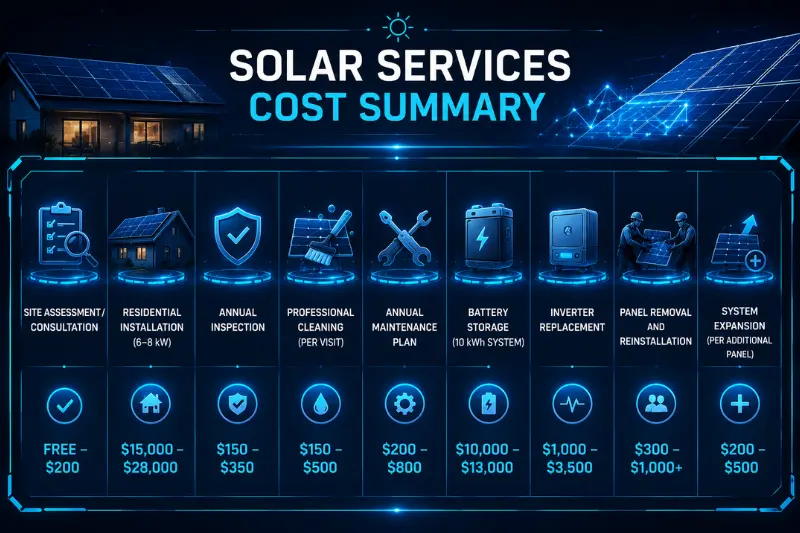
Solar Services Cost Summary
| Service | Typical Cost |
|---|---|
| Site assessment / consultation | Free – $200 |
| Residential installation (6–8 kW) | $15,000–$28,000 |
| Annual inspection | $150–$350 |
| Professional cleaning (per visit) | $150–$500 |
| Annual maintenance plan | $200–$800 |
| Battery storage (10 kWh system) | $10,000–$13,000 |
| Inverter replacement | $1,000–$3,500 |
| Panel removal and reinstallation | $300–$1,000+ |
| System expansion (per additional panel) | $200–$500 |
FAQs
What solar services do I need after installation?
After installation, you need regular cleaning (2–4 times per year depending on your location), an annual professional inspection, and ongoing system monitoring. These three services keep your system performing at its best and catch problems early.
How do I know if my solar system is working properly?
Use your monitoring app to check daily energy production. Compare it to the same period last year. A drop of 10% or more that isn’t weather-related usually indicates a cleaning, maintenance, or repair issue. If your electric bill rises without a change in usage, that’s another warning sign.
What is the most common solar repair?
Inverter failure is the most frequently needed repair. Inverters typically last 10–15 years — shorter than the panels themselves — so most homeowners face at least one inverter replacement during their system’s life. The cost ranges from $1,000 to $3,500 depending on system size and inverter type.
Do I need battery storage?
Battery storage is not required for solar to work, but it dramatically increases your energy independence and can improve your financial return — especially in areas with reduced net metering credit rates or frequent power outages. More homeowners are adding batteries as prices continue to fall.
Are federal solar tax credits still available in 2026?
The 30% federal Investment Tax Credit for new customer-owned residential solar installations expired on December 31, 2025. New installations in 2026 do not qualify. Homeowners who installed solar before that date may still claim the credit on their taxes. Check your state and local programs, as many independent incentives remain available.
Can I add more panels to my existing system?
Yes, in most cases. However, your existing inverter must be compatible with the expansion. A solar services company will assess your current equipment, available roof space, and electrical panel capacity before recommending an addition.
What happens to my solar system if I sell my home?
Owned solar systems generally transfer to the new owner as part of the home sale and typically increase property value. Leased systems or PPAs must be transferred to the new buyer — confirm your contract terms well before listing your home.
What solar services are most commonly skipped — and why does it matter?
Monitoring and annual inspections are the most commonly skipped services. Homeowners set up their system, see savings on their bill, and assume everything is fine. But panels can quietly lose 10–20% efficiency from soiling or minor faults without triggering any obvious alarm. Regular solar services — even simple ones — protect the long-term return on a $15,000–$30,000 investment.
Final Thoughts
Solar energy is a long-term investment, and solar services are how you protect it. Installation is just the beginning. The real value comes from monitoring your system consistently, keeping panels clean, scheduling annual inspections, and acting quickly when something seems off.
Whether you’re just starting to explore solar or you’ve had panels for years, understanding the full range of solar services available gives you the knowledge to make smart decisions — and the confidence that your system is always working as hard as it should.