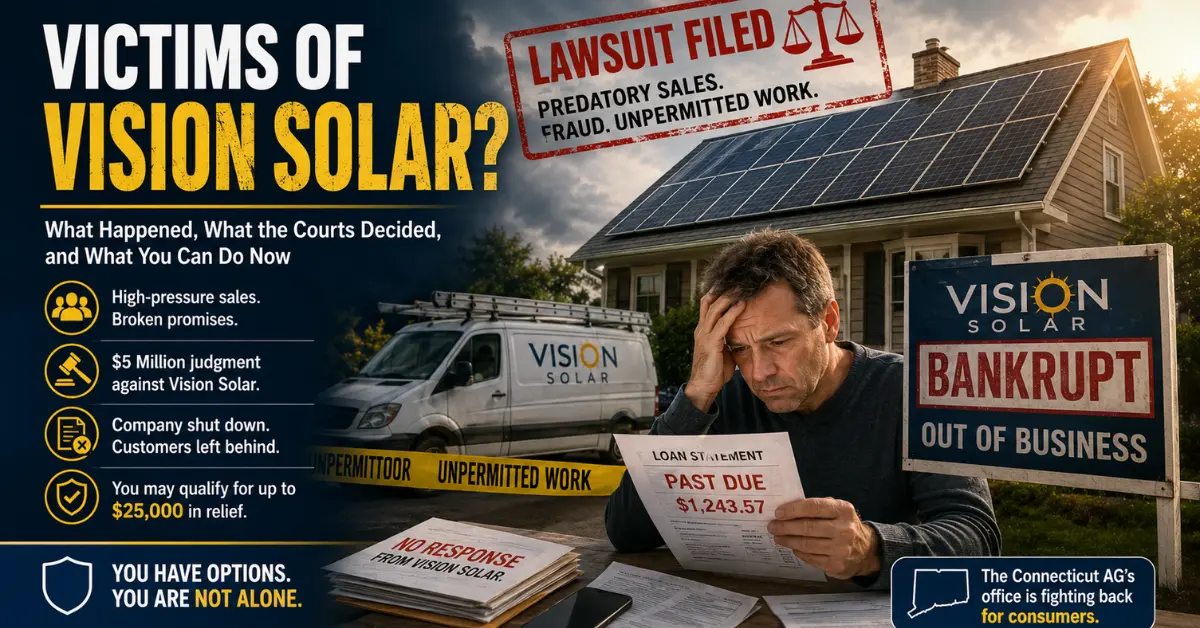
If you signed a contract with Vision Solar, you are not alone — and you are not without options. Vision Solar, LLC was a Connecticut-based residential solar company that promised homeowners lower energy bills, federal tax credits, and a cleaner future. What many customers got instead was a high-pressure salesperson who would not leave their home, a loan they could not afford, and solar panels that were never properly activated.
The damage was significant enough that Connecticut Attorney General William Tong filed a lawsuit against the company in March 2023, accusing Vision Solar of predatory sales tactics, fraudulent misrepresentations, and unpermitted work. The Hartford Superior Court ultimately issued a $5 million judgment against the company. But before Vision Solar could be held fully accountable, it filed for Chapter 7 bankruptcy in December 2023 — shutting down completely and leaving hundreds of customers with active loans, underperforming systems, and no one to call.
This article breaks down exactly what Vision Solar did, who was harmed, what the courts decided, and — most importantly — what you can do right now if you were one of its customers. Whether you are looking for financial relief, trying to understand your legal options, or simply want to know what happened, you will find clear and honest answers here.
The Short Version (If You’re in a Hurry)
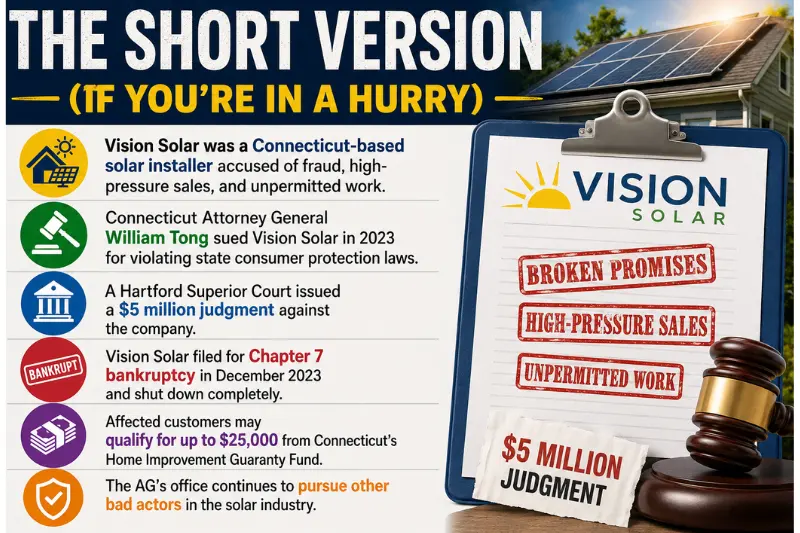
- Vision Solar was a Connecticut-based solar installer accused of fraud, high-pressure sales, and unpermitted work.
- Connecticut Attorney General William Tong sued Vision Solar in 2023 for violating state consumer protection laws.
- A Hartford Superior Court issued a $5 million judgment against the company.
- Vision Solar filed for Chapter 7 bankruptcy in December 2023 and shut down completely.
- Affected customers may qualify for up to $25,000 from Connecticut’s Home Improvement Guaranty Fund.
- The AG’s office continues to pursue other bad actors in the solar industry.
What Was Vision Solar?
Vision Solar, LLC was a residential solar installation company that began operating in Connecticut in December 2020. It registered as a Home Improvement Contractor and quickly expanded its customer base — mostly through aggressive cold-calling and door-to-door sales.
On the surface, Vision Solar promised homeowners lower energy bills, federal tax credits, and a greener future. Behind the scenes, the company was running a very different operation.
How Vision Solar Harmed Customers
High-Pressure Sales Tactics
Vision Solar salespeople used a playbook built around pressure, not information.
- They made repeated cold calls to set up in-home pitches.
- Once inside, representatives would refuse to leave — sometimes staying hours after being asked to go.
- Customers were pressured into same-day contract signings, with no time to consult a lawyer or family member.
- Some reps told customers that contracts were just “pre-approval forms” to trick them into signing.
- Others requested e-signatures over the phone, while customers could not see what they were signing.
- Customers were never given copies of their contracts.
Targeting Vulnerable Homeowners
Vision Solar did not target customers at random. Complaints show a pattern of deliberately targeting people who were less likely to push back:
- Elderly homeowners were pressured into loans they could not afford.
- Disabled individuals were manipulated into signing contracts without understanding them.
- In one documented case, a Vision salesperson dealt exclusively with an intellectually disabled homeowner — even though they knew the other property owner had refused the installation.
- Language barriers were exploited to push customers through the signing process.
Broken Promises and Shoddy Work
Signing the contract was just the beginning of the problems.
- Vision Solar completed installations without applying for required permits, leaving panels that could not legally connect to the electric grid.
- Some customers had panels placed in unauthorized locations, resulting in less energy generation than promised.
- The company altered the scope of work without customer consent.
- In some cases, Vision used unlicensed electricians to perform electrical work.
- At least some town electrical permits were obtained by falsely using the credentials of a licensed electrician who no longer worked for the company — which amounts to forgery.
- Several customers were told they would receive substantial federal tax credits, even though Vision knew their income was too low to benefit meaningfully.
Fraudulent Financing
The cost of a Vision Solar installation — including roof replacement in some cases — ran as high as $95,000. Customers took out multi-year loans through third-party lenders that Vision selected.
- Vision may have misrepresented customers’ income to get them approved for financing they could not actually afford.
- Customers were left with monthly loan payments on top of energy bills — even when panels were never activated.
The Lawsuit: What the Attorney General Did
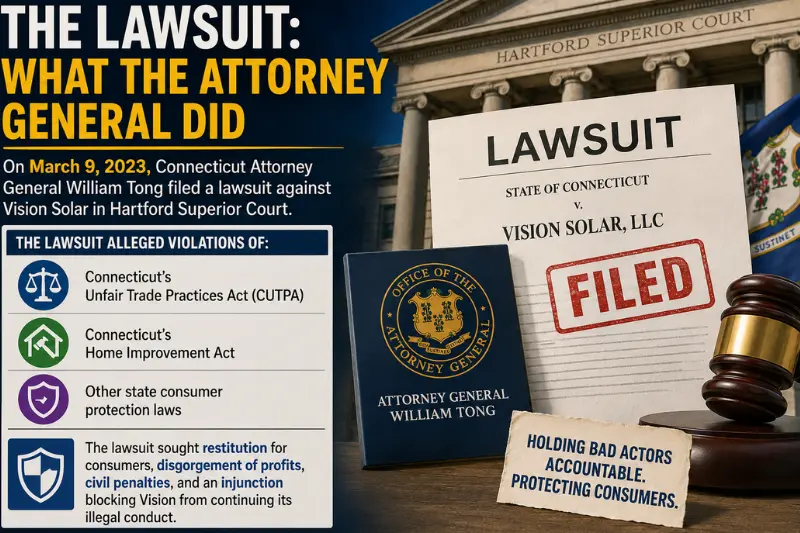
On March 9, 2023, Connecticut Attorney General William Tong filed a lawsuit against Vision Solar in Hartford Superior Court. The suit alleged violations of:
- Connecticut’s Unfair Trade Practices Act (CUTPA)
- Connecticut’s Home Improvement Act
- Other state consumer protection laws
The lawsuit sought restitution for consumers, disgorgement of profits, civil penalties, and an injunction blocking Vision from continuing its illegal conduct.
By the time the lawsuit was filed, the AG’s office had already received 134 complaints about Vision Solar — representing 45% of all solar complaints in Connecticut since 2021. That’s not a rounding error. That’s a company that was the solar industry’s single biggest consumer protection problem in the entire state.
The $5 Million Judgment
Hartford Superior Court issued a $5 million judgment against Vision Solar. The ruling covered the full range of violations: deceptive sales practices, contract manipulation, permitting failures, and use of unlicensed contractors.
The settlement also established new conduct requirements for the solar industry going forward, including:
- No phone or tablet e-signatures
- No same-day contract signings on the day of initial consultation
- Clear disclosure of how energy generation and cost savings are estimated
- Itemization of all billable services
- No work before permits are obtained
- No use of unlicensed electricians
The Bankruptcy: What It Means for Customers
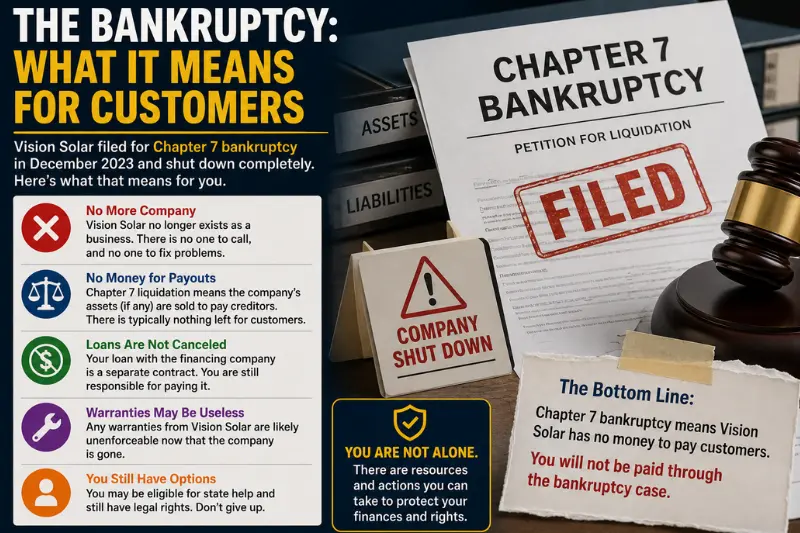
Vision Solar filed for Chapter 7 bankruptcy on December 28, 2023. Chapter 7 means full liquidation — the company will not reorganize or continue operating. The phone number has been disconnected. There is no one to call.
This creates serious problems for customers:
- Outstanding loans still exist. Customers still owe money to third-party lenders, even if their solar systems never worked properly.
- No warranty service. There is no longer a company to repair or maintain systems.
- The $5 million judgment is likely uncollectable. Because Vision Solar went bankrupt, it cannot pay the court judgment.
- The lawsuit is on hold. The AG’s lawsuit was paused once Vision entered bankruptcy proceedings.
What About Eversource?
Some Vision Solar customers were told that Vision was “working with” or “partnering with” Eversource, Connecticut’s major electric utility. This was not true.
Andrew Belden, Eversource’s VP of Solar Programs, confirmed: “From time-to-time people will say, ‘oh we’re working with Eversource. We’re partnering with Eversource.’ Frankly, we don’t do that.”
Eversource connects solar systems to the grid — it does not manage, install, or warranty them.
What Vision Solar Customers Can Do Right Now
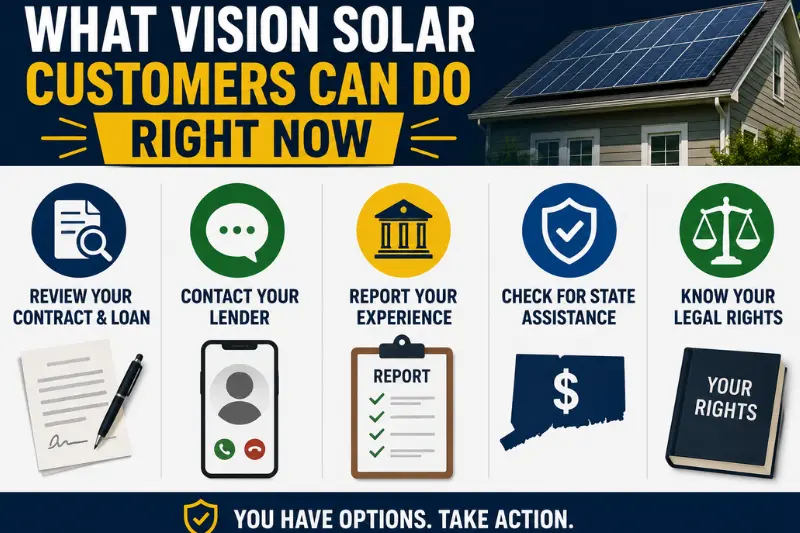
If you are a current or former Vision Solar customer, here are your concrete options:
1. File a Proof of Claim with the Bankruptcy Court
Because Vision Solar filed for Chapter 7 bankruptcy, a bankruptcy trustee is handling what little assets remain. You can submit a Proof of Claim to the bankruptcy court to register your financial losses.
This is an important step — it creates an official record of what you are owed and positions you to receive any distribution if assets are recovered.
2. Apply to Connecticut’s Home Improvement Guaranty Fund
Customers who submitted a proof of claim may be eligible for up to $25,000 from the Connecticut Department of Consumer Protection’s Home Improvement Guaranty Fund.
To learn more or ask questions about eligibility, contact: dcp.guarantyfunds@ct.gov
3. File a Complaint with the Attorney General’s Office
Even if Vision Solar is bankrupt, filing a complaint creates a record and supports ongoing investigations.
- AG’s Office
- Dept. of Consumer Protection
4. Contact Your Lender
If Vision Solar misrepresented your income to qualify you for a loan, or if your system was never properly installed or activated, contact your lender directly. Explain the situation and ask about dispute processes or hardship accommodations. Some lenders will pause or cancel loans in cases of contractor fraud.
5. Consult a Consumer Protection Attorney
If your damages exceed $25,000 or you are dealing with a complex situation (defective installation, fraudulent contract, ongoing loan payments for a non-functioning system), speak with a licensed Connecticut consumer protection attorney. Many offer free consultations.
Real Customer Story: Pamela Miller
Pamela Miller of Oxford, Connecticut had always wanted to go solar. But a large tree whose canopy shaded her entire roof was always the obstacle — until Vision Solar’s telemarketer called in March 2023 and told her that was not a problem.
A salesperson arrived at her home on March 7th, 2023, and insisted on a same-day signing.
“He was very pushy when it came to like oh just sign this and what not,” said Miller.
Two days later — on March 9, 2023 — the AG filed his lawsuit against Vision Solar.
Panels were installed on Miller’s home in August 2023, but the tree never came down. The shade still limits her panels’ output, meaning her energy bill has barely dropped. On top of that, she now carries a monthly loan payment of $89.
“Did we get a good deal? Absolutely not,” she said.
When Vision Solar filed for bankruptcy in December 2023, Miller found herself with a functioning-but-underperforming solar system, an active loan, and no company to call for repairs or accountability.
“I was just, I was so, so upset because I understand we should have done more research.”
Miller’s story is not unique. It reflects what happened to hundreds of Connecticut homeowners.
What to Look for When Choosing a Solar Company (Lessons from Vision Solar)
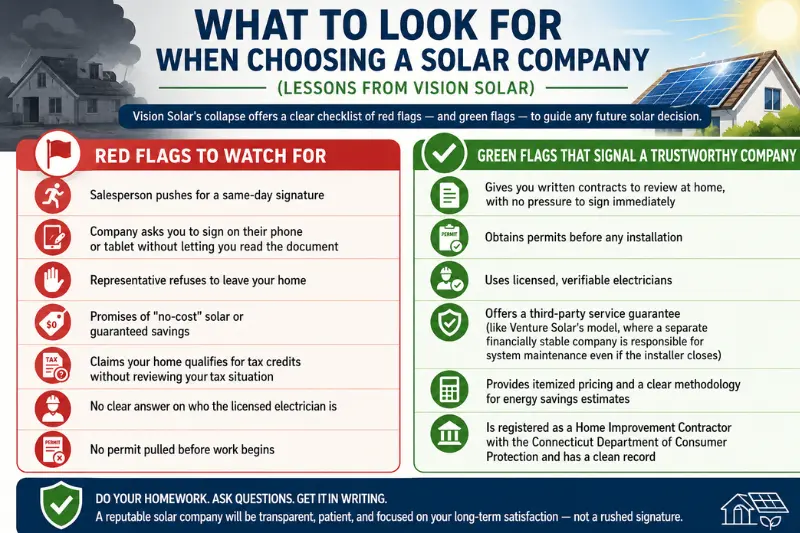
Vision Solar’s collapse offers a clear checklist of red flags — and green flags — to guide any future solar decision.
Red Flags to Watch For
- Salesperson pushes for a same-day signature
- Company asks you to sign on their phone or tablet without letting you read the document
- Representative refuses to leave your home
- Promises of “no-cost” solar or guaranteed savings
- Claims your home qualifies for tax credits without reviewing your tax situation
- No clear answer on who the licensed electrician is
- No permit pulled before work begins
Green Flags That Signal a Trustworthy Company
- Gives you written contracts to review at home, with no pressure to sign immediately
- Obtains permits before any installation
- Uses licensed, verifiable electricians
- Offers a third-party service guarantee (like Venture Solar’s model, where a separate financially stable company is responsible for system maintenance even if the installer closes)
- Provides itemized pricing and a clear methodology for energy savings estimates
- Is registered as a Home Improvement Contractor with the Connecticut Department of Consumer Protection and has a clean record
The Broader Solar Industry in Connecticut
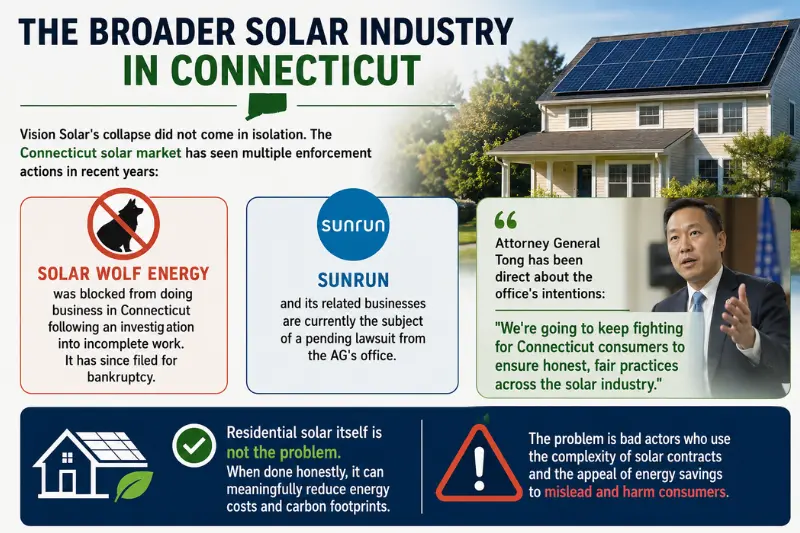
Vision Solar’s collapse did not come in isolation. The Connecticut solar market has seen multiple enforcement actions in recent years:
- Solar Wolf Energy was blocked from doing business in Connecticut following an investigation into incomplete work. It has since filed for bankruptcy.
- SunRun and its related businesses are currently the subject of a pending lawsuit from the AG’s office.
Attorney General Tong has been direct about the office’s intentions:
“We’re going to keep fighting for Connecticut consumers to ensure honest, fair practices across the solar industry.”
Residential solar itself is not the problem. When done honestly, it can meaningfully reduce energy costs and carbon footprints. The problem is bad actors who use the complexity of solar contracts and the appeal of energy savings to exploit homeowners.
Key Contacts and Resources
| Resource | Contact |
|---|---|
| CT Attorney General’s Complaint Form | dir.ct.gov/ag/complaint |
| Dept. of Consumer Protection Complaint | portal.ct.gov/DCP |
| Home Improvement Guaranty Fund | dcp.guarantyfunds@ct.gov |
| CT Dept. of Consumer Protection (General) | portal.ct.gov/DCP |
Frequently Asked Questions About Vision Solar
1. Is Vision Solar still in business?
No. Vision Solar filed for Chapter 7 bankruptcy on December 28, 2023, and has shut down completely. The company is not reorganizing, its phone number has been disconnected, and there is no one at the company to contact for repairs, warranties, or complaints.
2. What did Vision Solar do wrong?
Vision Solar was accused of using high-pressure sales tactics, pressuring customers into same-day contract signings, misrepresenting tax credits and energy savings, completing installations without required permits, using unlicensed electricians, forging permit credentials, and deliberately targeting elderly, disabled, and low-income homeowners.
3. How much was the judgment against Vision Solar?
Hartford Superior Court issued a $5 million judgment against Vision Solar for violating Connecticut’s Unfair Trade Practices Act, the Home Improvement Act, and other state consumer protection laws.
4. Can Vision Solar pay the $5 million judgment?
No. Because Vision Solar filed for Chapter 7 bankruptcy, it is unable to pay the judgment. The company has no remaining assets to distribute, which means most customers will not recover the full amount they are owed directly from Vision Solar.
5. I still have a loan for my Vision Solar panels. Do I still have to pay it?
Yes, unfortunately. Your loan is with a third-party lender, not Vision Solar itself. The lender’s obligation does not disappear because Vision Solar went bankrupt. However, if Vision Solar misrepresented your income to qualify you for the loan, or if your system was never properly installed or activated, you may have grounds to dispute the loan. Contact your lender directly and consider speaking with a consumer protection attorney.
6. My Vision Solar panels are not working properly. Who do I call?
Since Vision Solar no longer exists, there is no company warranty to fall back on. Your options are to hire an independent licensed solar technician to inspect and repair the system, contact your lender to dispute the loan if the system was defective from the start, and apply to Connecticut’s Home Improvement Guaranty Fund for financial relief.
7. How much can I get from Connecticut’s Home Improvement Guaranty Fund?
Eligible customers may receive up to $25,000 from the Connecticut Department of Consumer Protection’s Home Improvement Guaranty Fund.
8. How do I file a complaint against Vision Solar?
You can file a complaint with the Connecticut Attorney General’s Office at dir.ct.gov/ag/complaint or with the Department of Consumer Protection at portal.ct.gov/DCP. Filing a complaint still matters — it supports ongoing investigations into the solar industry.
9. Are other solar companies in Connecticut also being investigated?
Yes. Solar Wolf Energy was previously blocked from doing business in Connecticut and has since filed for bankruptcy. A lawsuit against SunRun and its related businesses is currently pending. The Attorney General’s office has made clear it will continue pursuing bad actors across the solar industry.
10. How do I avoid being scammed by a solar company in the future?
Never sign a contract on the same day a salesperson visits your home. Always ask for a written contract to review privately. Verify that the company holds a valid Home Improvement Contractor license in Connecticut. Confirm that permits are pulled before any work begins. Ask whether the company offers a third-party service guarantee in case they go out of business. If anything feels rushed or too good to be true, walk away.
Bottom Line
Vision Solar is gone. Its $5 million court judgment will likely never be paid. The company’s phone is disconnected, and its customers are left navigating bankruptcy court, underperforming panels, and active loans on their own.
The good news: Connecticut law provides real protections, and the state’s Guaranty Fund exists precisely for situations like this. If you were a Vision Solar customer, take action now — file your bankruptcy claim, contact the Guaranty Fund, and speak with an attorney if your losses are significant.
And if you are shopping for solar today, take your time. Demand permits. Ask for a third-party service guarantee. Never sign on the day a salesperson knocks on your door.