Solar pole lights have come a long way from the dim, decorative stakes that gave solar outdoor lighting a bad reputation. Today’s solar pole lights — whether you are lighting a residential driveway, a commercial parking lot, or a municipal street — are genuinely capable, long-lasting, and increasingly cost-competitive with grid-connected alternatives.
But the market spans an enormous range: from $30 garden ornaments that barely light a footpath to $2,000 commercial units that illuminate entire parking areas with 10,000+ lumens. Knowing which category you actually need — and what specifications matter within that category — is what this guide is for.
What Are Solar Pole Lights?
Solar pole lights are self-contained outdoor lighting systems mounted on a pole, powered entirely by solar energy collected through an integrated or separate photovoltaic (PV) panel. They store energy in an onboard battery during the day and automatically activate at dusk, providing illumination through the night without any connection to the electrical grid.
A complete solar pole light system includes:
- One or more solar panels (integrated or mounted separately)
- A rechargeable battery bank
- An LED light head
- A charge controller (the brain that manages charging and discharge)
- A mounting pole (sometimes sold separately)
- A motion sensor and/or light sensor (in most modern units)
The self-contained nature of solar pole lights is their defining advantage — no trenching, no electrical wiring, no ongoing electricity costs, and no dependency on grid infrastructure. That makes them viable in locations where running electricity is impractical, expensive, or simply unnecessary.
The Two Worlds of Solar Pole Lights: Residential vs. Commercial
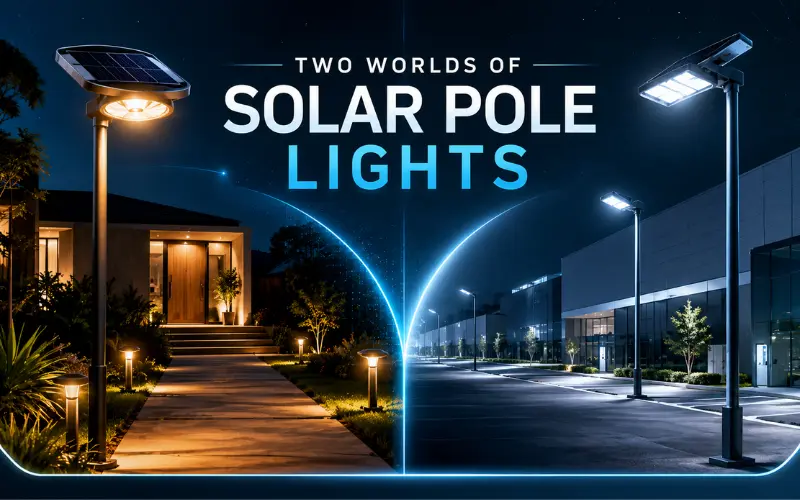
Before anything else, you need to be honest with yourself about which category you are shopping in. These are fundamentally different products despite sharing the same name.
Residential Solar Pole Lights
Residential solar pole lights are designed for driveways, garden paths, front entrances, and decorative outdoor areas. They prioritize aesthetics and ease of installation over raw performance.
Typical specifications:
- Lumens: 200–2,000 lm — sufficient for pathway guidance and decorative accent lighting
- Pole height: 1.5–3 meters (5–10 feet)
- Battery: Lithium-ion or NiMH — functional but with shorter cycle life
- Panel: Small integrated panel, often mounted on the lamp head itself
- Backup autonomy: 1–3 nights without sun before dimming significantly
- Construction: Aluminum alloy, ABS plastic, or die-cast zinc
- Price range: $30–$400 per unit
Who these are right for: Homeowners who want attractive, zero-wiring outdoor lighting for visual appeal and basic path guidance. These work well in most residential applications when placed in locations with good sun exposure.
Who these are NOT right for: Anyone needing genuine security lighting, commercial area illumination, or consistent performance through extended cloudy periods.
Commercial and Municipal Solar Pole Lights
Commercial solar pole lights are engineered infrastructure — designed to meet illumination standards, withstand decades of outdoor exposure, and perform reliably under real-world conditions including cloudy weeks, coastal salt air, and temperature extremes.
Typical specifications:
- Lumens: 3,000–15,000+ lm — sufficient for security, safety, and area illumination
- Pole height: 4–12 meters (13–40 feet)
- Battery: LiFePO4 (Lithium Iron Phosphate) — 2,000–6,000 charge cycles, approximately 5–10 years
- Panel: Separate high-efficiency mono or poly-crystalline panel, often 40W–200W
- Backup autonomy: 3–7 consecutive nights of full output without sun
- Construction: Hot-dip galvanized steel pole, die-cast aluminum fixture, tempered glass
- IP rating: IP65–IP67 (dust-tight and water-resistant to immersion)
- Price range: $500–$3,000+ per complete unit
Who these are right for: Contractors, facility managers, municipalities, property developers, and anyone lighting a parking lot, street, commercial campus, sports area, or security perimeter.
Key Specifications: What Actually Matters When Choosing Solar Pole Lights
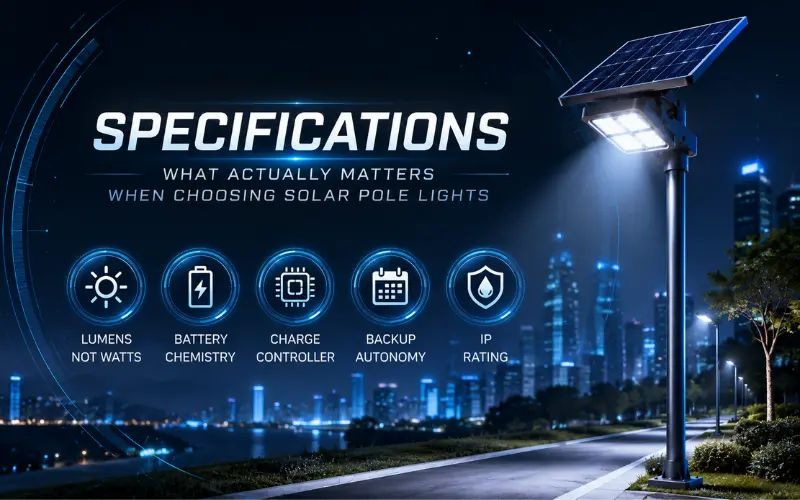
Most buyers focus on wattage. Wattage is almost meaningless for comparing solar pole lights. Here is what actually determines performance:
1. Lumens — Not Watts
Lumens measure the actual amount of visible light produced. Watts measure power consumption. Two solar pole lights might both claim “30W” while one produces 2,000 lumens and the other produces 4,500 lumens — a radically different illumination level.
Lumen requirements by application:
- Residential pathway: 200–800 lm
- Residential driveway or front entrance: 800–2,000 lm
- Small commercial area or perimeter: 2,000–5,000 lm
- Parking lot (per pole at 6m height): 4,000–8,000 lm
- Street lighting: 5,000–12,000 lm
- Large commercial or municipal areas: 8,000–15,000+ lm
Efficacy (lumens per watt) is the quality indicator within the LED module. Better lights produce 150–200+ lumens per watt. Budget lights often produce 80–100 lumens per watt — meaning they need more battery power to produce the same amount of light, shortening backup autonomy.
2. Battery Chemistry: LiFePO4 vs. Everything Else
The battery is the component most responsible for whether your solar pole lights work reliably for two years or ten years.
LiFePO4 (Lithium Iron Phosphate):
- Cycle life: 2,000–6,000 charge cycles (approximately 5–10 years of daily use)
- Stable performance from -20°C to 60°C
- Does not overheat or catch fire — the safest lithium chemistry
- Maintains capacity well through discharge cycles
- The correct choice for any commercial application and recommended for quality residential products
Standard lithium-ion:
- Cycle life: 500–1,000 cycles (1–3 years with daily use)
- More temperature-sensitive than LiFePO4
- Widely used in budget residential solar pole lights
- Adequate for casual residential use but will degrade faster
NiMH (Nickel Metal Hydride):
- Older chemistry, low energy density, poor cold-weather performance
- Still found in some budget residential products
- Not recommended if you have a choice
Lead acid:
- Heavy, large, poor cycle life in cycling applications
- Found in some older-style all-in-two systems
- Avoid for modern solar pole light applications
3. The Charge Controller: MPPT vs. PWM
The charge controller manages energy flow between your solar panel and battery. This component is invisible but critically important.
MPPT (Maximum Power Point Tracking):
- Continuously adjusts voltage to extract maximum energy from the panel regardless of light angle and intensity
- 20–30% more efficient than PWM
- Standard in quality commercial solar pole lights
- Worth paying for in any residential application where performance matters
PWM (Pulse Width Modulation):
- Simpler, cheaper, less efficient
- Wastes 20–30% of available solar energy
- Common in budget residential products
- Acceptable only if you are in a consistently sunny climate with generous battery capacity
4. Backup Autonomy — How Many Nights Without Sun
Backup autonomy is the number of consecutive nights the solar pole lights can operate at full output without any solar recharge. This specification is particularly critical for reliability in variable-weather climates.
- 1–2 nights: Budget residential products — vulnerable to dimming or shutting off after overcast days
- 3 nights: Standard for quality residential products and entry-level commercial
- 5–7 nights: Commercial and municipal grade — designed for genuine weather resilience
Intelligent dimming extends backup autonomy — good solar pole lights automatically reduce output during the second or third consecutive cloudy night rather than shutting off entirely, maintaining basic safety lighting even in extended low-sun periods.
5. IP Rating — Weather Protection
The IP (Ingress Protection) rating tells you how well a fixture is sealed against dust and water.
- IP44: Splash-resistant — minimum for outdoor use
- IP54: Protected against dust and water splashed from any direction — adequate for most residential applications
- IP65: Dust-tight and protected against low-pressure water jets — good baseline for commercial
- IP66: Protected against powerful water jets — suitable for coastal and high-rainfall environments
- IP67: Protected against temporary submersion up to 1 meter — maximum practical rating for pole lighting
Any solar pole light used outdoors should carry at least IP54. Commercial applications should specify IP65 or above.
Solar Panel Types in Solar Pole Lights
The solar panel’s efficiency determines how much energy your system can collect in a given amount of space and time.
Monocrystalline silicon: The most efficient commercially available panel type — 19–23% efficiency. Performs better in low-light conditions and high temperatures than other types. The correct choice for any application where space is limited and performance matters.
Polycrystalline silicon: 15–18% efficiency. Slightly lower performance than monocrystalline but lower cost. Adequate for residential applications with good sun exposure.
Amorphous silicon (thin film): 8–12% efficiency. Lower performing but more flexible in application — sometimes used in curved or integrated panel designs. Not recommended for applications where lumen output is critical.
The Vertical Solar Panel Revolution
Traditional solar pole lights mounted a flat panel on an arm above the light fixture — functional but creating significant wind resistance and a large cleaning surface for dust and bird debris.
Vertical solar pole lights integrate panels directly into or around the pole itself, in a cylindrical or near-vertical orientation. This design addresses several real problems:
Self-cleaning: Vertical panels shed rain, dust, and debris naturally. Flat horizontal panels accumulate dirt that reduces efficiency — vertical panels largely maintain their efficiency without manual cleaning.
Wind resistance: A cylindrical pole profile creates dramatically less wind drag than a flat panel arm assembly. This reduces structural loading requirements and makes vertical solar pole lights more suitable for high-wind environments.
360-degree light capture: Cylindrical panel arrangements capture light from all directions throughout the day rather than optimizing only for the primary sun direction. This is particularly valuable in locations where the optimal panel orientation is not available.
Aesthetics: Vertical solar pole lights look like conventional street lights — the technology is integrated invisibly, making them suitable for heritage areas, plazas, and locations where the appearance of a large flat solar panel would be visually intrusive.
Solar Pole Lights Styles: Matching Form to Function
Standard Post-Top Solar Pole Lights
The most common residential style — a lamp head mounted on a pole with a separate or integrated solar panel. Style options range from modern minimalist to traditional Victorian lantern designs. These suit residential driveways, garden paths, and front entrance lighting where aesthetics are as important as performance.
Barn Light Style Solar Pole Lights
A directional single-arm fixture mounted on a pole — similar in profile to farmhouse or utility area lighting. Excellent for lighting a specific area rather than providing 360-degree illumination. Popular for illuminating garage aprons, outbuildings, and workshop areas.
Dual-Head Solar Pole Lights
Two light heads on a single pole, often adjustable to direct illumination in two different directions. Practical for corners, intersections, and locations where a single head cannot cover the required area. Found in both residential and entry-level commercial applications.
All-In-One Solar Pole Lights (Integrated Design)
The panel, battery, controller, and LED are all integrated into a single compact unit — typically a flat or slightly curved assembly that attaches to the pole with minimal hardware. Popular in commercial applications because they reduce installation time, minimize parts count, and present a clean profile.
All-In-Two Solar Pole Lights (Split Panel Design)
The solar panel mounts separately from the LED fixture — usually on an arm above the light or at a different angle. The split design allows the panel and the light head to be positioned independently for optimal sun exposure and light direction. Preferred for applications where the pole location does not have ideal panel orientation.
Decorative Solar Pole Lights
Purpose-designed for aesthetic settings — parks, plazas, hospitality environments, and heritage streetscapes. These prioritize visual quality and architectural coherence alongside lighting function. Available in colonial, Victorian, contemporary, and custom designs.
Choosing the Right Pole Height for Solar Pole Lights
Pole height directly affects the area each light covers and the quality of illumination at ground level. Getting this wrong means either too-bright uncomfortable glare or inadequate coverage requiring more poles than necessary.
Residential applications:
- Garden path accent: 0.6–1.2m (2–4 feet)
- Driveway edging: 1.2–1.8m (4–6 feet)
- Front entrance or driveway lighting: 1.8–3m (6–10 feet)
Light commercial and campus applications:
- Small parking areas, walkways: 4–6m (13–20 feet) — typically 3,000–6,000 lm
- Medium parking lots: 6–8m (20–26 feet) — typically 6,000–10,000 lm
Municipal and large commercial:
- Street lighting: 8–12m (26–40 feet) — typically 8,000–15,000+ lm
- Highway or high-mast lighting: 15–40m (50–130 feet) — beyond the scope of standard solar pole lights
The photometric principle: As pole height increases, each fixture covers a larger area but at lower intensity. For safety and security applications, confirm that the foot-candle or lux levels at ground level meet local standards — a lighting professional or DIALux simulation is the most reliable way to verify this before purchase.
Solar Pole Light Installation: What You Need to Know
Installation requirements vary dramatically between residential and commercial systems.
Residential Installation
Most residential solar pole lights are designed for straightforward DIY installation:
- Choose your location carefully. This is the most important step. The solar panel needs a minimum of 4–6 hours of direct sunlight daily. Map shade patterns across your property at different times of day before committing to a location. Shade from trees, buildings, or fences during peak sun hours will significantly reduce performance.
- Prepare the base. Most residential solar pole lights come with a ground stake or require a simple concrete footing. For poles above 1.8m in exposed locations, a concrete footing provides stability against wind.
- Assemble and activate. Most residential units ship as assemblies requiring minimal tool use. Charge the battery fully in sunlight (2–3 days of exposure) before expecting full-night performance.
- Set the controls. Most quality residential solar pole lights include a light sensor for automatic dusk-to-dawn activation and motion sensing adjustment. Configure these before positioning the light head.
Commercial Installation
Commercial solar pole light installation is a professional undertaking requiring licensed contractors in most jurisdictions:
- Site assessment and lighting design. Use photometric software (DIALux or AGi32) to model illumination levels before specifying pole placement and equipment. This prevents both under-lighting and over-specification.
- Structural foundation. Commercial poles require engineered concrete foundations designed for the specific pole height, wind load zone, and soil conditions. This is a structural engineering decision — not a general contractor estimate.
- Pole installation. Hot-dip galvanized steel poles are crane-lifted and set in concrete foundations. Plumb alignment must be verified before concrete sets.
- Fixture installation and commissioning. Solar panel orientation is optimized during installation. Controller settings for dimming schedules, backup autonomy management, and motion sensing are configured to the specific site requirements.
- Permitting. Most commercial solar pole light installations require permits and inspection. Confirm requirements with your local Authority Having Jurisdiction before beginning.
Solar Pole Lights vs. Grid-Connected Pole Lights: The Real Cost Comparison
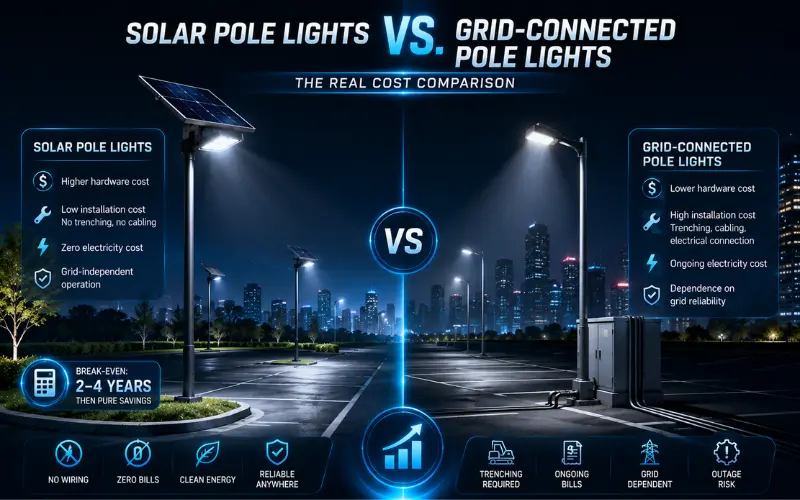
The honest cost comparison between solar and grid-connected pole lighting is more nuanced than most guides present.
Grid-connected pole lights:
- Lower hardware cost per unit
- High installation cost — trenching, conduit, cabling, transformers, electrical connection
- Ongoing electricity cost for 25+ years
- Dependence on grid reliability
Solar pole lights:
- Higher hardware cost per unit
- Low installation cost — no trenching, no cabling, no electrical connection
- Zero ongoing electricity cost
- Grid-independent operation
Where solar wins clearly:
- Locations where trenching for electrical service is expensive or impractical (existing parking lots, remote areas, crossing roads or paved surfaces)
- New installations in areas without existing electrical infrastructure
- Locations where grid reliability is uncertain
Where grid-connected wins:
- Dense urban installations where trenching cost is low and many lights share a single service connection
- Locations with significant shading that prevents adequate solar collection
- High-security applications requiring absolute certainty of illumination
The break-even calculation: For most new parking lot and street lighting installations, commercial solar pole lights reach cost parity with grid-connected systems within 2–4 years when installation costs are fully accounted for. After that point, the zero electricity cost becomes pure savings.
Smart Features in Modern Solar Pole Lights
Quality solar pole lights increasingly include intelligent management features that improve both performance and efficiency:
Motion sensing with intelligent dimming The most impactful smart feature. Lights operate at 30–50% output during low-traffic periods and ramp to 100% when motion is detected. This dramatically extends backup autonomy — a light at 30% base output uses roughly one-third the battery capacity, allowing 3-night autonomy systems to effectively provide 7–9 nights of base illumination with full output on demand.
Wireless monitoring and remote control Commercial solar pole lights increasingly include IoT connectivity — allowing facility managers to monitor individual light status, battery levels, charging rates, and fault alerts remotely. Some systems integrate with building management platforms.
Adaptive scheduling Time-based dimming that reduces output in the early morning hours when areas are typically unoccupied, extending autonomy further and reducing light pollution impact on surrounding areas.
Vehicle-to-grid and demand management Emerging feature in premium commercial systems — the ability to manage charging priorities based on grid demand signals or integrate with on-site renewable energy systems.
Common Problems With Solar Pole lights — And How to Avoid Them
Problem: Lights dim or go out before dawn Cause: Insufficient battery capacity, inadequate panel size, or too many consecutive cloudy days. Solution: Choose lights with at least 3-night backup autonomy for your climate, specify MPPT controllers, and select higher-efficiency monocrystalline panels.
Problem: Light output declines significantly after the first year Cause: Cheap battery chemistry (standard lithium-ion or NiMH) degrading with daily charge cycles. Solution: Specify LiFePO4 batteries. Accept that quality batteries cost more upfront but pay off over years of maintained performance.
Problem: Charging port or connection corrosion causing failures Cause: Inadequate IP rating for the installation environment — particularly problematic in coastal, high-humidity, or high-rainfall locations. Solution: Specify IP65 or higher for all commercial applications. In coastal environments, add marine-grade corrosion inhibitors to all metal connections.
Problem: Panel efficiency declining due to soiling Cause: Horizontally-mounted or low-angle panels accumulating dust, pollen, and debris. Solution: Specify vertical or near-vertical panel orientations for minimal cleaning requirement. Schedule annual panel cleaning for flat-mounted systems.
Problem: Residential solar pole lights fail to meet initial brightness claims Cause: Manufacturer lumen claims often reflect peak output under ideal conditions rather than sustained, real-world performance. Solution: Request test data showing maintained lumens at 25°C after 2,000 hours of operation. Reputable manufacturers provide this data; those who do not are typically hiding performance degradation.
Frequently Asked Questions
How bright do solar pole lights need to be?
It depends entirely on the application. Residential path lighting needs 200–800 lumens per fixture. Driveway and entrance lighting works well at 800–2,000 lumens. Commercial parking lots require 4,000–8,000 lumens per pole at 6-meter height, and street lighting typically requires 5,000–12,000+ lumens. Match your lumen specification to the actual area you need to illuminate and the pole height you are planning to use.
How long do solar pole lights last?
Quality varies enormously. Budget residential solar pole lights with standard lithium-ion batteries typically last 2–4 years before the battery requires replacement. Commercial solar pole lights with LiFePO4 batteries and quality LED modules are engineered for 10–15 years of operation, with the battery as the most likely first-replacement component at 5–8 years.
Do solar pole lights work in winter or during cloudy weather?
Quality solar pole lights include enough battery capacity to operate for multiple consecutive nights without solar recharge. Commercial-grade systems provide 3–7 days of autonomy. Residential-grade systems vary from 1–3 nights. Cold weather affects battery capacity — LiFePO4 chemistry handles cold better than standard lithium-ion. Vertical panel designs perform better in winter because they do not accumulate snow and can collect low-angle winter sunlight more effectively.
What is the best pole height for solar pole lights?
For residential use: 1.8–3 meters suits most driveways and entrance areas. For commercial parking lots: 6–8 meters per standard lighting guidelines. For streets: 8–12 meters. Higher poles require significantly more lumens to maintain adequate ground-level illumination but allow fewer poles to cover the same area. Consult a photometric simulation for commercial applications.
Can I install solar pole lights myself?
For residential units: Yes, in most cases. Most residential solar pole lights are designed for homeowner installation without electrical knowledge. For commercial units: No — commercial installations require licensed electrical contractors, structural foundations, and permits in most jurisdictions.
What is the difference between all-in-one and all-in-two solar pole lights?
All-in-one solar pole lights integrate the panel, battery, controller, and LED into a single compact unit — simpler installation, clean profile. All-in-two designs mount the panel separately from the light head, allowing independent optimization of panel angle and light direction. All-in-two is preferred when panel orientation and light direction requirements differ, which is common on east–west oriented poles.
How do I choose between residential and commercial solar pole lights?
If you need more than 2,000 lumens, a pole height above 3 meters, a lifespan beyond 4–5 years, or reliable performance through extended cloudy periods — you need commercial-grade equipment. Budget residential products simply cannot deliver these requirements regardless of how their marketing describes them.
Are solar pole lights worth it compared to traditional grid-connected lights?
For new installations in locations without existing electrical infrastructure — almost always yes. The savings from eliminating trenching, cabling, and electrical service often exceed the hardware premium within 2–4 years. For dense urban areas with existing electrical infrastructure, the comparison is closer and depends on specific site conditions and local electricity rates.
Final Thoughts
The solar pole light market rewards research and punishes assumptions. The gap between the best and worst products in this category is enormous — a well-specified commercial solar pole light will perform reliably for a decade in almost any climate. A budget residential unit purchased based on watt claims and attractive photos may last two cloudy weeks before disappointing you.
Before you buy: know your lumen requirement, confirm the battery chemistry, verify the IP rating, calculate your backup autonomy needs for your local climate, and be honest about whether you are a residential or commercial buyer.
With the right specification in hand, solar pole lights are genuinely excellent — zero operating cost, zero trenching, zero grid dependence, and often a better total project cost than the grid-connected alternative they replace.
The sun is free. The question is whether your equipment is good enough to use it well.