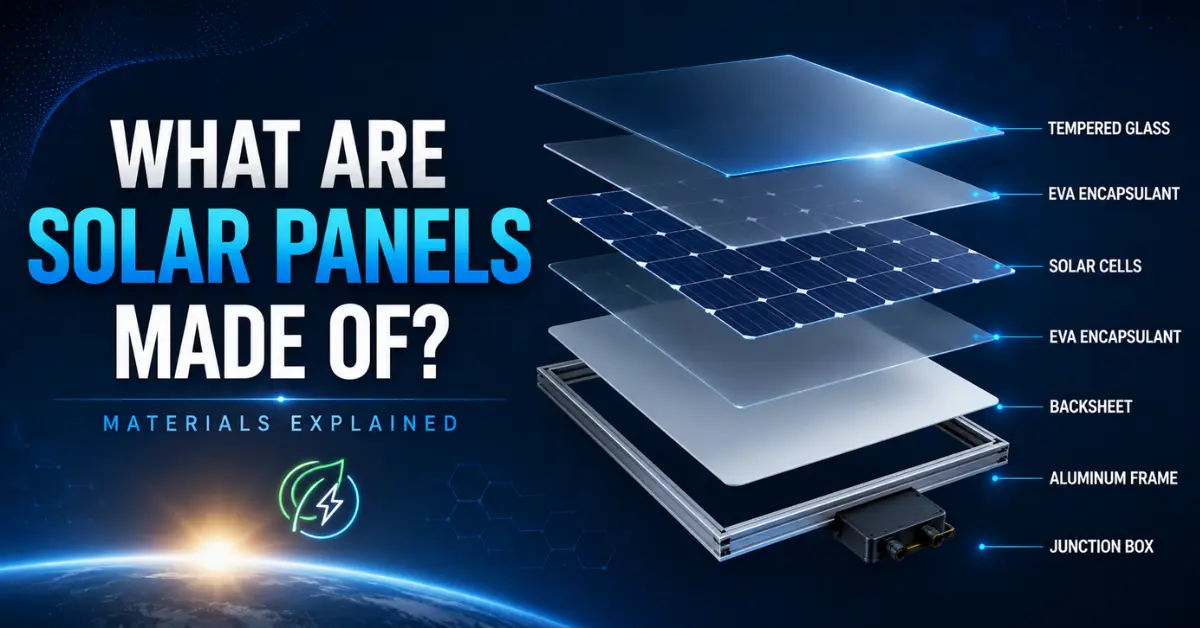
If you’ve ever stood in your garden squinting up at a neighbour’s roof and thought — what are solar panels made of, exactly? — you’re asking one of the most practical questions in renewable energy. They look deceptively simple from the outside: a flat, dark rectangle sitting in the sun. But understanding what are solar panels made of reveals a carefully engineered stack of materials, each chosen for a very specific reason.
This guide gives you a complete, honest answer. Whether you’re a homeowner evaluating a solar installation, a student doing research, or just someone who wants to understand the technology powering the clean energy revolution — by the end you’ll know precisely what are solar panels made of, and why every single layer matters.
Quick Answer: What Are Solar Panels Made Of?
Before going deep, here’s the short version. What are solar panels made of? At their core:
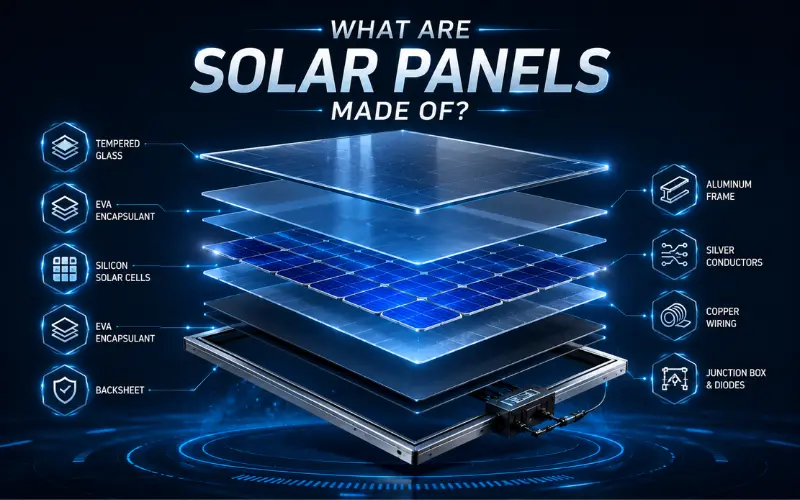
- Silicon photovoltaic (PV) cells — convert sunlight into electricity
- Tempered low-iron glass — protects the cells from weather and impact
- EVA encapsulant — bonds the layers and blocks moisture
- Polymer backsheet — seals and insulates the rear
- Anodized aluminum frame — provides structural support
- Silver conductors and copper wiring — collect and carry the electric current
- Junction box with bypass diodes — manages the electrical output
Here’s a fast-reference table:
| Component | Material | Function |
|---|---|---|
| Solar cells | Silicon | Convert light to electricity |
| Front cover | Tempered, low-iron glass | Weather and impact protection |
| Encapsulant | EVA or POE polymer | Bond layers, seal out moisture |
| Backsheet | PVF or PET polymer | Rear insulation and sealing |
| Frame | Anodized aluminum | Structural support and mounting |
| Cell conductors | Silver paste | Collect current from cells |
| Wiring | Copper | Carry current to output |
| Junction box | Plastic + bypass diodes | Output management |
Now let’s go through each one in proper detail.
1. Silicon: The Core of What Are Solar Panels Made Of
When people ask what are solar panels made of, the answer almost always starts with silicon — and for good reason. Silicon is the photovoltaic material that does the actual work of turning sunlight into electricity.
Silicon is a semiconductor. On its own it doesn’t conduct electricity freely, but when photons from sunlight strike its atoms, they knock electrons loose. Those electrons begin to flow, creating a direct current. This is called the photovoltaic effect, and it’s the entire basis of how solar panels generate power.
Why silicon specifically? It’s the second most abundant element in Earth’s crust, found in ordinary sand and quartz. It’s chemically stable, tolerates outdoor conditions for decades, and has a bandgap energy level that lets it absorb a broad range of the solar spectrum efficiently.
The catch is purity. The silicon in sand is nowhere near clean enough for solar cells. Solar-grade silicon must be at least 99.9999% pure. Achieving that requires reducing silicon dioxide in an electric arc furnace at roughly 2,000°C, then further purifying it through a chemical process involving hydrogen gas and hydrochloric acid until polysilicon-grade purity is reached. It’s energy-intensive, which is one reason solar panels carry an upfront carbon cost — though they repay it many times over during their operational lifespan.
Monocrystalline vs. Polycrystalline: Two Answers to What Are Solar Panels Made Of
One of the most important distinctions in what are solar panels made of is whether the silicon cells are monocrystalline or polycrystalline. Both use silicon, but the manufacturing process differs — and so does the performance.
Monocrystalline silicon panels are made from a single continuous silicon crystal grown using the Czochralski process. A cylindrical ingot is slowly pulled from molten silicon, then sliced into thin wafers. Because electrons travel through a single unbroken crystal structure, these cells are the most efficient available commercially, typically reaching 20–23% efficiency. They appear uniformly black with slightly rounded edges. They cost more to produce but deliver more power per square metre — ideal for homes with limited roof space.
Polycrystalline silicon panels are made by melting silicon and pouring it into rectangular moulds, allowing multiple crystals to form as it cools. The boundaries between those crystals create slight resistance to electron flow, dropping efficiency to around 15–18%. They have a distinctive blue, fragmented appearance. They’re cheaper and still highly reliable — just less efficient per unit of area.
Understanding this distinction is a big part of knowing what are solar panels made of in practical terms, because it directly shapes which product is right for your situation.
Inside the Silicon Cell: Doping and the P-N Junction
To make a silicon wafer actually generate electricity, it needs an internal electric field. This is created by doping — introducing impurities that change the electrical behaviour of the silicon:
- Phosphorus doping adds extra electrons, creating an n-type (negative) layer
- Boron doping creates electron “holes” — spaces ready to accept electrons — creating a p-type (positive) layer
The boundary between these two layers is the p-n junction. When light knocks electrons loose, the electric field at the junction forces them to travel in one consistent direction — producing usable direct current. This p-n junction is the true engine of every silicon solar cell, and grasping it is central to understanding what are solar panels made of at a physics level.
2. Silver and Copper: The Conductors
Once silicon cells generate electricity, that current needs to be collected and carried out of the panel. This is where two metals come in.
Silver is screen-printed onto the front surface of each cell in a fine grid pattern — thin lines called fingers running across the cell, connected to wider lines called busbars. Silver is the most electrically conductive element on Earth, minimizing energy lost as heat as electrons travel through those tiny lines. A standard residential panel contains around 15–20 grams of silver — a small amount by weight, but one that accounts for a meaningful portion of the panel’s raw material cost.
Copper takes over once the current leaves the cell level. The wiring that connects cells in series, links the panel to the junction box, and ultimately connects to your inverter is copper. It’s far cheaper than silver and more than conductive enough for bulk wiring applications.
The quality of both the silver paste formulation and the copper wiring gauge affects how much power actually reaches your inverter — a less visible but genuinely important aspect of what are solar panels made of from a performance standpoint.
3. Tempered Low-Iron Glass
Silicon cells are fragile on their own. Expose them directly to rain, hail, or temperature extremes and they’d fail within days. The front surface of every panel is therefore a sheet of tempered, low-iron glass — typically 3–4mm thick — that protects the cells while allowing sunlight through.
“Low-iron” matters here. Ordinary window glass has enough iron content to absorb a small percentage of incoming light. Low-iron glass is optically clearer, transmitting more of the solar spectrum down to the cells below.
Tempering involves heating the glass to around 620°C and rapidly cooling it, creating internal compression that makes it roughly four times stronger than standard glass. Most panels meet IEC standards for hail resistance — capable of withstanding 25mm hailstones at 23 m/s. An anti-reflective coating on the surface reduces the light that bounces off rather than entering the panel.
Glass is also, by weight, the single largest component of what are solar panels made of — accounting for approximately 75–76% of a typical panel’s total weight. When you lift a solar panel, you’re mostly lifting glass.
4. EVA Encapsulant
Sandwiching the silicon cells on both sides is a transparent film of ethylene vinyl acetate (EVA) — a thermoplastic polymer that plays a quiet but critical role in panel longevity.
During manufacturing, the entire panel stack — glass, front EVA, cells, rear EVA, backsheet — is placed in a laminator and heated under pressure. The EVA softens and flows around the cells, bonding everything into a single sealed unit. Once cured, it holds the fragile wafers firmly in place, prevents moisture and oxygen from reaching the silicon, and absorbs mechanical shock.
Lower-quality EVA yellows over time under UV exposure, reducing the light reaching the cells and gradually degrading output. Premium panels use higher-grade EVA formulations or newer POE (polyolefin elastomer), which resists yellowing and moisture penetration more effectively. In humid or hot climates, this encapsulant choice directly impacts how well the panel holds up over its 25-year lifespan.
5. Backsheet
The rear of the panel is sealed with a backsheet — typically made from PVF (polyvinyl fluoride), PET polyester, or multi-layer combinations. It acts as the final barrier against moisture ingress, electrical leakage, and UV degradation from the rear.
Most backsheets are white, reflecting some light back through the cells for a minor efficiency gain. All-black panels — increasingly popular for aesthetics — use black backsheets that absorb rather than reflect, running marginally hotter but looking cleaner on a dark roof.
Bifacial panels take a different approach entirely — they replace the opaque backsheet with a second glass layer, allowing the panel to generate power from both faces by capturing reflected light from the ground or surrounding surfaces.
6. Aluminum Frame
Every standard solar panel is enclosed in an anodized aluminum frame running around its perimeter. This provides rigid structural support that keeps the glass from flexing under wind or snow loads, protects the edges from mechanical damage, and supplies the mounting points used to fix the panel to a roof or ground-mount structure.
Aluminum is chosen because it’s lightweight, strong, naturally corrosion-resistant, and among the most recyclable materials available. When solar panels eventually reach end of life, the aluminum frame is one of the easiest and most economically valuable components to recover and reuse.
7. Junction Box
On the rear of every panel sits a small weatherproof junction box — usually UV-resistant plastic — housing the panel’s output terminals. Inside are bypass diodes, which allow current to route around shaded or underperforming cells, preventing partial shading from dragging down the output of the entire string.
The junction box is also where the output cables terminate, typically fitted with MC4 connectors — a standardized, weatherproof plug-and-socket system that makes connecting panels both easy and reliably watertight.
Beyond Silicon: What Are Solar Panels Made Of in Other Technologies
Standard crystalline silicon accounts for around 95% of the global solar market, but understanding what are solar panels made of across different technologies gives a fuller picture.
Thin-Film Panels
Thin-film technology deposits a photovoltaic material in a very thin layer onto a substrate like glass, steel, or flexible plastic. The three main materials used are:
- Cadmium telluride (CdTe): The most commercially successful thin-film technology. Performs well in high temperatures and diffuse light. Contains cadmium — a toxic heavy metal requiring careful end-of-life handling.
- CIGS (copper indium gallium selenide): A high-performing thin-film material approaching crystalline silicon efficiency in some applications.
- Amorphous silicon (a-Si): Lower efficiency but flexible and lightweight — suited to curved surfaces and portable applications.
Perovskite Solar Cells
Perovskite cells have achieved lab efficiencies above 25%, and silicon-perovskite tandem designs could theoretically push past 30%. The challenge is durability — perovskite degrades faster with moisture and heat, and some formulations contain lead. This remains an active research frontier rather than a commercial mainstream product.
What Are Solar Panels Made Of by Weight?
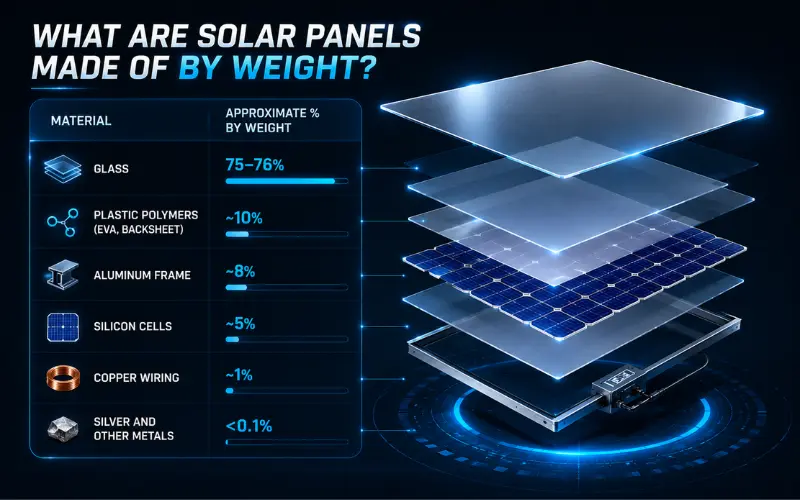
Here’s an approximate weight breakdown for a standard crystalline silicon panel:
| Material | Approximate % by Weight |
|---|---|
| Glass | ~75–76% |
| Plastic polymers (EVA, backsheet) | ~10% |
| Aluminum frame | ~8% |
| Silicon cells | ~5% |
| Copper wiring | ~1% |
| Silver and other metals | <0.1% |
The cells doing the actual work are only about 5% of the panel’s weight. The rest is protection, structure, and conductivity.
Why What Are Solar Panels Made Of Matters When You’re Buying
Understanding what are solar panels made of isn’t just academic — it has direct implications when comparing products and quotes.
Cell grade: Not all silicon wafers are equal. Premium manufacturers use Grade A cells free of micro-cracks with consistent doping profiles. Lower-tier panels may use B-grade cells that degrade faster.
Glass quality: Anti-reflective coatings and iron content vary. Better glass transmits more light and resists the micro-scratching that builds up over years of dust and cleaning.
Encapsulant grade: Higher-quality EVA or POE resists yellowing and delamination. In Pakistan’s hot and humid conditions, this is particularly relevant — heat accelerates encapsulant degradation in cheaper panels.
Silver paste quality: Better conductor formulations mean less resistive loss and higher long-term output. Invisible to the eye but measurable in energy bills.
Warranty as a signal: A manufacturer confident in their materials backs them with a 10–12 year product warranty and a 25–30 year performance warranty guaranteeing at least 80–85% output retention. Shorter warranties often reflect lower material quality.
Environmental Side of What Are Solar Panels Made Of
One honest concern that comes up when people learn what are solar panels made of is the environmental cost of making them. It deserves a straight answer.
Manufacturing does require energy — purifying silicon, smelting aluminum, producing glass. But most silicon panels repay their entire manufacturing energy debt within 1–4 years. After that, they generate clean electricity for 20+ more years. Over their full lifecycle, solar panels emit roughly 25–50g of CO₂-equivalent per kWh — compared to 800–1,000g for coal power.
Recyclability is improving. Aluminum and copper are profitably recyclable. Glass recovery is straightforward but currently underinvested. Dedicated solar panel recycling infrastructure is being built globally as the first generation of large-scale installations approaches end of life.
Frequently Asked Questions
What are solar panels made of at the most basic level?
Silicon cells that convert sunlight to electricity, surrounded by glass, polymer encapsulant layers, an aluminum frame, and copper and silver conductors.
What are solar panels made of that makes them last 25+ years?
Tempered glass, UV-stable encapsulant, anodized aluminum, and high-purity silicon — all chosen for their ability to withstand decades of outdoor exposure with minimal degradation.
What are solar panels made of in thin-film technology?
Instead of silicon wafers, thin-film panels use cadmium telluride, CIGS, or amorphous silicon deposited in thin layers on glass or metal substrates.
What are solar panels made of that drives up the cost?
The energy-intensive purification of silicon, the silver used for cell conductors, and the precision manufacturing environment all contribute to cost.
What are solar panels made of that can be recycled at end of life?
The aluminum frame, copper wiring, and glass are all recyclable. Silicon recovery is increasingly viable. Cadmium in thin-film panels requires specialist handling.
What are solar panels made of in terms of hazardous materials?
Standard silicon panels contain no acutely hazardous materials. CdTe thin-film panels contain cadmium, but responsible manufacturers run take-back and recycling programs.
Final Summary
So — what are solar panels made of? They’re made of silicon cells that exploit the photovoltaic effect, silver and copper conductors that collect and carry the current, tempered low-iron glass that protects and transmits, EVA encapsulant that bonds and seals, a polymer backsheet that insulates the rear, an aluminum frame that holds everything structurally together, and a junction box that manages the output cleanly. Each material is there for a precise reason, and the quality of each one shapes how much power the panel produces and for how long.
Knowing what are solar panels made of puts you in a much stronger position — whether you’re comparing installation quotes, scrutinizing warranties, or simply making sure the technology you’re investing in is built to last in your climate and conditions.