There’s a moment every outdoor enthusiast knows — you’re three days into a backpacking trip, your GPS is on its last bar, and the nearest outlet is somewhere on the other side of a mountain range. That’s exactly when having the best solar power bank in your pack goes from a nice-to-have to an absolute lifeline.
We spent three months testing the top-rated models to find the best solar power bank for real-world use — hiking with them, strapping them to packs in direct sun, leaving them in partial shade, and timing exactly how long each one takes to charge a phone. Not in a lab. On trails. At campsites. During a week-long overlanding trip in the desert.
This guide covers everything we found — including which is the best solar power bank for your money in 2026, what specs actually matter (and which are pure marketing noise), and several things competitors don’t tell you — like how drastically your charging expectations need to shift on cloudy days.
Quick Picks: Best Solar Power Banks at a Glance
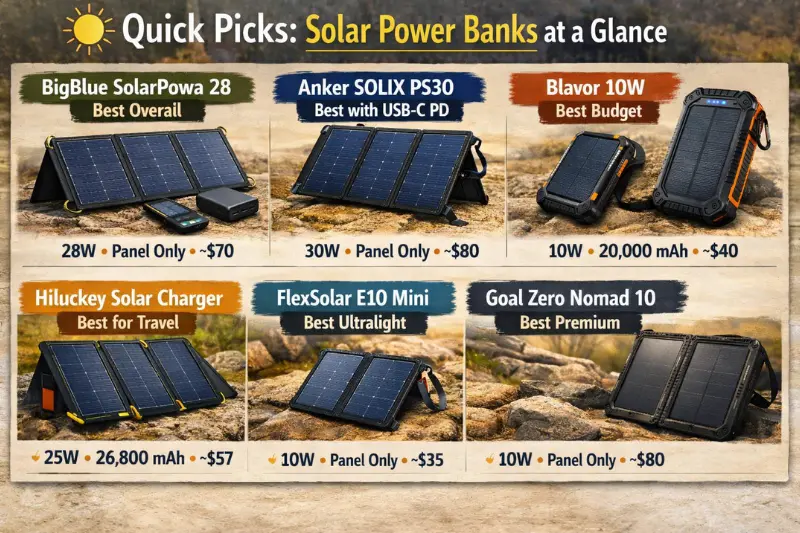
| Pick | Best For | Wattage | Battery | Price |
|---|---|---|---|---|
| BigBlue SolarPowa 28 | Best overall | 28W | Panel only | ~$70 |
| Anker SOLIX PS30 | Best with USB-C PD | 30W | Panel only | ~$80 |
| Blavor 10W | Best budget solar power bank | 10W | 20,000 mAh built-in | ~$40 |
| Hiluckey Solar Charger | Best all-in-one for travel | 25W | 26,800 mAh built-in | ~$57 |
| FlexSolar E10 Mini | Best ultralight backpacking | 10W | Panel only | ~$35 |
| Goal Zero Nomad 10 | Best rugged/premium option | 10W | Panel only | ~$80 |
What Is a Solar Power Bank — and Do You Actually Need One?
A solar power bank is a portable device that converts sunlight into electricity to charge your devices. Some models are panel-only (they charge a separate battery bank), while others have an integrated battery that stores solar energy so you can charge your phone even after dark.
They’re genuinely useful for:
- Multi-day backpacking or thru-hiking where you can’t find outlets
- Emergency preparedness and go-bags
- Camping, overlanding, or van life
- International travel in regions with unreliable power infrastructure
- Day hikes and festivals where you’re outdoors for 8+ hours
If you spend most of your time in cities or car-camping with AC hookups, a standard power bank will likely serve you better and cost far less. But if you’re regularly off-grid for more than 24 hours, a solar power bank can eliminate the battery anxiety that follows you on every trip.
The Honest Truth About Solar Charging Speed
This is the thing most reviews gloss over, and it’s the single most important piece of information for managing your expectations.
Solar panels are slower than you think — especially on cloudy days.
In our testing, here’s what we actually measured charging a 4,700 mAh iPhone 15 Pro Max from a 28W panel:
| Condition | Energy generated per hour | Hours to fully charge a phone |
|---|---|---|
| Direct full sun, panel angled | ~2,100–2,200 mAh | ~2.5–3 hours |
| Partial shade / thin cloud | ~400–600 mAh | ~8–12 hours |
| Heavy overcast | ~100–200 mAh | Not practical |
| Dusk / dawn (low angle sun) | ~50–150 mAh | Trickle only |
This is why the type of charger you choose matters so much. If you only have a foldable panel (no integrated battery), you need to be in consistent direct sun while your device is plugged in. If you buy an all-in-one unit with a built-in battery, you can charge the battery in the sun throughout the day and plug your phone in at night — a far more practical setup for most hikers and campers.
Two Types of Solar Power Banks: Which One Do You Need?
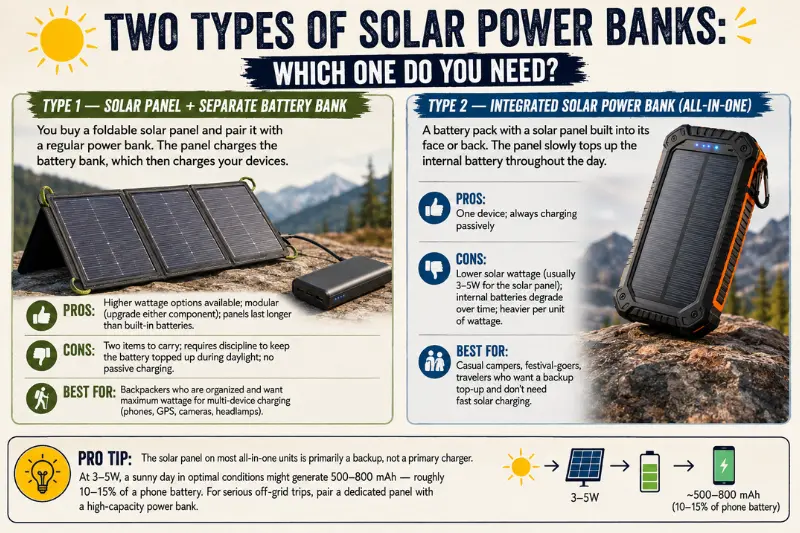
Type 1 — Solar panel + separate battery bank
You buy a foldable solar panel and pair it with a regular power bank. The panel charges the battery bank, which then charges your devices.
Pros: Higher wattage options available; modular (upgrade either component); panels last longer than built-in batteries.
Cons: Two items to carry; requires discipline to keep the battery topped up during daylight; no passive charging.
Best for: Backpackers who are organized and want maximum wattage for multi-device charging (phones, GPS, cameras, headlamps).
Type 2 — Integrated solar power bank (all-in-one)
A battery pack with a solar panel built into its face or back. The panel slowly tops up the internal battery throughout the day.
Pros: One device; always charging passively; simpler to use.
Our Top Solar Power Bank Picks, Tested
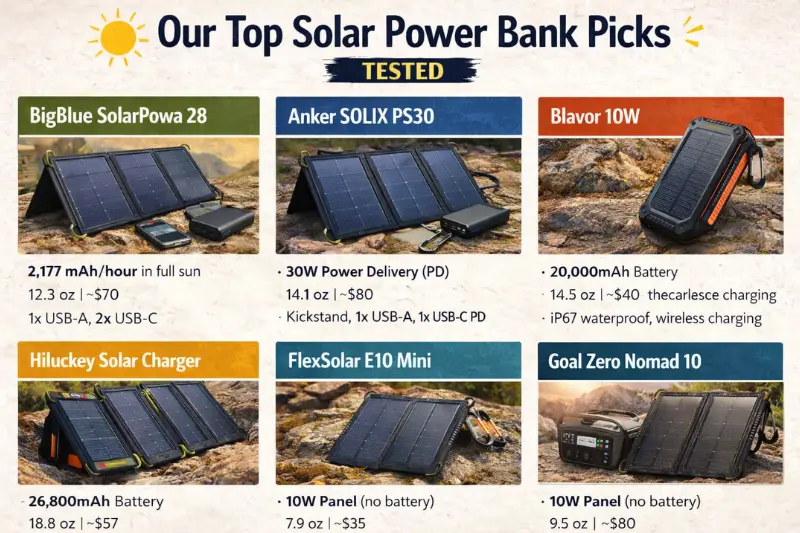
1. BigBlue SolarPowa 28 — Best Overall Solar Power Bank
Why we picked it: The BigBlue SolarPowa 28 earned the top spot in our testing for one straightforward reason — it generates the most usable energy in direct sun while staying light enough for a day pack. It produced 2,177 mAh per hour in full sun during our testing, the highest of any panel in its class.
It folds into four panels and has one USB-A and two USB-C ports, so you can charge a phone, a GPS, and top up a battery bank at the same time. There’s a built-in storage pocket for cables and accessories, which sounds small but matters when you’re rummaging through a pack at camp.
What we didn’t love: No kickstand legs, so you have to prop it against a rock to angle it toward the sun. A minor issue, but something competitors like the Anker SOLIX PS30 handle better.
Real-world charging data:
- Full sun: fully charged an iPhone 15 in approximately 2 hours 40 minutes (panel only, phone in standby)
- Cloudy day: generated just 583 mAh/hour — manageable if you top up a battery bank across a full day
Weight: 12.3 oz | Price: ~$70 | Ports: 1x USB-A, 2x USB-C
2. Anker SOLIX PS30 — Best USB-C PD Solar Power Bank
Why we picked it: This is the right panel to buy if you’re charging USB-C laptops, tablets, or newer devices that benefit from Power Delivery fast charging. The SOLIX PS30 outputs up to 30W with USB-C PD support — something most competitors skip.
It has fold-out kickstand legs (a genuine quality-of-life improvement over the BigBlue), includes two carabiners so you can clip it to a pack and walk while it charges, and comes with an 18-month warranty — the longest of any panel we tested.
One important note: the PS30 is a panel only — it has no integrated battery. You’ll need a separate USB-C battery bank.
Weight: 14.1 oz | Price: ~$80 | Ports: 1x USB-A, 1x USB-C PD
3. Blavor 10W — Best Budget Solar Power Bank
Why we picked it: If your budget is under $45 and you want a solar power bank that fits in a jacket pocket, the Blavor 10W is the pick. It’s a true all-in-one: 20,000 mAh built-in battery, a 10W solar panel on the face, USB-C in/out, wireless Qi charging, a built-in flashlight, and an IP67-rated waterproof shell.
In direct sun, it generated around 600–700 mAh per hour — slower than the BigBlue, but at less than half the price, with a battery already inside. For weekend camping trips or music festivals, it’s genuinely excellent.
What competitors miss: The Blavor also works as a wireless charging pad. Lay your iPhone or Android face-down on the panel side in the sun, and it charges passively — no cables needed. We haven’t seen this pointed out elsewhere, and it’s genuinely useful at a campsite.
Weight: 14.5 oz | Price: ~$40 | Battery: 20,000 mAh | IP Rating: IP67
4. Hiluckey Solar Charger — Best All-In-One Solar Power Bank for Travel
Why we picked it: The Hiluckey packs a 26,800 mAh battery (the highest of any all-in-one we tested), four solar panels on the face, four charging ports (2x USB-A, 2x USB-C), and a rugged rubberized shell.
It’s the solar power bank we’d bring on an international trip where we might go days without a reliable outlet. You can fully charge it via wall outlet before you leave, use the battery for your first few days, and then let the solar panels top it up while exploring.
Solar input is around 4W from the face panels, which means expect 400–600 mAh per hour in good sun. Pair that with a 26,800 mAh battery and you have serious capacity reserves.
Weight: 18.8 oz | Price: ~$57 | Battery: 26,800 mAh | Ports: 2x USB-A, 2x USB-C
5. FlexSolar E10 Mini — Best Ultralight Solar Power Bank Panel
Why we picked it: At just 7.9 oz, the FlexSolar E10 Mini is the lightest 10W panel we tested and the one we’d grab for a fast-and-light alpine trip. It folds flat, fits in the side pocket of most packs, and clips onto a bag strap via corner loops.
It doesn’t have an integrated battery, so you’ll pair it with your own power bank. Charging speed is modest — plan for 3–4 hours of sun to generate a full phone charge — but for ultralight hikers who count every gram, the weight savings justify the trade-off.
Weight: 7.9 oz | Price: ~$35 | Ports: 1x USB-A, 1x USB-C
6. Goal Zero Nomad 10 — Best Premium Rugged Solar Power Bank
Why we picked it: Goal Zero is the benchmark brand for serious outdoor solar gear, and the Nomad 10 is their most trail-appropriate panel. It’s built to last — the kind of product that still works after years of packing, unpacking, folding in the rain, and getting caught under a rockfall.
The quality is reflected in the price (~$80 for a 10W panel), which makes it hard to recommend on pure wattage-per-dollar math. But if you’re a serious backpacker who puts gear through genuine abuse and hates replacing things, the Nomad 10 earns its keep.
Weight: 9.5 oz | Price: ~$80 | Ports: 1x USB-A
How to Choose the Right Solar Power Bank: The Real Buyer’s Guide
Wattage — the number that actually matters
Ignore mAh output specs on integrated panels (usually inflated). Focus on wattage:
- Under 10W: Slow — best as a trickle backup, not a primary charger
- 10–20W: Adequate for one phone a day in good conditions
- 25–30W: Fast enough to charge a phone in under 3 hours of direct sun; can handle tablets
- 40W+: Best for camping with power stations, laptops, or multiple devices
Battery capacity
If you’re buying an all-in-one unit with an integrated battery, here’s what the mAh numbers mean in practice:
- 10,000 mAh: Roughly 1.5–2 full charges for a typical smartphone
- 20,000 mAh: 3–4 full smartphone charges, or 1 tablet charge
- 26,800 mAh: 4–5 full smartphone charges; comfortable for a 3-day trip
Weight vs. power trade-off
Every extra watt of solar panel adds weight. Here’s how to think about it:
- Ultralight hikers (every gram counts): Stick to 10W panels; pair with a small 10,000 mAh bank
- Weekend backpackers: 25–28W panel + 10,000–20,000 mAh bank is the sweet spot
- Car campers / overlanders: Go 40W or higher; weight doesn’t matter here
Ports and charging protocols
This is the most overlooked spec in any buying decision. Check for:
- USB-C Power Delivery (PD): Required if you’re charging a MacBook, iPad Pro, or recent Android flagship
- Quick Charge 3.0 (QC3.0): Faster charging for compatible Android devices
- Multi-port simultaneous charging: Useful if you’re charging a phone, GPS, and headphones at once
Most budget solar power banks use standard USB-A at 5W — fine for phones, inadequate for laptops.
Waterproofing: IP ratings explained
Look for at least IPX4 (splash-resistant) for hiking. Here’s the breakdown:
- No rating: Keep it dry — not trail-ready
- IPX4: Splash-resistant; handles rain if you’re not submerging it
- IPX6: Water-resistant to heavy jets; suitable for most outdoor use
- IP67/IP68: Fully waterproof; can handle submersion — the Blavor 10W earns this
What Competitors Don’t Tell You: 7 Things to Know Before You Buy
1. Mount angle changes everything
A solar panel flat on a picnic table generates 30–40% less power than one angled directly at the sun. Most people don’t realize this until they’re disappointed by how slow their charging is. Always tilt your solar power bank panel toward the sun — even a rough angle makes a measurable difference.
2. The “Big White Sheet” test
The best review methodology we’ve seen (from OutdoorGearLab) tests panels under a white sheet to simulate cloud cover. The results show that some panels — particularly those with monocrystalline cells — perform significantly better in low light than polycrystalline alternatives. Ask what cell type is used in any panel you’re considering. Mono is worth it.
3. Heat reduces efficiency
Solar panels are most efficient around 25°C (77°F). On a hot summer day with the panel sitting on a dark rock face in 40°C heat, you’ll lose 10–25% efficiency. If you can give it some airflow or shade the back of the panel, do it.
4. Integrated solar panels degrade
The solar panel built into your all-in-one solar power bank will lose efficiency over time, just like the battery. A unit that charges at 700 mAh/hour when new may do 400 mAh/hour after two years of regular use.
5. USB-C cables matter more than you’d think
A cheap USB-C cable can throttle charging from 18W down to 5W. Always use cables that support the full wattage of your panel — most quality panels come with one, but replacement cables need to match.
6. Panels don’t work well through glass
If you’re thinking about strapping a solar power bank panel to the outside of a car window — most glass blocks 30–60% of UV light. Put the panel on the roof or dashboard facing up, not behind the window.
7. Pair with the right power bank
Not all power banks accept fast solar input. A 28W panel plugged into a power bank that only accepts 5W input is a waste. Match the panel output wattage to the power bank’s supported input wattage.
Cloud Cover & Real-World Performance: What to Actually Expect
One of the most common complaints about solar chargers is that “they barely work on cloudy days.” Here’s how to reframe that expectation:
A solar power bank in partial cloud cover is generating real power — just less of it. Think of cloudy-day solar like a slow drip. Over a full hiking day (8 hours), even a 10W panel generating 400 mAh/hour in modest sun can accumulate 3,200 mAh — roughly 60–70% of a phone charge.
The strategy is simple: don’t plug devices directly into the panel on cloudy days. Instead, run the output into a battery bank. Let it drip charge all day. By evening, you have a meaningful buffer.
The panels that perform best in diffuse light are monocrystalline units with higher efficiency ratings (21–24%). The BigBlue SolarPowa 28 and Anker SOLIX PS30 both fall into this category.
Solar Power Banks for Specific Use Cases
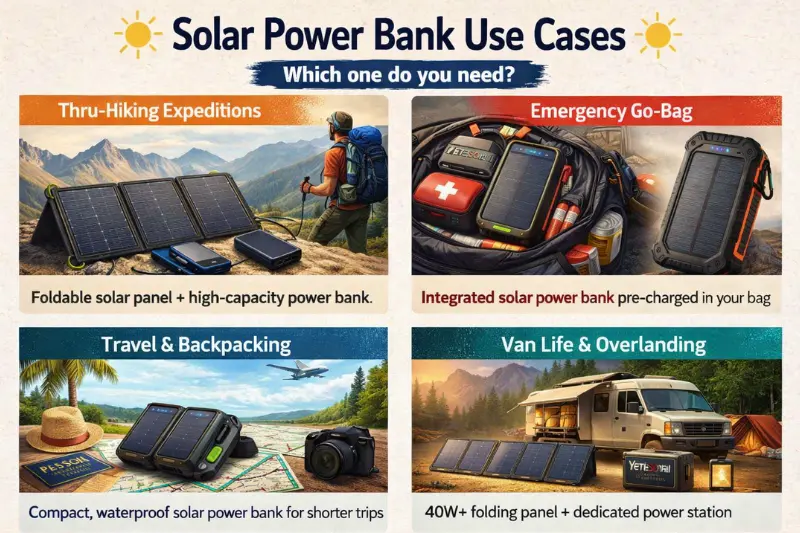
For thru-hiking and multi-week expeditions
You need reliability, weight efficiency, and enough wattage to power a GPS unit alongside your phone. Our pick: BigBlue SolarPowa 28 paired with a 20,000 mAh Anker power bank. The panel handles daytime charging, the bank handles overnight and weather-day reserves.
For emergency preparedness (go-bag)
You want a self-contained charger that works without needing a separate device — something you can grab and go. Our pick: Hiluckey 26,800 mAh, kept pre-charged in your bag. Its built-in panels mean you can top it up during an emergency without grid power.
For travel and international trips
Pack light. Our pick: Blavor 10W (all-in-one, waterproof, wireless charging) for stays of 1–3 days off-grid, or a Hiluckey 26,800 for longer self-sufficient travel.
For van life and overlanding
Weight isn’t a constraint; power output is. Look at 40W+ foldable panels (FlexSolar 40W, Jackery SolarSaga 40) paired with a proper power station (Goal Zero Yeti, Jackery Explorer series). These go well beyond what a phone-focused portable panel can offer.
Maintenance: How to Make Your Solar Power Bank Last Longer
Most people never think about this, and it shows — solar panels degrade faster than they need to.
- Store partially charged (40–60%) if you won’t use it for months. Full charge storage degrades lithium batteries.
- Clean the panel surface. Dust and grime reduce efficiency. A damp microfiber cloth is enough — no abrasives.
- Avoid extreme heat. Don’t leave it in a parked car in summer. Temperatures above 60°C (140°F) damage both panels and batteries.
- Fold panels for transport. Most panels are designed to fold. Don’t roll or bend them beyond their intended axis.
- Charge the battery occasionally even if not in use (every 3–4 months) to prevent deep discharge.
Frequently Asked Questions
How long does the best solar power bank take to charge a phone?
In direct full sun, the best solar power bank with 25–30W output can charge most smartphones in 2–3 hours. A 10W unit takes 4–6 hours under the same conditions. On a cloudy day, multiply those times by 3–5x — or route the output into a separate battery bank to store energy throughout the day and charge your phone at night.
Can the best solar power bank charge a laptop?
Only if it supports USB-C Power Delivery at 30W or higher. The Anker SOLIX PS30 handles smaller laptops like the MacBook Air or lightweight Windows machines, but won’t keep up with power-hungry models. For laptop charging off-grid, a 65–100W solar panel paired with a proper power station is a more reliable setup than even the best solar power bank designed for phones.
Is the best solar power bank worth buying for outdoor use?
For multi-day camping, hiking, or backpacking trips, absolutely yes. The best solar power bank removes the anxiety of running out of charge and keeps emergency GPS units, phones, and headlamps powered without any grid access. For occasional weekend trips with outlet stops along the way, a standard high-capacity power bank might be more practical and cheaper.
What is the best solar power bank hikers actually use on the trail?
Based on real feedback from hiking communities and our own trail testing, the BigBlue 28W and Anker SOLIX PS30 paired with a separate battery bank are the most common choices among serious backpackers. For casual hikers who want simplicity, the Blavor waterproof all-in-one is a popular pick that handles rain, dust, and rough handling without complaint — making it arguably the best solar power bank for beginners.
Can the best solar power bank charge in indirect sunlight or shade?
Yes — but output drops significantly. Indirect light or thin cloud cover typically produces 20–30% of what you’d see in direct sun. A quality monocrystalline unit handles diffuse light better than polycrystalline panels, but neither performs well enough in full shade to rely on as a primary charging source. Plan your charging windows around the sunniest part of the day for any panel, even the best solar power bank on the market.
What is the best solar power bank for emergency preparedness?
For emergency kits and go-bags, you want a self-contained unit with a large built-in battery — not a panel-only charger. The Hiluckey 26,800 mAh is our top pick for this use case: keep it pre-charged at home, and its built-in solar panels can top it up during a prolonged outage or disaster scenario without any grid power needed. If long-term reliability is your priority, this is the best solar power bank for emergencies hands down.
Our Verdict
The best solar power bank for most people in 2026 is the BigBlue SolarPowa 28 paired with a 20,000 mAh power bank — it generates meaningful power in real-world conditions, stays light enough to carry every day, and won’t break the bank at $70.
If you’re looking for the best solar power bank in an all-in-one format with no separate devices to manage, the Blavor 10W at $40 is the most practical option, especially with its waterproofing and wireless charging built right in.
For anyone charging laptops or flagship tablets on the road, the Anker SOLIX PS30 earns its place as the best solar power bank for USB-C PD output — it’s the only option in its class worth seriously considering.
And if you’re still deciding which is the best solar power bank for your specific situation — camping, hiking, travel, or emergencies — go back to the use-case section above. The right answer depends on how many days you’ll be off-grid, how much weight you can carry, and whether you need an integrated battery or are happy pairing a panel with a separate bank.
Whatever you pick, adjust your expectations for cloudy days, invest in a good cable, and angle your panel toward the sun. The best solar power bank won’t do its job flat on a picnic table — technique matters just as much as the gear itself.