Walmart is quietly building one of the most consequential EV charging networks in the United States — and most drivers do not yet know the full picture. This is not just a retailer adding a few chargers as a customer perk. Walmart is building a company-owned, company-operated national DC fast-charging network targeting thousands of locations by 2030, using some of the most powerful charging hardware commercially available.
This guide covers everything you actually need to know: how the network works, what it costs, what hardware they are installing, which connectors are supported, where stations are currently open, how Walmart+ membership affects your charging costs, and how this network compares to Electrify America, Tesla Superchargers, and EVgo.
What Is the Walmart EV Charging Network?
Walmart’s EV charging network is a company-owned, company-operated DC fast-charging infrastructure built on Walmart and Sam’s Club property across the United States. This distinguishes it fundamentally from the third-party charging partnerships Walmart previously hosted — most notably with Electrify America and EVgo, which operate independently on Walmart-owned land.
The new Walmart EV charging network means Walmart controls everything: the hardware procurement, installation, pricing, customer experience, and network operations. This is a significant strategic shift — and for EV drivers, it means the charging experience at Walmart is no longer dependent on how well a third-party operator manages their equipment.
The scale ambition is enormous. Walmart operates more than 5,200 stores in the United States — including Walmart Supercenters, Neighborhood Market locations, and Sam’s Club warehouses. Even if only a fraction of those locations receive charging stations, the potential size of this network is larger than most existing US charging networks combined.
Walmart EV Charging Hardware: 400 kW Fast Chargers
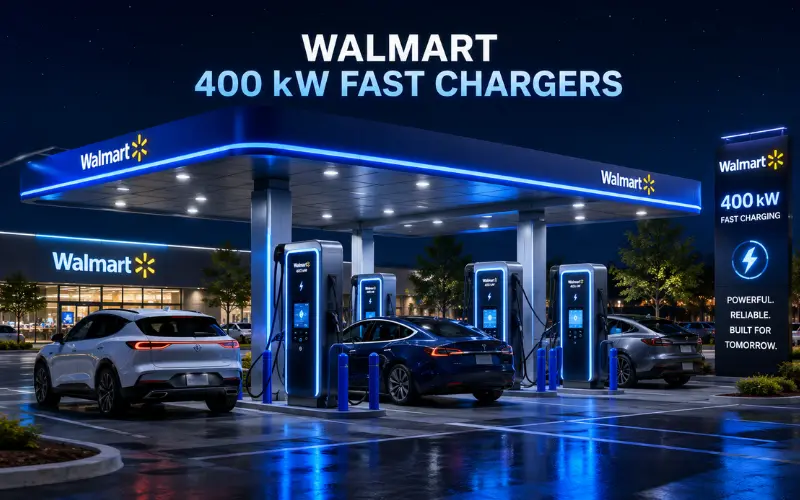
This is where Walmart’s network immediately stands out from the crowd. The hardware Walmart has chosen is not mid-tier infrastructure — it is among the most powerful commercially deployed charging equipment in the United States.
Walmart installs 400 kW DC fast chargers using two hardware suppliers:
- Alpitronic HYC400 — a European-manufactured charger with a strong reliability track record and wide deployment across premium charging networks globally
- ABB A400 — ABB’s high-power commercial DC fast charger, another established manufacturer with strong global credentials
Each 400 kW charger unit serves two vehicles simultaneously by dynamically sharing power between two charging bays. The dynamic power sharing means that when only one vehicle is connected, it can receive the full 400 kW. When two vehicles are connected, the system intelligently allocates power based on each vehicle’s real-time charging needs.
What 400 kW means in practice: When Tom Moloughney tested the McKinney, Texas Walmart charging station using a GMC Hummer EV, the vehicle pulled over 300 kW for a sustained period, charging from 1% to 53% in just 27 minutes — delivering 100 kWh of energy in that session.
Station layout: Current Walmart EV charging stations typically feature 2–6 charger units serving 4–12 individual charging bays. Stations are designed with pull-through access for maximum convenience, well-lit canopies for safety and visibility, and front-of-store placement for easy access.
Walmart EV Charging Connectors: NACS and CCS1 — No CHAdeMO
Each Walmart charging unit provides two connectors — one NACS and one CCS1 — covering the two dominant North American fast-charging standards.
NACS (North American Charging Standard / SAE J3400): The Tesla-originated connector that has become the emerging North American standard, now adopted by Ford, GM, Rivian, Honda, Nissan, and most major automakers for new models. Native to all Tesla vehicles and newer model-year EVs from most major brands.
CCS1 (Combined Charging System): The previous North American DC fast-charging standard, widely deployed and still used on many EVs currently on the road — including Hyundai, Kia, BMW, Volkswagen, Audi, and most non-Tesla EVs purchased before the NACS transition.
CHAdeMO: Not available at Walmart. Walmart’s network general manager, Adam Happel, confirmed this directly — there will be no CHAdeMO connectors at any Walmart charging location. This means Nissan Leaf owners using CHAdeMO cannot use Walmart’s own network (though existing Electrify America stations on Walmart property may still offer CHAdeMO where installed).
The NACS trajectory: Walmart has indicated it will lean more heavily toward NACS over time as the North American market continues consolidating around that standard. For drivers of newer EVs, this is good news — the network is explicitly designed for the direction the US market is heading.
Walmart EV Charging Costs: What You Actually Pay
Walmart EV charging pricing is location-specific rather than fixed across the network — a deliberate policy confirmed by Adam Happel, Walmart’s charging network general manager.
Current pricing data:
- Average: $0.48 per kWh across active stations, according to DCFC Tracker data
- Range: $0.40 to $0.57 per kWh depending on location and local electricity rates
- Pilot site pricing: The McKinney, Texas pilot site charged $0.42 per kWh during its initial operation — slightly below competitor rates at nearby stations
- Off-peak pricing: Some sites offer lower rates during off-peak hours — this varies by location
What a typical charging session costs: Using the average rate of $0.48 per kWh:
- Adding 50 miles of range in a typical EV (using approximately 15 kWh): approximately $7.20
- Adding 100 miles of range (approximately 30 kWh): approximately $14.40
- Full charge from 20% to 80% in a 75 kWh battery pack (approximately 45 kWh added): approximately $21.60
Comparison to competitors:
- Electrify America: approximately $0.48–0.56 per kWh (Pass+ member rates) or higher without membership
- Tesla Supercharger: approximately $0.25–0.35 per kWh for Tesla owners; approximately $0.48–0.53 per kWh for non-Tesla vehicles
- EVgo: approximately $0.30–0.45 per kWh with membership; higher without
- Walmart: approximately $0.40–0.57 per kWh, with Walmart+ discounts expected
The honest cost takeaway: Walmart pricing is competitive but not dramatically cheaper than established networks at standard rates. The potential Walmart+ discount (see below) is where the value proposition becomes more compelling.
Walmart+ and EV Charging Discounts
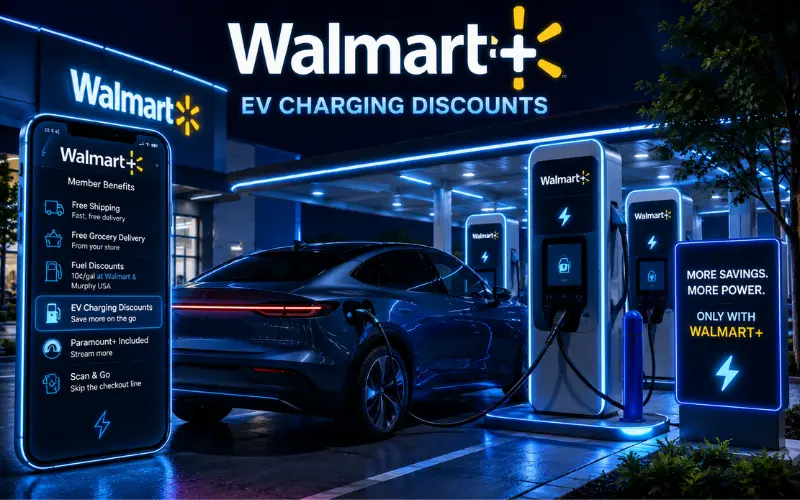
Walmart has confirmed that Walmart+ membership will offer discounts on the EV charging network — aligning it with the broader Walmart+ value proposition that already includes fuel discounts at Walmart and Murphy USA gas stations.
What we know:
- Walmart+ members will receive a discount on charging compared to standard rates
- The discount structure has not yet been formally detailed beyond the confirmation that it exists
- Adam Happel specifically referenced Walmart+ charging benefits as part of Walmart’s differentiation strategy
The Walmart+ context: Walmart+ is Walmart’s membership program, priced at $12.95/month or $98/year. Current Walmart+ benefits include:
- Free shipping on most Walmart.com orders
- Free grocery delivery from store
- Fuel savings of 10 cents per gallon at Walmart Fuel Stations and Murphy USA
- Paramount+ subscription inclusion
- Access to Scan & Go in-store checkout
Adding meaningful EV charging discounts to this package would significantly increase Walmart+’s value proposition for the growing segment of EV-driving households — a demographic that indexes higher on income and spending than the average Walmart customer.
Where Walmart EV Charging Stations Are Currently Open
Walmart’s network is in active rollout. As of recent tracking data, stations are operational across nine states with Texas leading significantly in deployment:
States with open Walmart EV charging stations:
- Texas — 15 stations (far ahead of all other states in early rollout)
- Arizona — 6 stations
- Florida — 3 stations
- Oklahoma — 2 stations
- Alabama — 1 station
- Arkansas — 1 station
- Georgia — 1 station
- New Jersey — 1 station
- South Carolina — 1 station
Network growth trajectory:
- The network grew from approximately 10 stations in early November 2025 to 20 stations by February 2026, then to 31 stations by April 2026 — a 50% increase in two months
- Average station size: approximately 7.2 charging bays per location
- Total public charging stalls as of April 2026: 224 individual charging points
- Approximately 86 additional stations identified as “coming soon” or under construction
- An additional ~200 locations found in permit filings and media reports
The growth math: The network’s expansion rate — roughly doubling or more every few months in the current phase — suggests meaningful national coverage is achievable within the stated 2030 timeline.
How to Find Walmart EV Charging Stations Near You
Finding open Walmart charging stations requires a slightly different approach than established networks, since Walmart’s own-brand stations are newer and not yet fully integrated into all charging apps.
Best methods for finding Walmart EV charging:
PlugShare The most comprehensive mapping platform for EV charging. Search near your location and look for stations labeled as Walmart-operated (distinct from Electrify America or EVgo stations on Walmart property). User-submitted check-ins provide real-time reliability data.
DCFC Tracker A specialist tracker maintained by the EV community specifically following Walmart’s network rollout. Particularly useful for finding stations that have recently opened or are coming soon in your area.
The Walmart charging station app (in development) Walmart is developing its own charging network app for locating stations, initiating sessions, and managing payment. As the network scales, app integration will become the primary access method.
Direct store verification For the most reliable current information, particularly in areas where new stations may have recently opened, calling your local Walmart store’s management directly and asking about EV charging availability can confirm what mapping apps may not yet show.
Walmart EV Charging vs. Existing Third-Party Stations on Walmart Property
This distinction confuses many drivers — and it is genuinely important to understand.
Walmart property currently hosts two distinct types of EV charging infrastructure:
1.
Walmart’s own new charging network Company-owned, 400 kW DC fast chargers with NACS and CCS1 connectors. Currently rolling out to selected locations. Pricing managed by Walmart. Walmart+ discounts applicable. This is what this article is primarily about.
2.
Third-party chargers on Walmart property Electrify America, EVgo, and other operators have stations installed on Walmart-owned land as part of separate commercial arrangements. These operate entirely independently under their own networks, pricing structures, and apps. A broken Electrify America charger at Walmart is an Electrify America problem, not a Walmart problem — and vice versa.
Adam Happel confirmed that Walmart will “reassess” its partnerships with existing third-party charging operators as its own network grows. What this means in practice is unclear — Electrify America has extensive infrastructure on Walmart land, and both parties have mutual interest in the arrangements continuing. But long-term, the relationship between Walmart’s own network and the third-party networks sharing its property will likely evolve.
Why Walmart’s EV Charging Network Matters for the Broader Market
Most competitor articles cover Walmart EV charging as a product review. Here is the bigger picture that matters for EV drivers and the market overall.
Geographic democratization of fast charging Walmart’s store network is uniquely positioned in American geography. Tesla Superchargers cluster in urban and affluent suburban areas. Electrify America prioritizes highway corridors. But Walmart stores exist in small towns, rural communities, and lower-income areas that have been largely ignored by existing fast-charging infrastructure investment.
A Walmart EV charging presence in a rural Arkansas town or a small Oklahoma city creates charging access that simply did not exist before. This genuinely expands the geographic viability of EV ownership for a demographic that has largely been excluded from the EV transition — exactly the “everyday low prices” customer that Walmart has served for decades.
Dwell time advantage The average Walmart shopping trip takes 41 minutes. A fast charging session on a 400 kW charger adds 150–250 miles of range in 20–35 minutes. The timing is nearly perfect — EV drivers can shop and charge simultaneously with no time penalty. This positions Walmart differently from standalone charging stations where the only activity is waiting for your car.
The 5,200-location ceiling Even if Walmart installs chargers at only 10% of its US locations, that is 520 charging sites. At 20% penetration, it is over 1,000 sites. The theoretical scale ceiling of Walmart’s network makes it one of the most significant potential charging infrastructure buildouts in US history.
Real Driver Experiences at Walmart EV Charging Stations
Early user reports from the charging community provide useful ground truth beyond the marketing claims.
What drivers are reporting positively:
- Charging speeds that genuinely approach 400 kW maximum for compatible vehicles (particularly the GMC Hummer EV, Rivian R1T/R1S, and high-end Tesla models)
- Pull-through station design that makes parking and connecting straightforward
- Well-lit, safe locations with immediate access to restrooms, food, and shopping
- Station uptime that has been consistently positive in early rollout — a meaningful contrast to the reliability problems that plagued early Electrify America deployments
What drivers are noting as limitations:
- Pricing ($0.40–0.57 per kWh) is competitive but not dramatically cheaper than alternatives
- No CHAdeMO means Nissan Leaf owners are excluded from Walmart’s own network
- The network is still small — most US drivers are not yet near an operational Walmart EV charging station
- Payment currently requires either a credit/debit card or the Walmart charging network approach — the Walmart+ discount integration is still coming
Frequently Asked Questions
How much does Walmart EV charging cost?
Walmart EV charging costs an average of $0.48 per kWh, with rates ranging from $0.40 to $0.57 per kWh depending on location and local electricity rates. Some sites offer off-peak pricing. Walmart+ membership is expected to offer a discount on charging, though the specific discount structure has not been formally detailed.
What connectors does Walmart EV charging use?
Each Walmart charger provides one NACS connector and one CCS1 connector per unit. This covers all current Tesla vehicles, newer model-year EVs from Ford, GM, Rivian, Honda, and most other major brands (NACS), as well as most non-Tesla EVs currently on the road (CCS1). CHAdeMO is not supported — Nissan Leaf owners cannot use Walmart’s own charging network.
How fast is Walmart EV charging?
Walmart installs 400 kW DC fast chargers — among the most powerful commercially deployed chargers in the US. Each unit dynamically shares up to 400 kW across two simultaneous vehicles. In practice, a GMC Hummer EV charging at the McKinney, Texas pilot station pulled over 300 kW, adding approximately 100 kWh in 27 minutes.
How many Walmart EV charging stations are open?
As of April 2026, Walmart operates 31 public DC fast-charging stations with 224 individual charging stalls across nine US states. Texas has the highest concentration. Approximately 86 additional stations are under construction or coming soon, with hundreds more in permit filings. The network is expanding rapidly, with roughly 50% growth reported in a two-month period.
Does Walmart+ give a discount on EV charging?
Walmart has confirmed that Walmart+ members will receive a discount on Walmart EV charging, similar to the fuel savings benefit the membership offers at Walmart gas stations. The specific discount rate has not yet been formally announced as the network is still in early rollout.
What hardware does Walmart use for EV charging?
Walmart’s network uses 400 kW DC fast chargers from two manufacturers: Alpitronic (HYC400 model) and ABB (A400 model). Each charger has two ports — one NACS and one CCS1 — and serves two vehicles simultaneously with dynamic power sharing.
Can I use the Electrify America chargers on Walmart property for Walmart charging benefits?
No. Electrify America chargers on Walmart property are a separate network with separate pricing, apps, and membership programs. Walmart+ discounts and Walmart charging network features apply only to Walmart’s own charging stations, not to third-party chargers co-located on Walmart land.
Where can I find Walmart EV charging stations near me?
Use PlugShare and search near your location — look specifically for Walmart-operated stations rather than Electrify America or EVgo stations that may also appear on Walmart property. DCFC Tracker provides specialized tracking of Walmart’s rollout. As the network grows, Walmart is developing its own charging app for locating and paying for sessions.
Final Thoughts
Walmart EV charging is not a fully built network yet — it is a serious, well-capitalized buildout in active progress. The hardware choices are excellent. The geographic footprint of Walmart’s store network gives this buildout a potential reach that no other single retailer can match. The pricing is competitive. The dwell-time alignment with a typical Walmart shopping trip is genuinely practical.
What the network is not yet: comprehensive, nationally available, or the clear price leader. Right now, it is a promising early-stage network that matters most to drivers in Texas and a handful of other states where stations are currently open.
Check PlugShare before you go. Confirm the station is operational. And if you are near an open Walmart charging station, the 400 kW hardware and pull-through design make the actual charging experience one of the better ones available in the US market today.