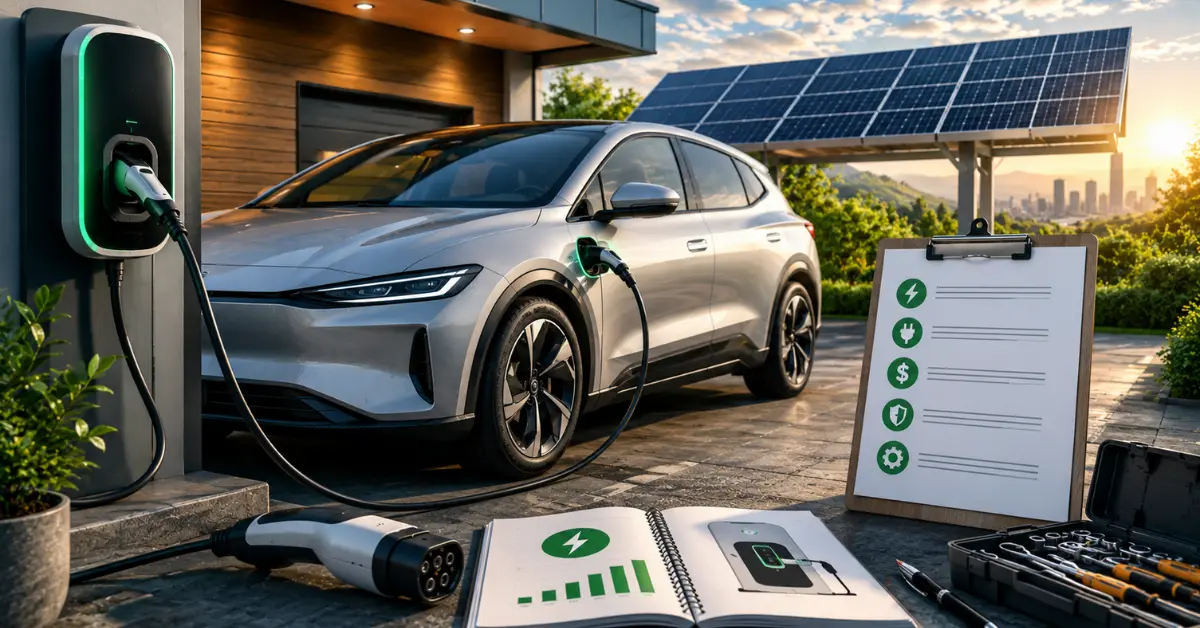
EV charging is the process of replenishing an electric vehicle’s battery by connecting it to a power source either a home outlet, a Level 2 wall charger, or a public DC fast charger. The method you choose determines how fast your car charges, how much it costs, and how long your battery lasts over time.
In short: home Level 2 charging is the most affordable and battery-friendly option for daily use, while DC fast charging is best reserved for road trips, since it’s faster but more expensive and puts more stress on the battery if used too often. Understanding this trade-off is the single most important thing to know before you plug in for the first time.
| Charging Type | Speed (Range Added) | Best For | Typical Cost |
|---|---|---|---|
| Level 1 (120V) | 3–5 miles/hour | Overnight top-ups | Lowest |
| Level 2 (240V) | 20–30 miles/hour | Daily home/work charging | Low-Moderate |
| DC Fast Charging | 100–250+ miles in 20-30 min | Road trips, quick top-ups | Highest |
Now let’s get into why charging behaves this way, and how to get the most out of every session.
Why EV Charging Speed Isn’t What You Expect
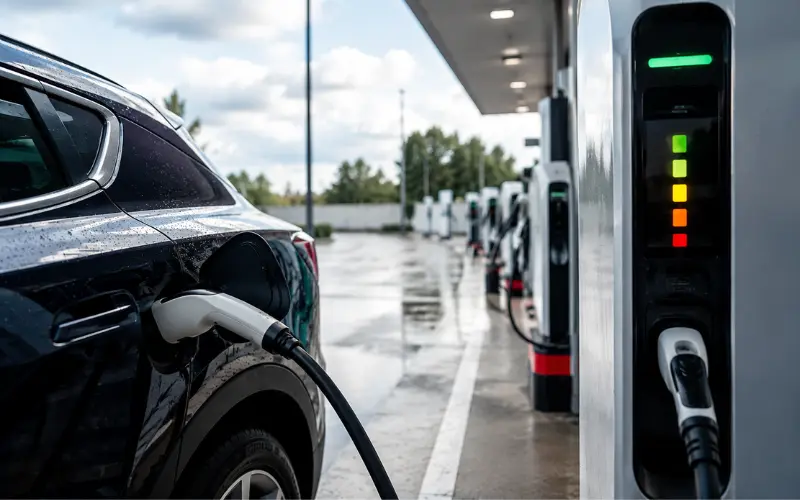
A lot of new EV owners assume charging works like filling a gas tank constant speed until full. It doesn’t. EV charging speed is controlled almost entirely by your car’s Battery Management System (BMS), not the charger itself.
Here’s what’s actually happening under the hood:
The battery negotiates, not the charger
When you plug in, your vehicle tells the charging station exactly how much voltage and current it’s willing to accept. A 350 kW charger won’t force more power into a car that can only take 100 kW.
Heat is the real bottleneck
Fast charging generates heat inside the battery cells. To protect long-term battery health, the BMS deliberately slows the charge rate as temperatures rise which is why charging crawls after about 80% capacity.
Cold weather slows things down too
Lithium-ion chemistry simply doesn’t move electrons efficiently below freezing, so charging speed and EV charging time both increase in winter.
This is why two people charging the same model EV charging session, at the same station, on different days, can see noticeably different speeds. It’s not a faulty charger it’s the battery protecting itself.
Step-by-Step: How to Charge an EV the Right Way
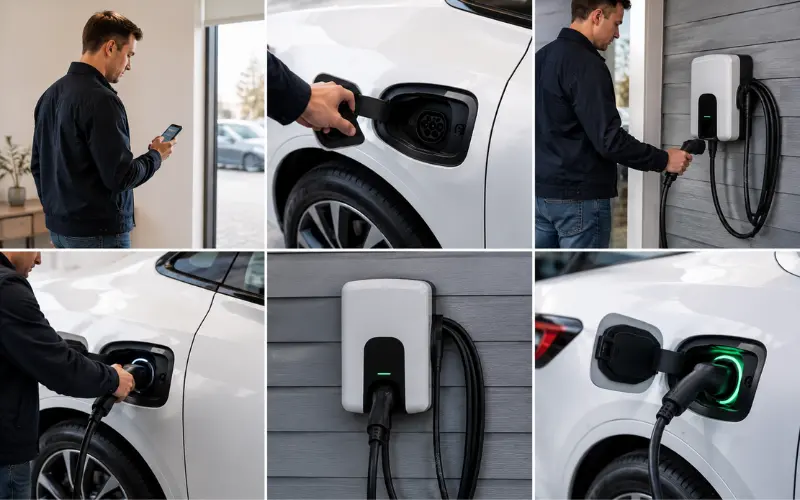
If you’re new to EV charging, follow this sequence every time to avoid common errors:
Check your state of charge first
Don’t wait until you’re near empty lithium-ion batteries last longer when kept roughly between 20% and 80%.
Plug in the connector fully
until you hear or feel the latch click. A loose connection is the most common reason charging won’t start.
Authenticate using the app, RFID card, or tap-to-pay
depending on the network.
Confirm the session has started
on your dashboard or the charger’s screen before walking away.
Unplug promptly once charging finishes
at busy public stations many networks now charge idle fees for cars left connected after the session ends.
- If you’re setting up home EV charging, the process looks slightly different:
- Install a NEMA 14-50 outlet or hardwired Level 2 unit in your garage/driveway
- Set charging schedule in your car’s app to align with off-peak electricity rates
- Charge overnight automatically wake up to a full battery
Alternative Charging Solutions Most Guides Skip
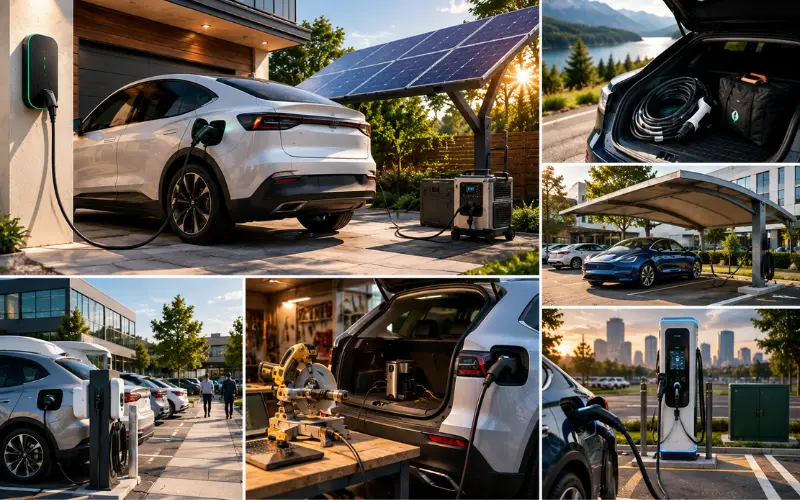
Most EV charging articles stop at “Level 1, Level 2, DC fast.” But there are a few overlooked options worth knowing about:
Destination charging at hotels and retail centers
Many EVs spend hours parked anyway, so Level 2 chargers at hotels, malls, and grocery stores often quietly add 20-40 miles for free or near-free while you do something else.
Bidirectional (V2G/V2H) charging
Some newer EVs and home setups allow the car’s battery to send power back into your house or the grid during outages essentially turning your EV charging setup into a backup power source.
Workplace charging programs
A growing number of employers install Level 2 chargers in parking lots, often at no cost, which can eliminate the need for home charging hardware entirely for some commuters.
Charging network roaming
If your primary network’s app shows “no chargers nearby,” check whether it has roaming partnerships many EV charging apps unlock access to competitor networks without a separate sign-up.
What Affects EV Charging Cost (And How to Lower It)
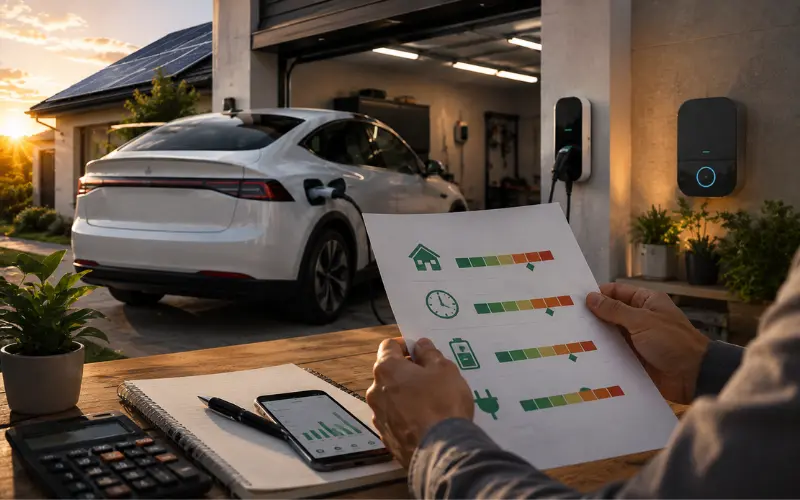
EV charging cost depends on three variables: your local electricity rate, the charging speed you choose, and the time of day you plug in. Public DC fast charging in the U.S. typically runs 30–60 cents per kWh, while home electricity averages 12-18 cents per kWh meaning home charging can cost roughly half as much per mile.
A practical way to cut costs further:
- Charge during off-peak utility hours (often 10 PM–6 AM) if your utility offers time-of-use rates.
- Use a charging network’s membership tier if you fast-charge often — most knock 10-20% off per-session pricing.
- Avoid topping up past 80% on fast chargers unless you need the range immediately; the last 20% takes disproportionately longer and costs more per minute on per-minute pricing plans.
Common EV Charging Mistakes That Shorten Battery Life
Even experienced drivers make these errors, and they quietly reduce battery lifespan over years of EV charging:
Charging to 100% every single night
Occasional full charges before long trips are fine, but daily 100% charges keep the battery at high voltage longer than necessary.
Letting the battery sit near 0% for days
This stresses the cells and, in extreme cases, can trigger irreversible capacity loss.
Relying exclusively on DC fast charging
It’s convenient, but frequent fast charging accelerates degradation compared to slower Level 2 charging.
Ignoring regional regulations
Some states (Colorado being a recent example) now require public charging stations to be registered and tested for billing accuracy a detail station hosts often overlook.
Frequently Asked Questions
1. How long does EV charging actually take?
It depends on charger type and battery size. Level 1 can take 20+ hours for a full charge, Level 2 takes roughly 4-10 hours, and DC fast charging typically reaches 80% in 20-40 minutes.
2. Is home EV charging cheaper than public charging?
Yes, in almost every case. Home electricity rates are usually half (or less) of what public DC fast charging networks charge per kWh.
3. Can I use any charger for any electric vehicle?
Not always. Connector types vary (CCS, NACS, CHAdeMO), so check compatibility or use an automaker-approved adapter third-party adapters aren’t recommended.
4. Does cold weather really affect EV charging speed?
Yes. Battery chemistry slows down in low temperatures, which can extend charging time by 20-30% or more in winter conditions.
5. What’s the difference between kW and kWh in EV charging?
kW measures the rate of power delivery (how fast you’re charging), while kWh measures total energy delivered (how much you’ve actually added to the battery).
6. Should I charge my EV every night?
You can, but charging to 80% rather than 100% on a daily basis is generally better for long-term battery health.
7. Why did my EV charging session stop early?
This usually happens due to a network connectivity issue, a payment authorization failure, or the vehicle reaching its temperature-based charging limit.
8. Are public EV charging stations regulated?
Increasingly, yes. Several states have introduced billing-accuracy and registration requirements for public charging equipment to protect consumers.
9. Can I install a home EV charger myself?
Level 1 charging needs no installation, but Level 2 home charging requires a licensed electrician due to the dedicated circuit and panel capacity needed.
10. What’s the safest way to fast charge an EV regularly?
Stick to 20-80% charging windows, avoid charging immediately after long highway drives when the battery is already hot, and use manufacturer-approved equipment only.
Final Thoughts
EV charging isn’t complicated once you understand that your car not the charger is calling the shots. Matching the right charging method to the right moment (Level 2 for daily routines, DC fast charging for road trips) is the simplest way to save money, save time, and protect your battery for the long haul. Get that balance right, and EV charging stops being a chore and becomes exactly what it should be: background noise in an otherwise normal day.