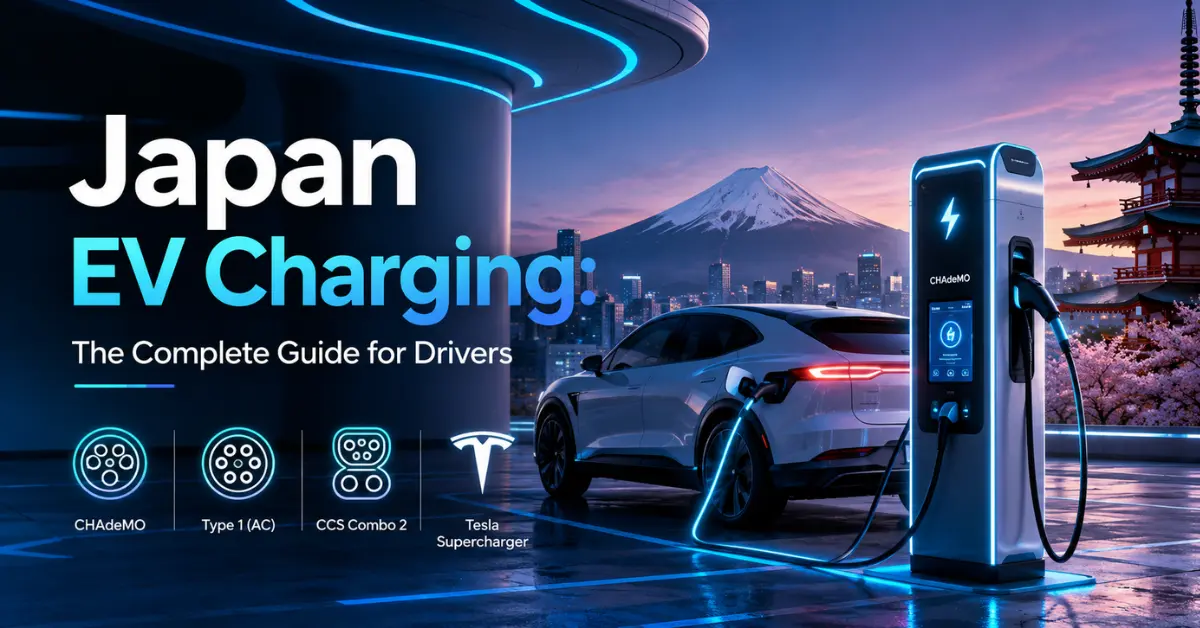
Japan invented fast EV charging. The CHAdeMO standard — developed in Tokyo by TEPCO alongside Nissan, Mitsubishi, Toyota, and Subaru — was the world’s first commercial DC fast-charging system, commissioned in 2009. For over a decade, Japan led the world in EV charging infrastructure density. That history shapes everything about Japan EV charging today: the standards in use, the networks operating, the apps you need, and the very real transition challenges the country is now navigating.
Whether you live in Japan, are visiting with a rental EV, or are researching the market professionally, this guide covers everything — the connector landscape, the major networks, practical charging tips by region, the honest infrastructure gaps, the costs, and the significant standard transition that is reshaping Japan’s EV future.
Understanding Japan’s EV Charging Connector Standards
Japan’s connector situation is more complex than most countries — and understanding it before you charge is essential.
CHAdeMO: The Dominant Fast-Charging Standard
CHAdeMO is Japan’s native DC fast-charging connector and remains the dominant rapid charging standard at public stations across the country. As of current reporting, Japan has approximately 8,200 public quick-charge points, the vast majority of which are CHAdeMO-compatible.
The name CHAdeMO comes from “CHArge de MOve” and a Japanese pun: “O cha demo ikaga desuka?” (How about a cup of tea?), a reference to the short break a driver takes during a fast charging session. The first commercial CHAdeMO infrastructure went live in 2009. The standard was developed by the CHAdeMO Association — formed by TEPCO, Nissan, Mitsubishi, Toyota, and Subaru — and represents Japan’s most significant contribution to global EV infrastructure.
Technical specifications:
- First-generation CHAdeMO: up to 62.5 kW (125A × 500V DC) — adds approximately 120 km of range in 30 minutes
- CHAdeMO 2.0: supports up to 400 kW
- New ultra-fast CHAdeMO: Japan updated regulations to enable 1,000V charging, with development of 350 kW chargers currently underway by e-Mobility Power and Takaoka Toko
Compatible vehicles:
- Nissan Leaf (all generations sold in Japan)
- Mitsubishi Outlander PHEV and Eclipse Cross PHEV
- Subaru Solterra (Japanese market)
- Toyota bZ4X (Japanese market)
- Older Kia models imported to Japan
The critical issue with CHAdeMO: Globally, the standard is declining. North American charging networks have largely stopped installing new CHAdeMO connectors. European charging infrastructure has adopted CCS2 as standard. Most new EV models outside Japan — including Nissan’s international lineup starting with the Ariya — have moved to CCS or NACS connectors. Japan’s domestic CHAdeMO infrastructure is extensive but increasingly isolated from the global EV ecosystem.
Type 1 (SAE J1772 / Japanese Variant)
The Type 1 connector is the Japanese and North American standard for AC Level 1 and Level 2 charging. It handles slower AC charging — overnight home charging, workplace charging, and destination charging at hotels and shopping centers. Every public charging station in Japan that offers regular (non-quick) charging uses Type 1.
Charging speed: 3 kW to 7 kW depending on power supply configuration.
Best for: Overnight home charging, workplace top-ups, destination charging at accommodation with 4–8+ hours dwell time.
Compatibility: All domestic Japanese EVs and PHEVs include a Type 1 port for AC charging alongside their CHAdeMO or CCS port for DC fast charging.
CCS Combo 2 (Combined Charging System): The Emerging International Standard
CCS Combo 2 — the European and internationally-aligned DC fast-charging standard — is slowly appearing at new Japanese public charging stations but remains sparse. Installations are being led by international brands: ANA installed a CCS-compatible charger at Tokyo Haneda Airport, and the Mercedes-Benz Charging Hub Chiba Park (launched with PowerX, opening 2025) uses high-power chargers supporting multiple standards.
Compatible vehicles:
- BMW, Hyundai, Kia, Volkswagen, Audi, Porsche — international models imported to Japan
- Tesla (via adapter in some configurations)
Network availability: Limited but growing. Finding a CCS Combo 2 charger in rural Japan is difficult. Urban areas — particularly Tokyo — have more options but coverage is inconsistent.
Tesla Supercharger Network in Japan
Tesla operates its own Supercharger network across Japan using NACS connectors. The network is now open to non-Tesla vehicles, though compatibility requires a CHAdeMO-to-NACS adapter or a NACS-equipped vehicle.
Tesla’s Supercharger network in Japan is particularly notable because it is the fastest, most reliable DC fast-charging option available in the country — outperforming most CHAdeMO infrastructure in both speed and uptime consistency. For NACS-equipped vehicles (primarily Teslas and newer imported models), Tesla’s Japan network provides the closest experience to the seamless charging that drivers in North America and Europe expect.
ChaoJI: The Next-Generation Standard in Development
ChaoJI is the most important development in Japan’s EV charging future — and the one most guides barely mention.
ChaoJI is a next-generation DC fast-charging connector jointly developed by CHAdeMO Association and China’s GB/T standardization body. It is designed as the successor to CHAdeMO — smaller, lighter, japan ev charging capable of higher power delivery, and explicitly designed to enable the kind of ultra-fast charging (350 kW+) that Japan’s current infrastructure cannot provide at scale.
Why ChaoJI matters:
- It represents Japan’s path to remaining relevant in global fast-charging standards
- Designed for backward compatibility with existing CHAdeMO infrastructure through adapters
- Supports vehicle-to-grid (V2G) bidirectional charging natively
- Co-developed with China positions Japan for stronger EV infrastructure ties with the world’s largest EV market
Current status: Active development, with formal commercialization expected as new stations are built. Japan’s regulatory update allowing 1,000V charging cleared the legal pathway for ChaoJI deployment. CHAdeMO is expected to remain operational at existing stations through at least 2030 as ChaoJI gradually replaces it in new installations.
Japan’s Public EV Charging Infrastructure: The Real Picture
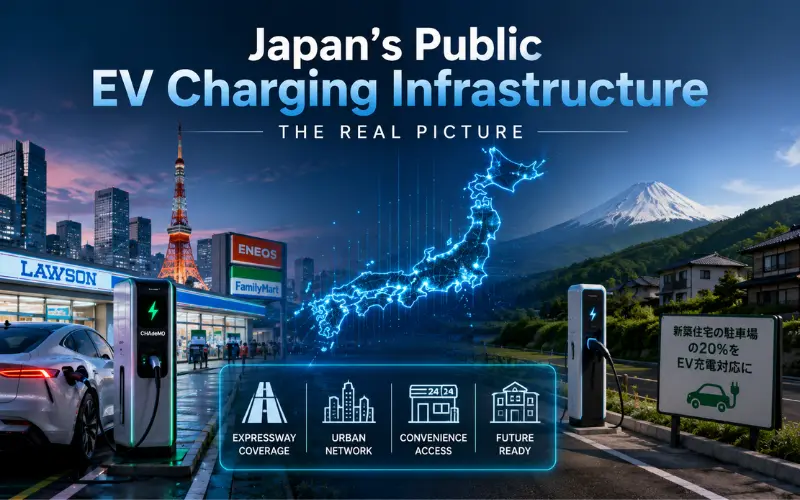
japan ev charging has approximately 30,000–31,600 public EV charging points nationwide, including approximately 8,200 quick-charge (DC fast) stations. These numbers sound impressive — and for a country Japan’s size, the density is genuinely significant. But the honest picture is more nuanced.
Where infrastructure is strong:
- Highway service areas (SA) and parking areas (PA) along expressways managed by NEXCO (Nippon Expressway Company Limited) — installations grew from 402 in 2020 to over 1,073 projected units, providing solid highway corridor coverage for long-distance travel
- Major urban centers — Tokyo, Osaka, Nagoya, Sapporo, Fukuoka — have reasonable public charging density
- Convenience stores — particularly those in the Lawson, FamilyMart, and ENEOS networks — frequently host CHAdeMO chargers, making them accessible during everyday errands
Where infrastructure is weak:
- Rural regions face significant gaps — the distribution of public charging is heavily skewed toward urban centers and highway corridors
- Academic research published in 2025 found that over 60% of roads in selected Tokyo metropolitan cities face charging insufficiency relative to demand, with 84.39% of prefectural roads in central Tokyo exceeding average insufficiency thresholds
- Multi-unit dwelling charging is a particular challenge — approximately 70% of Tokyo’s population lives in apartments, and private home charging installation in existing buildings requires approvals that are frequently slow or denied
Tokyo’s policy response: The Tokyo Metropolitan Government now mandates that all new residential buildings starting construction require 20% of parking spaces to be EV-charging capable. This addresses new construction but does not solve the installed base of apartment buildings without charging access.
Major Japan EV Charging Networks
e-Mobility Power (eMobility Power)
The largest charging network operator in Japan, managing the “EV Charging Infrastructure Network” with a target of 22,000 chargers connected through partnerships with over 1,650 companies and local governments. e-Mobility Power is a joint venture originally formed by Toyota and Nissan, japan ev charging reflecting the domestic automotive industry’s commitment to building national charging infrastructure. Their network covers commercial facilities, highway service areas, municipal locations, and public spaces across the country.
App: e-Mobility Power app (充電インフラサービス) — essential for locating and accessing their extensive station network.
Nippon Charge Service (NCS)
A collaboration between Nissan, Toyota, Honda, and Mitsubishi — four of Japan’s largest domestic automakers — NCS operates one of the broadest cooperative charging networks in the country. The network’s cooperative structure means compatibility across brand-specific vehicles, and the mobile app supports credit card payment and advance station location.
Japan Charge Network (JCN)
Japan ev charging Managed by Mitsubishi Corporation, JCN focuses on urban and expanding rural CHAdeMO and AC charging. Subscription-based membership options reduce per-session costs for frequent users.
ENEOS Charger Network
ENEOS — Japan’s largest energy company and petrol station operator — has invested significantly in adding EV charging to its extensive network of fuel stations across Japan. Particularly useful for drivers familiar with the ENEOS station network as their regular refueling locations.
Premium Charging Alliance (PCA)
A premium charging network operated by Porsche Japan and Audi Japan, offering high-speed charging (up to 180 kW at current installations) primarily targeting luxury import EV drivers. japan ev charging Less relevant for CHAdeMO-equipped domestic EVs but increasingly important for CCS-equipped imported vehicles.
Tesla Supercharger Japan
Tesla’s proprietary network — now open to non-Tesla vehicles with compatible connectors or adapters — provides the highest-reliability fast-charging experience in Japan. Ideal for Tesla owners and increasingly relevant for owners of newer NACS-equipped imports.
The Japan EV Charging App Ecosystem
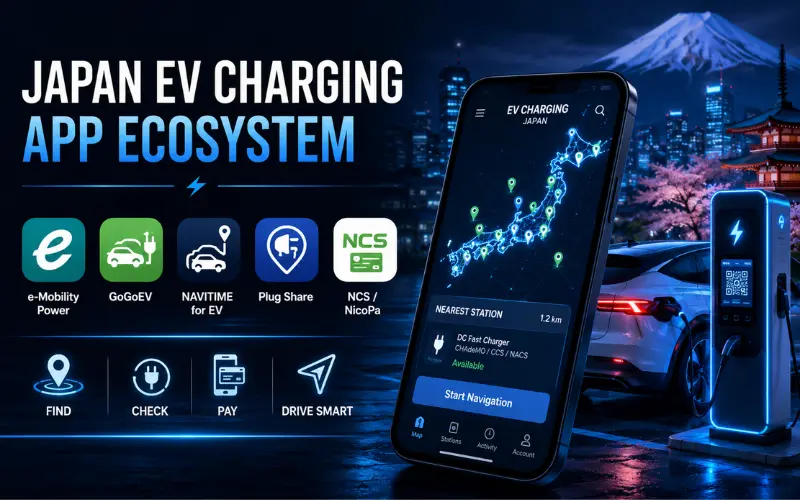
Finding and paying for Japan EV charging requires apps — this is not optional. Japan’s charging network is fragmented across multiple operators, and without the right apps installed, you will regularly find chargers you cannot access or pay for.
Essential apps for Japan EV charging:
e-Mobility Power app Covers the largest single network in Japan. Shows real-time availability, provides navigation to stations, japan ev charging and handles payment. Download before you need it — creating an account requires registration that is easier done at home than at a charging station.
GoGoEV (GoGoEV充電スポット) An aggregator app that maps charging stations across multiple networks. Particularly useful for finding the nearest available charger regardless of network operator. Shows station type, connector compatibility, and historical usage data.
Navitime for EV Japan’s Navitime navigation service offers an EV-specific version that plans routes with charging stops factored in, japan ev charging showing range and charging station locations simultaneously. Highly recommended for road trips.
Plug Share The international platform has reasonable Japan coverage and is particularly useful for locating Tesla Superchargers and CCS stations for drivers of imported vehicles.
NCS / NicoPa Card For Nippon Charge Service network access, a NicoPa membership card or the associated app reduces per-session fees and streamlines payment.
Payment reality check: Many Japanese public charging stations require either a network membership card or a specific app for payment. Credit card-only payment is not universal at Japanese charging stations — this catches many visitors off guard. Carry multiple payment options and download relevant apps before arriving at a station.
Japan EV Charging Costs
Japan EV charging costs vary significantly by network operator, charger type, and membership status.
Quick charging (DC fast / CHAdeMO):
- Without membership: ¥20–¥40 per minute, or ¥600–¥1,200 for a standard 30-minute session
- With network membership: Typically ¥10–¥25 per minute or reduced flat rates
- Highway expressway chargers: Often included in expressway service area fees or priced at a flat session rate
Regular charging (AC Type 1):
- Free at some shopping centers, hotels, and public facilities
- Paid: ¥200–¥500 per session or per-hour rates at commercial facilities
- Standard Japanese residential electricity rate: approximately ¥30–¥40 per kWh
- Off-peak rates with time-of-use plans: approximately ¥15–¥25 per kWh overnight
- Japan has not yet widely adopted EV-specific time-of-use electricity plans, though this is developing
Comparison with gasoline: At approximately ¥40 per kWh home charging rate, driving 100 km in a vehicle consuming 15 kWh costs approximately ¥600. The same journey in a 15km/L petrol vehicle at ¥170/L costs approximately ¥1,133 — making home EV charging roughly half the cost of petrol per kilometer in Japan.
Road Tripping Japan in an EV: Practical Advice
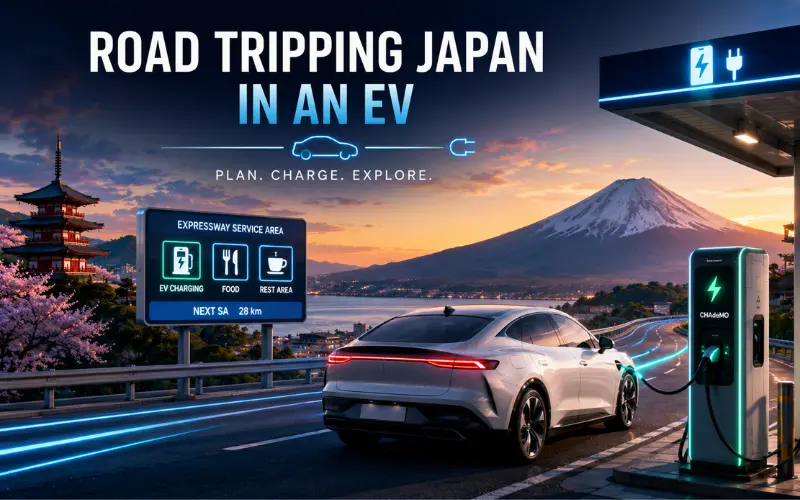
Japan’s expressway network is well-served by CHAdeMO quick chargers at service areas, and driving long distances in a CHAdeMO-equipped domestic EV is genuinely practical with proper planning.
Highway charging strategy: NEXCO expressway service areas now have over 1,000 EV charging installations across the highway network. For most domestic EVs on Japan’s major highway corridors (Tomei, Meishin, Sanyo, Tohoku expressways), charging stops every 150–200 km are feasible and comfortable.
Practical tips for EV road trips in Japan:
- Download Navitime EV before departure — plan your charging stops in advance rather than searching at the roadside
- Charge to 80% rather than 100% at fast chargers — the final 20% takes disproportionately long and is usually unnecessary between stops
- Understand that popular service areas have queues on holiday weekends — Golden Week, Obon, and New Year are the most congested periods; charging queue times of 20–40 minutes are reported at busy locations
- Rural mountain areas and the San-in coast have the most significant coverage gaps — research specific charging availability carefully before driving these regions
- Carry the e-Mobility Power app, GoGoEV, and your network membership cards before you leave home
For drivers of imported CCS vehicles: Rural road trips in CCS-only vehicles are genuinely difficult in japan ev charging. CCS infrastructure outside major urban areas is sparse, and stretches between CCS-compatible chargers on some routes can exceed 100 km. Plan with extreme care and consider whether a road trip destination is accessible before committing.
Charging PHEVs in Japan
Japan has more plug-in hybrid electric vehicles (PHEVs) than most markets — the Mitsubishi Outlander PHEV and Eclipse Cross PHEV are among the best-selling electrified vehicles in the country, and Toyota’s PHEV range is extensive.
PHEVs in Japan can use either:
- CHAdeMO DC fast charging (Mitsubishi PHEVs specifically — one of the only PHEVs globally with DC fast charging capability)
- Type 1 AC charging at regular charging points
- Petrol when charging is unavailable
The PHEV advantage in Japan’s current infrastructure environment is significant — range anxiety is simply not a factor, and the extensive regular AC charging network at shopping centers, hotels, and parking facilities provides ample opportunity to supplement the electric range without the urgency that pure BEV drivers face.
The CHAdeMO Transition: What It Means for Japan EV Owners
Japan’s EV charging future is at a genuine inflection point — and understanding the transition is important for anyone making a long-term decision about EV ownership in Japan.
The challenge: CHAdeMO, despite being Japan’s standard, is being abandoned globally. Nissan’s international models have moved to CCS and NACS. European charging infrastructure mandates CCS2. North American networks have stopped adding CHAdeMO connectors. The global EV market is standardizing around NACS and CCS — leaving Japan’s domestic CHAdeMO infrastructure increasingly isolated.
Japan’s response: Rather than adopting an external standard, Japan is co-developing ChaoJI with China as a next-generation evolution of CHAdeMO. This preserves some continuity with existing infrastructure investment while providing a path to higher-power charging and global alignment with China’s large EV market.
The honest practical implication for buyers:
- If you buy a domestic Japanese EV (Nissan Leaf, Mitsubishi PHEV, Toyota bZ4X Japanese spec) today, CHAdeMO will serve you well domestically for the foreseeable future — the installed base is too large to disappear quickly
- If you import a CCS-equipped EV from Europe or own a newer international model, infrastructure limitations are a real daily consideration in much of Japan
- Tesla owners in Japan have access to the best fast-charging network available — the Supercharger network’s reliability advantage over much of the public CHAdeMO infrastructure is significant
Frequently Asked Questions
What connector do I need to charge an EV in Japan?
It depends on your vehicle. Domestic Japanese EVs (Nissan Leaf, Mitsubishi PHEVs, Toyota BEVs) use CHAdeMO for DC fast charging and Type 1 (SAE J1772 variant) for AC charging — both widely available. Imported European EVs typically use CCS Combo 2, which is available but sparse in Japan. Tesla vehicles use NACS connectors compatible with Japan’s Supercharger network. Confirm your vehicle’s connector type before planning charging in Japan.
How many public EV charging stations are there in Japan?
Japan has approximately 30,000–31,600 public EV charging points nationwide, including around 8,200 DC quick-charge stations. This gives Japan one of the highest public charging densities globally, though distribution is uneven — urban areas and expressway corridors are well-served while rural regions face significant gaps.
What apps do I need for EV charging in Japan?
Essential apps include e-Mobility Power (largest single network), GoGoEV (multi-network aggregator for finding stations), and Navitime for EV (route planning with charging stops). For Tesla drivers, the Tesla app covers Supercharger access. Many Japanese charging stations also require network membership cards — the NicoPa card for NCS network access is commonly needed. Download and register for all apps before arriving at a charging station.
How much does EV charging cost in Japan?
Quick charging without membership typically costs ¥20–¥40 per minute, with a standard 30-minute fast-charge session running ¥600–¥1,200. Network members pay lower rates, typically ¥10–¥25 per minute. Regular AC charging at commercial facilities costs ¥200–¥500 per session or is free at some shopping centers and hotels. Home charging costs approximately ¥30–¥40 per kWh at standard residential rates.
What is CHAdeMO and is it being phased out?
CHAdeMO is Japan’s domestic DC fast-charging standard, developed by TEPCO, Nissan, Mitsubishi, Toyota, and Subaru in 2009. It remains dominant in Japan with approximately 8,200 quick-charge stations but is declining globally — North American networks have stopped installing new CHAdeMO connectors, and European standards mandate CCS2. In Japan, CHAdeMO is expected to remain operational through at least 2030 while being gradually succeeded by ChaoJI, a next-generation standard co-developed with China.
Can I drive long distances in Japan with an EV?
Yes, particularly on Japan’s expressway network. NEXCO expressway service areas now have over 1,000 EV charging installations along major highway corridors, making long-distance travel in CHAdeMO-equipped domestic EVs genuinely practical with proper planning. Use Navitime EV to plan charging stops. Rural areas and less-traveled routes require more careful planning — coverage gaps exist, particularly on mountain routes and the Japan Sea coast.
Does Tesla have Superchargers in Japan?
Yes. Tesla operates a Supercharger network across Japan that is now open to non-Tesla vehicles with compatible connectors or adapters. Tesla’s network is considered the most reliable fast-charging option in Japan, offering better uptime and faster charging speeds than much of the public CHAdeMO infrastructure. For Tesla owners living in or visiting Japan, the Supercharger network significantly simplifies the charging experience.
Final Thoughts
Japan’s EV charging situation is genuinely fascinating — a country that invented the fast-charging industry now navigating the most significant technology transition in its EV infrastructure history. The CHAdeMO network is extensive, historically impressive, and increasingly facing global isolation. The transition to ChaoJI is underway but will take years. The infrastructure gaps in apartments and rural areas are real and acknowledged. And yet — for domestic EV and PHEV owners driving Japanese-market vehicles on Japan’s well-served expressway network — the practical charging experience is quite functional.
Understanding the landscape before you drive, download the right apps before you need them, carry your network membership cards, and plan rural routes with genuine care. Japan EV charging rewards preparation more than almost any other market — and with preparation, it works.