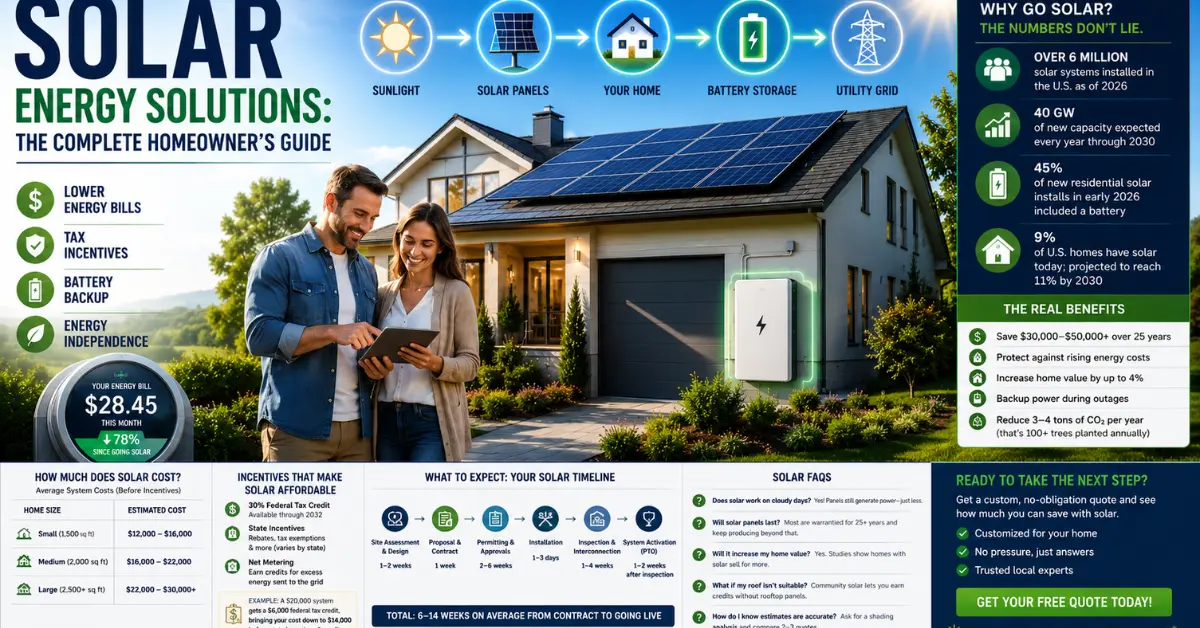
Thinking about going solar but not sure where to start? You’re not alone. Millions of homeowners are making the switch to solar energy solutions every year — and for good reason. Lower electricity bills, energy independence, and a smaller carbon footprint are just the beginning.
This guide gives you everything your competitors’ articles leave out: real numbers, honest timelines, financing options, and the questions you should be asking before you sign anything.
What Are Solar Energy Solutions — and How Do They Work?
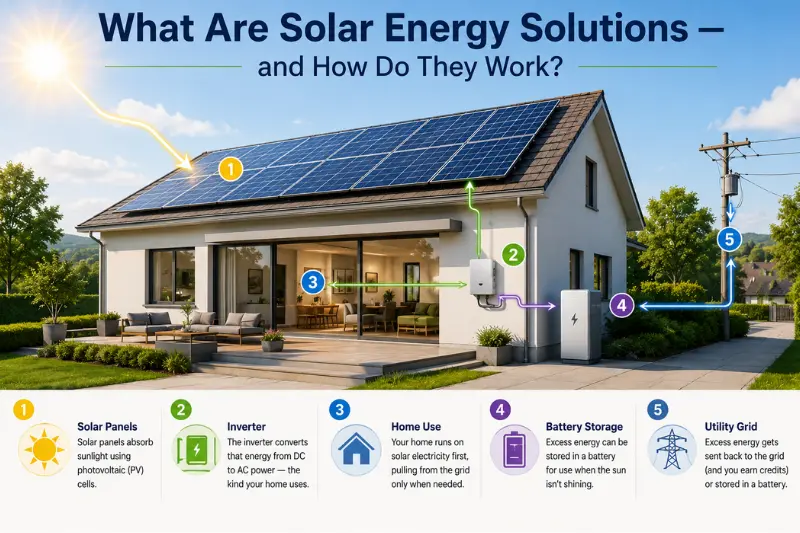
Solar energy solutions refer to systems that capture sunlight and convert it into usable electricity for your home or business. The most common setup includes solar panels, an inverter, a monitoring system, and optionally a battery for energy storage.
Here’s how the process works in simple terms:
- Solar panels absorb sunlight using photovoltaic (PV) cells
- The inverter converts that energy from DC to AC power — the kind your home uses
- Your home runs on solar electricity first, pulling from the grid only when needed
- Excess energy gets sent back to the grid (and you earn credits) or stored in a battery
| Quick Fact: In 2025, a new solar project was installed every 59 seconds in the United States. Solar and storage combined to provide 79% of all new energy capacity added to the U.S. grid. |
Why Go Solar? The Numbers That Matter
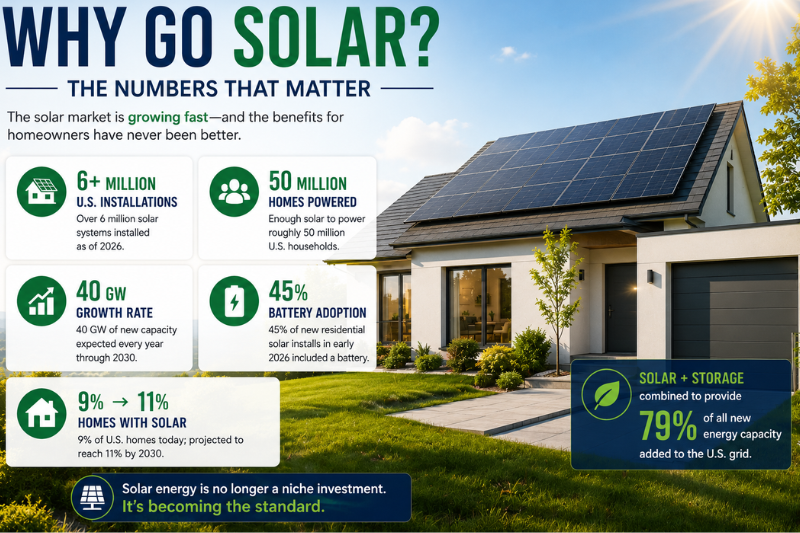
The solar market has never been more accessible. Here’s what the data says:
| Stat | Detail |
| U.S. Installations | Over 6 million solar systems installed as of 2026 |
| Homes Powered | Enough solar to power roughly 50 million U.S. households |
| Growth Rate | 40 GW of new capacity expected every year through 2030 |
| Battery Adoption | 45% of new residential solar installs in early 2026 included a battery |
| Homes with Solar | 9% of U.S. homes today; projected to reach 11% by 2030 |
These numbers tell a clear story: solar energy is no longer a niche investment. It’s becoming the standard.
The Real Benefits of Solar Energy Solutions
1. Significant Savings on Electricity Bills
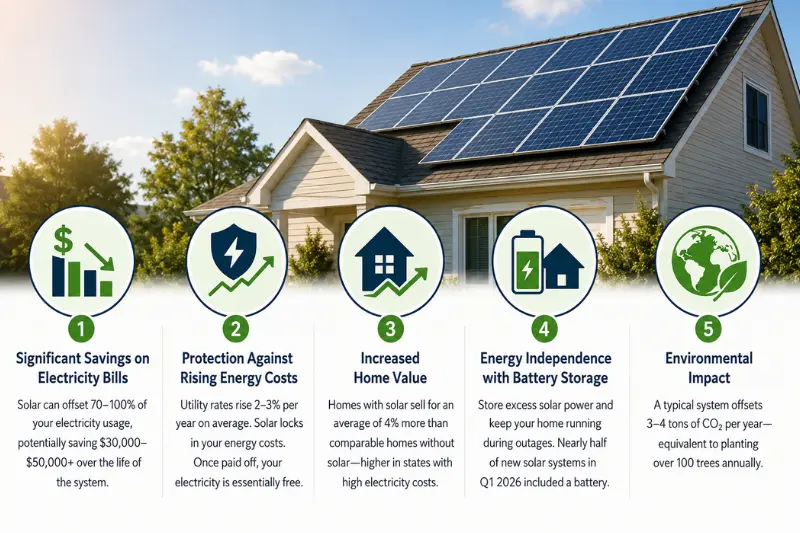
The average American household spends over $1,500 per year on electricity. A properly designed solar energy system can offset 70–100% of that usage, depending on your roof, location, and energy consumption. Over a 25-year system life, the savings can easily exceed $30,000–$50,000.
What competitors don’t tell you: savings depend heavily on system design. A poorly shaded analysis or undersized system can dramatically reduce your ROI. Always ask your installer for a site-specific production estimate.
2. Protection Against Rising Energy Costs
Utility rates have risen an average of 2–3% per year over the last decade. Solar locks in your energy costs. Once your system is paid off, your electricity is essentially free.
3. Increased Home Value
Studies from Zillow and Lawrence Berkeley National Laboratory show that homes with solar panels sell for an average of 4% more than comparable homes without them. In high-electricity-cost states, that premium can be even higher.
4. Energy Independence with Battery Storage
Pairing solar panels with a home battery (like a Tesla Powerwall or similar system) means you can keep the lights on even during grid outages. In the first quarter of 2026, nearly half of all new residential solar installations included a battery — a clear signal of where the market is heading.
5. Environmental Impact
A typical residential solar system offsets roughly 3–4 tons of carbon dioxide per year — the equivalent of planting over 100 trees annually. Over the life of the system, that’s a meaningful contribution to reducing your carbon footprint.
What Most Solar Companies Don’t Tell You (But You Need to Know)
After analyzing the most common competitor articles and sales pages, here are the gaps that matter most to homeowners:
Your roof condition matters before anything else
Before investing in solar, have your roof inspected. If it needs replacement within 5–10 years, do it before installing panels. Removing and reinstalling panels adds $1,500–$3,000 to the cost.
Not all inverters are equal
String inverters are cheaper but lose efficiency if even one panel is shaded. Microinverters or power optimizers cost more upfront but maximize output panel by panel. Ask your installer which type they use and why.
Permits and timelines vary widely
The average solar installation takes 1–3 months from contract to flip-the-switch. Most of that time is permits and utility interconnection — not the installation itself (which takes 1–3 days). Plan accordingly.
Production guarantees are rare — and valuable
Most installers only offer manufacturer warranties. A production guarantee means the company stands behind the actual electricity output of your system. If it underperforms, they make it right. This is a key question to ask every quote.
Lease vs. buy changes everything
Leasing solar can get you started with $0 down, but you won’t own the panels, won’t qualify for the federal tax credit, and may face complications when selling your home. Buying — whether outright or through a solar loan — almost always delivers better long-term value.
How Much Do Solar Energy Solutions Cost — and What Incentives Are Available?
Average System Costs
| Home Size | Estimated System Cost (Before Incentives) |
| Small (1,500 sq ft) | $12,000 – $16,000 |
| Medium (2,000 sq ft) | $16,000 – $22,000 |
| Large (2,500+ sq ft) | $22,000 – $30,000+ |
Federal & State Incentives
- Federal Solar Tax Credit (ITC): Deduct 30% of your total system cost from your federal taxes — available through 2032
- State incentives: Many states offer additional rebates, property tax exemptions, or sales tax waivers on solar equipment
- Net metering: Most utilities allow you to sell excess electricity back to the grid, further reducing your bill
- Local utility programs: Some utilities offer additional rebates or interest-free loan programs
| Example: A $20,000 system qualifies for a $6,000 federal tax credit, bringing your net cost to $14,000 — before any state incentives or net metering credits. |
How to Choose the Right Solar Energy Solution for Your Home
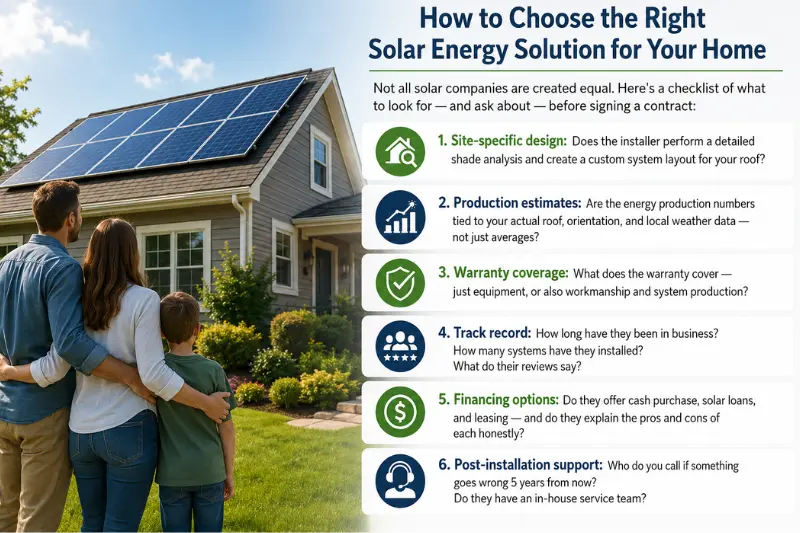
Not all solar companies are created equal. Here’s a checklist of what to look for — and ask about — before signing a contract:
- Site-specific design: Does the installer perform a detailed shade analysis and create a custom system layout for your roof?
- Production estimates: Are the energy production numbers tied to your actual roof, orientation, and local weather data — not just averages?
- Warranty coverage: What does the warranty cover — just equipment, or also workmanship and system production?
- Track record: How long have they been in business? How many systems have they installed? What do their reviews say?
- Financing options: Do they offer cash purchase, solar loans, and leasing — and do they explain the pros and cons of each honestly?
- Post-installation support: Who do you call if something goes wrong 5 years from now? Do they have an in-house service team?
Should You Add Battery Storage to Your Solar System?
Battery storage is the fastest-growing segment of the residential solar market. Nearly 1 in 2 new solar installations now includes a battery — and for good reason.
A home battery lets you:
- Store excess solar energy generated during the day for use at night
- Keep essential appliances running during power outages
- Reduce reliance on the grid during peak-rate hours (time-of-use billing)
- Maximize the value of your solar investment over time
The most common home battery options include the Tesla Powerwall, Enphase IQ Battery, and SunPower SunVault. Capacity typically ranges from 10–27 kWh, with prices from $8,000–$15,000 installed (before incentives — batteries also qualify for the 30% federal tax credit).
What to Expect: Your Solar Installation Timeline
| Stage | Typical Timeframe |
| Site assessment & design | 1–2 weeks |
| Proposal & contract signing | 1 week |
| Permitting & HOA approval | 2–6 weeks |
| Physical installation | 1–3 days |
| Utility inspection & interconnection | 1–4 weeks |
| System activation (PTO) | 1–2 weeks after inspection |
| Total (contract to live) | 6–14 weeks on average |
Frequently Asked Questions About Solar Energy Solutions
Does solar work on cloudy days?
Yes. Solar panels still generate electricity on overcast days — just at reduced output (typically 10–25% of peak production). Germany, one of the world’s top solar markets, has less sunlight than most of the U.S.
What happens to my solar panels after 25 years?
Most panels are warrantied for 25 years but continue producing electricity well beyond that — typically at 80–85% of original capacity. Many manufacturers are now offering 30-year performance warranties.
Will solar hurt my home’s resale value?
Studies consistently show the opposite — owned solar panels increase home resale value. Leased systems can complicate sales, which is another reason to consider buying.
What if my roof isn’t suitable for solar?
Community solar programs allow you to subscribe to a shared solar array and receive credits on your electricity bill — no rooftop installation required. This is a growing option in many states.
How do I know if my installer is giving me accurate estimates?
Ask for a shading analysis report (tools like Aurora Solar or HelioScope are industry standard), and compare production estimates across at least 2–3 installers. Be wary of estimates that seem unusually high.
The Bottom Line: Solar Energy Solutions Are a Smart Investment — When Done Right
Solar energy has never been more affordable, more efficient, or more supported by policy incentives. But like any major home investment, the outcome depends almost entirely on the quality of your installer and the design of your system.
The homeowners who get the best results are the ones who do their research, ask the right questions, and choose a partner — not just a price.
Use this guide as your starting point. Get multiple quotes, demand site-specific production estimates, and make sure your warranty covers more than just the hardware.