Solar electric systems have moved from a niche investment to a mainstream choice for homeowners looking to cut costs and rely on cleaner energy. With panel prices dropping and efficiency improving year after year, going solar in this year is more accessible and affordable than ever before. Whether you’re motivated by rising utility bills, environmental concerns, or simply wanting more control over your energy future, understanding how these systems work is the first step toward making an informed decision.
At its core, a solar electric system converts sunlight into usable electricity for your home, reducing or even eliminating your dependence on the grid. But behind that simple concept lies a range of components, technologies, and choices, from panel types and inverters to battery storage and net metering, that can feel overwhelming to a first-time buyer. This guide breaks down each piece in plain English, so you can understand exactly what you’re investing in and why it matters.
By the end of this guide, you’ll have a clear picture of how solar panels work, what installation involves, the real costs and savings you can expect, and how to choose the right system for your home’s needs. Whether you’re just starting to explore your options or ready to get quotes from installers, this complete guide will give you the confidence to move forward with your solar journey
You flip on a light switch, your refrigerator hums, your phone charges overnight — and all of it runs on electricity you never have to think about. But what if that electricity came from your own roof, cost you almost nothing after year one, and added real value to your home? That is exactly what solar electric technology delivers, and in this year, it has never been more accessible, more affordable, or more powerful.
This guide explains everything you need to know about solar electric systems — from how a single photovoltaic cell works all the way to the tax credits waiting in your mailbox.
What Is Solar Electric Energy?
Solar electric energy, also called photovoltaic (PV) energy, is electricity generated directly from sunlight. When sunlight strikes a solar cell, it knocks electrons loose and sends them flowing through a circuit — producing a clean, direct electrical current. Group those cells into a panel, connect several panels into an array, and you have a solar electric system capable of powering an entire home or business.
This technology is not new. The photovoltaic effect was first discovered in 1839, and Bell Labs commercialized the first practical solar cell in the 1950s. What has changed dramatically is the cost: solar electric power is now the cheapest source of electricity in history, making it a smart financial decision rather than a lifestyle sacrifice.
How a Solar Electric System Works — Step by Step
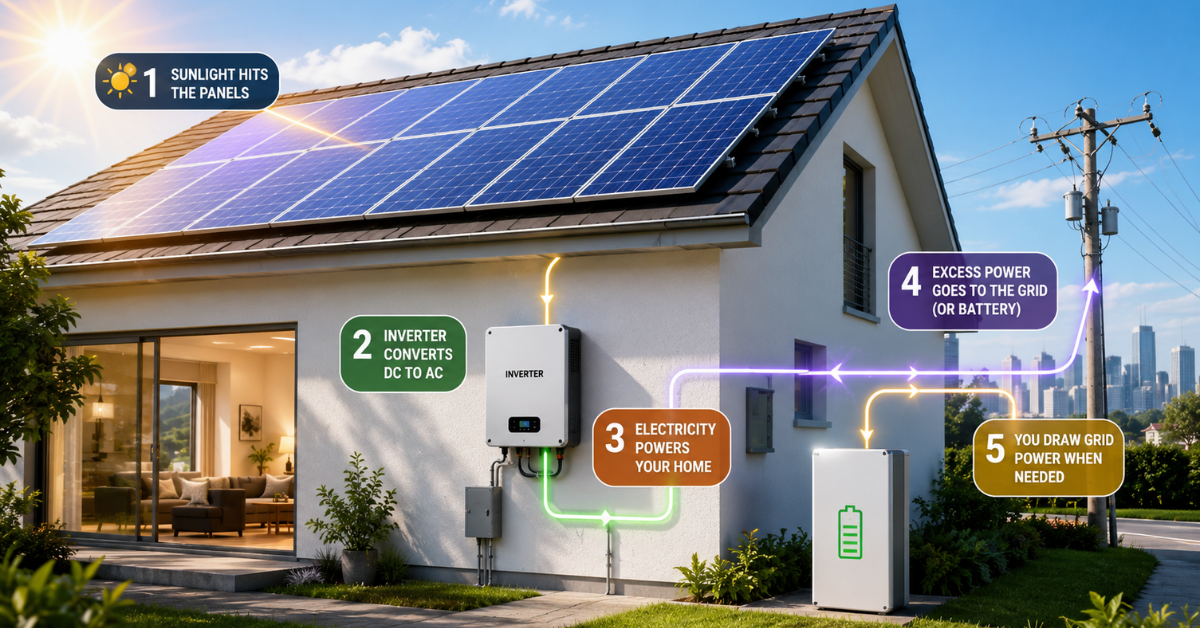
Understanding your solar electric setup takes about two minutes. Here is the simple flow of energy from roof to outlet:
Step 1 — Sunlight hits the solar panels.
PV cells inside the panels absorb photons from sunlight and convert them into direct current (DC) electricity.
Step 2 — The inverter converts the current.
Your home runs on alternating current (AC). An inverter transforms the DC power from your panels into the AC power your appliances use.
Step 3 — Electricity powers your home.
That AC power flows to your breaker box and then to every light, appliance, and device in the house — just like utility electricity.
Step 4 — Excess power goes to the grid (or your battery).
If your panels produce more than you need, the extra power either feeds back into the utility grid (earning you credits through net metering) or charges a home battery system for use at night.
Step 5 — You draw grid power when needed
At night or on cloudy days, you pull electricity from the grid at offset prices — or from your battery if you have one installed.
Types of Solar Electric Systems
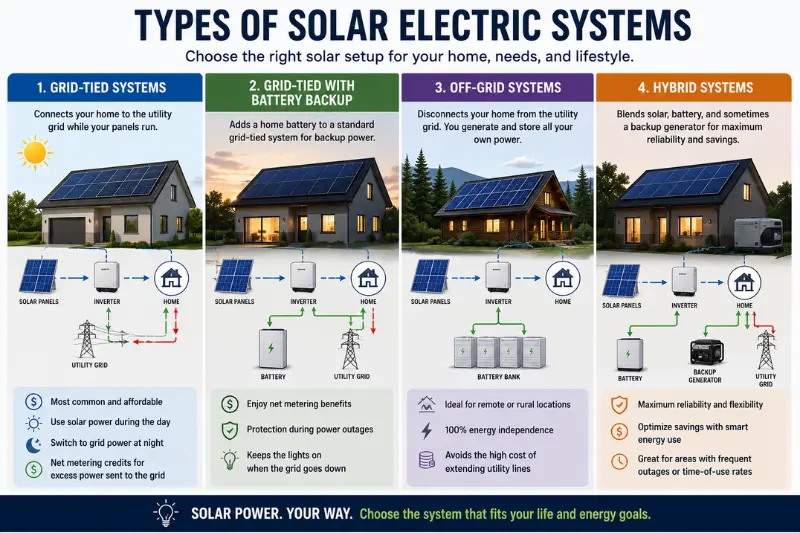
Not all solar electric setups are the same. Choose the right type for your situation:
Grid-Tied Systems
connect your home to the utility grid while your panels run. This is the most common and most affordable setup. You benefit from solar electric power during the day and seamlessly switch to grid power at night. Net metering programs let the utility credit you for every kilowatt-hour you send back.
Grid-Tied With Battery Backup
adds a home battery (like a Tesla Powerwall or similar unit) to a standard grid-tied system. You get the financial benefits of net metering plus protection during power outages. This system keeps the lights on even when the grid goes down.
Off-Grid Systems
disconnect your home from the utility entirely. You generate and store all your own solar electric power. This setup makes the most sense for rural properties far from utility lines, where running new power infrastructure would cost tens of thousands of dollars.
Hybrid Systems
blend solar, battery, and sometimes a backup generator to maximize reliability and savings. These are ideal for areas with frequent outages or time-of-use electricity rates.
The Three Main Types of Solar Panels
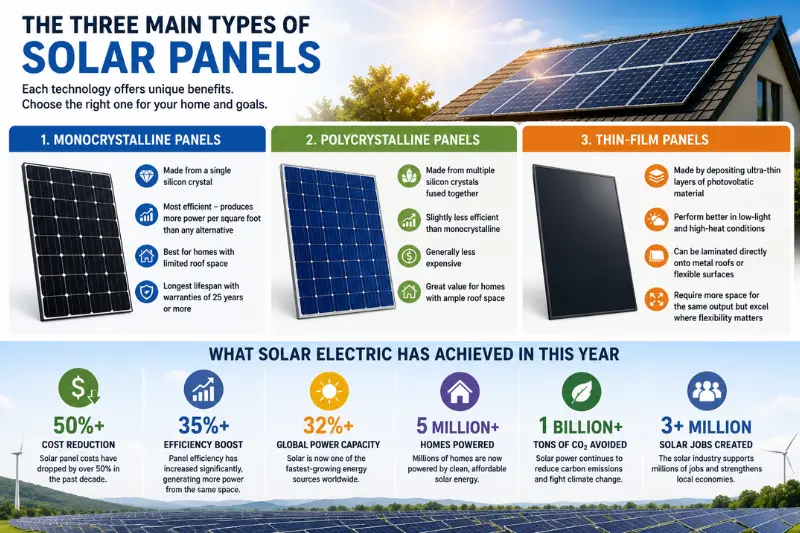
When you shop for a solar electric system, you will encounter three panel technologies. Each has real advantages:
Monocrystalline Panels
are made from a single silicon crystal. They are the most efficient panels on the market — a monocrystalline panel produces more power per square foot than any alternative. If roof space is limited, this is your best choice. They also tend to last the longest, with warranties of 25 years or more.
Polycrystalline Panels
are made from multiple silicon crystals fused together. They are slightly less efficient than monocrystalline but are generally less expensive, making them a solid value for homeowners with ample roof space.
Thin-Film Panels
are made by depositing ultra-thin layers of photovoltaic material onto glass, metal, or flexible plastic. They perform better in low-light and high-heat conditions and can be laminated directly onto metal roofs. They require more space for the same output but shine in applications where flexibility matters.
What Solar Electric Has Achieved in this year
Here is a fact that deserves a moment of attention: in this year, solar electric generation surpassed coal in the U.S. electricity mix for the very first time in history. Solar supplied 12.8% of all U.S. electricity that month, while coal fell to 12.2%. That same month, solar hit a record 45.5 terawatt-hours of generation — up 17% from the previous year.
Solar is now the third-largest individual source of electricity in the United States, behind only natural gas and nuclear. And it is the fastest-growing. From a 5.4% share of U.S. electricity in May 2021 to 12.8% in this year — that is a remarkable rise in just five years.
For homeowners, this momentum matters. It means solar technology continues to improve, installers are abundant and competitive, and the grid is growing friendlier to distributed solar electric generation every year.
What Competitors Do Not Tell You: The Details That Actually Matter
Most solar electric articles cover the basics. Here is what they leave out:
Panel orientation is more nuanced than “face south.”
While south-facing arrays maximize annual production in the Northern Hemisphere, a southwest orientation can be smarter if your utility charges higher rates in the late afternoon. Matching your panel direction to your utility’s time-of-use pricing can increase your savings without adding a single panel.
Microinverters vs. string inverters change everything about shading.
With a traditional string inverter, one shaded panel drags down your entire system’s output. Microinverters — small inverters mounted behind each individual panel — eliminate this problem. Each panel performs independently, so a shadow from a chimney or tree limb hurts only that one panel. You also get real-time monitoring of each panel’s performance from your phone.
Your inverter needs to match your future plans, not just today’s system.
If you might add panels later or install a battery, buy a slightly oversized inverter now. The labor cost of returning to resize it will far exceed the small upfront difference.
Battery storage pairs perfectly with solar electric at a price that makes sense.
Home battery costs have fallen roughly 90% over the past decade. A battery system not only protects you during outages — it lets you store cheap solar electric energy and use it during peak-rate evening hours when grid electricity is most expensive.
Your roof structure matters before you sign anything.
A reputable solar electric installer evaluates your roof’s load-bearing capacity before installation. Elevated racking adds wind uplift forces that older roofs may not be designed to handle. If your roof is over 15 years old, address any needed repairs before going solar — it is much easier and cheaper before panels are installed.
Solar electric adds measurable resale value to your home.
Studies consistently show that homes with owned solar electric systems sell faster and at a premium — often $15,000 to $25,000 higher — compared to similar homes without solar. Leased systems, however, can complicate a home sale, since the lease must be transferred to the buyer.
How to Size Your Solar Electric System
Getting the right size system saves you money and prevents undershooting or overshooting your needs. Here is a simple framework:
- Find your average monthly electricity usage in kilowatt-hours (kWh). It is on your utility bill.
- Divide by 30 to get your average daily usage.
- Divide by the average peak sun hours in your area (typically 4 to 6 hours per day in the U.S.).
- That number is roughly your required system size in kilowatts (kW).
Example: If you use 900 kWh per month, that is 30 kWh per day. In a region with 5 peak sun hours, you need a 6 kW solar electric system to offset your full bill.
A quality installer will run a full analysis using your actual bills, your roof’s orientation and shading profile, and local climate data to give you a precise recommendation.
Solar Electric Financing: How to Pay for Your System
Going solar does not always require a large upfront payment. You have real options:
Cash Purchase
gives you the highest lifetime savings and full ownership of your system from day one. You claim the full federal investment tax credit (ITC) and any state incentives yourself. Most homeowners recover their investment in 6 to 10 years.
Solar Loan
lets you finance the full cost with no money down in most cases. Your monthly loan payment is typically lower than your previous electric bill, so you save money from day one. Once the loan is paid off, your solar electric power is essentially free.
Solar Lease
means a solar company owns the panels on your roof and charges you a monthly fee lower than your utility rate. You get predictable energy costs with no maintenance responsibility. The downside: the solar company claims the tax credits, not you, and owned systems are easier to sell with.
Power Purchase Agreement (PPA)
is similar to a lease, but instead of a fixed monthly payment, you pay a set rate per kilowatt-hour for the power the system produces. PPAs work well for commercial properties and large-scale solar users.
PACE Financing (Property Assessed Clean Energy)
attaches the loan to your property rather than your personal credit. Repayment happens through your property tax bill over a period of up to 20 years. Approval is typically fast and does not depend on your credit score.
Federal and State Solar Electric Incentives
The financial case for solar electric is significantly boosted by available tax incentives:
Federal Investment Tax Credit (ITC):
This credit lets you deduct a significant percentage of your solar electric system’s cost directly from your federal taxes. Check the current ITC rate with a tax professional or the IRS, as rates are subject to scheduled changes.
Net Metering:
Most U.S. states require utilities to credit you for excess solar electric power you send to the grid. In many states, this credit applies at the full retail electricity rate — meaning your meter effectively runs backward when you produce more than you use.
State and Local Incentives:
Many states offer additional tax credits, rebates, or exemptions — including property tax exemptions (so your home’s increased value from solar does not raise your tax bill) and sales tax exemptions on solar equipment. Check your state’s energy office website for current programs.
Solar Electric Maintenance: Easier Than You Think
Solar electric systems are among the lowest-maintenance home improvements you can make. Here is what ownership actually looks like:
Panels
Rinse with a garden hose two to four times per year to remove dust, pollen, and debris. Rain handles most of this naturally.
Inverter
Mount it in a cool, shaded location and check the monitoring system periodically. String inverters typically last 10 to 15 years. Microinverters often carry 25-year warranties.
Monitoring
Most modern solar electric systems include app-based monitoring that shows real-time production, alerts you to underperforming panels, and tracks your lifetime energy and savings.
Warranty
Quality solar panels carry 25-year performance warranties guaranteeing they will produce at least 80% of their rated output for a quarter century.
Is Solar Electric Right for Your Home?
Solar electric works well for most homes, but a few factors determine how quickly you will see returns:
Your solar electric system will perform at its best if your home has good south, southeast, or southwest roof exposure, minimal shading from trees or neighboring buildings, a roof in good condition with at least 15 years of life remaining, and electricity costs of $0.10 per kWh or higher (the higher your current bill, the faster your payback).
Even if your roof is not ideal, ground-mounted arrays or community solar programs let you access solar electric benefits without needing a perfect rooftop.
Frequently Asked Questions About Solar Electric
How long does a solar electric system last?
Most solar panels are rated for 25 to 30 years and continue producing electricity well beyond that — just at slightly reduced efficiency. Many systems installed in the 1990s are still generating power today. The panels themselves have no moving parts, which makes them exceptionally durable.
Does solar electric work on cloudy days?
Yes. Solar electric panels generate power from daylight, not direct sunshine. Output drops on heavy overcast days — typically to 10 to 25% of their sunny-day capacity — but the system continues working. Countries like Germany with famously cloudy weather are among the world leaders in solar electric adoption.
Will solar electric panels power my home during a blackout?
A standard grid-tied solar electric system shuts off during a grid outage for safety reasons — to protect utility workers repairing the lines. To have power during an outage, you need a system with battery backup or a grid-independent off-grid setup.
How much does a solar electric system cost in this year?
Residential solar electric systems typically range from $15,000 to $35,000 before incentives, depending on system size, panel type, and installation complexity. After the federal tax credit and any state incentives, the net cost can be significantly lower. Many homeowners find their payback period falls between 6 and 10 years.
What is net metering and how does it benefit me?
Net metering is a utility billing arrangement that credits you for solar electric power you send to the grid. When your panels produce more than you use — often in the middle of a sunny day — the excess flows to the grid and your meter runs backward. At night, you draw that credit back. Net metering effectively uses the grid as a free storage system, maximizing the value of every kilowatt-hour your solar electric system produces.
Can I add battery storage to my existing solar electric system?
In most cases, yes. Many modern inverters are designed to be battery-ready, and home battery systems like the Tesla Powerwall can be added after the original solar installation. If you anticipate adding a battery later, tell your installer upfront — they can specify compatible components from the start.
Does solar electric increase my home’s value?
Yes. Research from multiple sources consistently shows that owned solar electric systems increase home resale value — often by more than the cost of the system. Buyers value lower ongoing energy costs, and homes with solar tend to sell faster than comparable homes without it.
What happens to my solar electric system when I sell my home?
If you own your system outright, it simply transfers with the house as a permanent improvement — just like a new roof or kitchen renovation. If you have a solar lease or PPA, the agreement must be transferred to the new buyer, which requires their qualification and approval. This is one reason financial advisors often recommend purchasing rather than leasing when the numbers allow.
Final Thoughts
Solar electric crossed a historic milestone in this year, generating more power in the U.S. than coal for the first time in history. Costs have fallen to a fraction of what they were a decade ago. Panels last 25 to 30 years. Incentives are real and substantial. And the technology keeps improving.
Whether you are motivated by cutting your electric bill, protecting against rising energy costs, reducing your environmental footprint, or simply adding value to your home — solar electric gives you a path to all four. The sun has been providing free energy for billions of years. Your roof is just waiting to put it to work.
Ready to explore solar electric for your home? Ask your installer for a full system analysis, review your utility’s net metering policy, and consult a tax professional about the federal investment tax credit before signing anything.