If you’re running a solar business in this year , you already know that competition has never been fiercer. Homeowners are bombarded with offers, ads, and cold calls every single day. That’s exactly why more solar companies are choosing to buy solar leads rather than waiting months for organic traffic to build up. When you buy solar leads from a trusted source, you skip the slow grind and put your sales team in front of people who are already thinking about going solar — today, not six months from now.Whether you’re a startup or an established installer, the decision to buy solar leads is one of the fastest ways to inject momentum into a stalled pipeline.
Buying solar leads works because it matches your pitch with intent. Instead of running ads and hoping the right homeowner sees them, you’re purchasing contact details of people who have already raised their hand and said, “Yes, I’m interested.” The best solar lead providers in this year pre-qualify every contact — verifying homeownership, roof condition, electricity bill size, and credit eligibility — so your sales team spends time closing deals instead of filtering out dead ends.
Not every company that sells solar leads is worth your money, though. The smartest solar businesses treat buying solar leads as one part of a bigger strategy. They test small batches first, track cost per acquisition religiously, and combine purchased leads with their own organic presence for long-term stability. If you approach it this way — with clear vetting, fast follow-up, and consistent tracking — buying solar leads becomes one of the most reliable growth tools in your entire business.
If you’re trying to grow your solar business, you already know that finding qualified customers is the hardest part of the job. Installing panels is the easy part — getting in front of the right homeowners is where most companies struggle.
That’s why so many solar companies choose to buy solar leads. Done right, it saves you time, fills your pipeline fast, and lets you focus on what you do best: closing deals and installing systems. Done wrong, it burns your budget and leaves your sales team chasing people who were never serious buyers.
This guide covers everything you need to know before you spend a single dollar on purchased leads — including what competitors don’t tell you.
What Does It Mean to Buy Solar Leads?
When you buy solar leads, you’re purchasing contact information for homeowners or businesses who have shown some level of interest in going solar. That interest could mean they filled out a form online, responded to an ad, or answered a survey about energy costs.
Lead generation companies collect this information and sell it to solar installers and sales teams — sometimes to just one company (exclusive leads), and sometimes to several companies at once (shared leads).
The quality of what you receive depends heavily on how the lead was generated, how recently it was collected, and how many other companies received the same contact.
Understanding these variables is essential before you buy solar leads at any volume — even a small test batch.
Types of Solar Leads You Can Buy

Not all solar leads are the same. Understanding the different types helps you spend your budget wisely.
Exclusive Solar Leads
These leads are sold to only one buyer — you. No other company receives that contact. Exclusive leads cost more, but your chances of converting them are significantly higher because you’re not racing five other installers to the same phone number. For companies that buy solar leads for the first time, exclusive leads are often the most beginner-friendly option.
Shared Solar Leads
These leads are sold to multiple companies, often three to five buyers. They’re cheaper per lead, but competition drives your conversion rates down. By the time you call, the homeowner may have already agreed to a quote from someone else — or they’ve been called so many times they’ve stopped picking up.
Solar Appointment Leads (Live Transfers)
These are the most valuable type. Instead of a contact form, you receive a live phone transfer from a homeowner who is on the line right now and has confirmed their interest. You skip the cold outreach entirely. These leads convert at the highest rate, but they come at a premium price.
Aged Solar Leads
These are older leads — typically 30 to 90 days old — sold at a deep discount. They’re a gamble. Some homeowners are still in research mode and haven’t made a decision. Others have already installed with a competitor. You can find gems in aged lead lists, but your team needs strong follow-up systems to work them effectively.
Still, aged leads can be a cost-effective entry point if you want to buy solar leads without committing a large upfront budget.
Pay-Per-Click (PPC) Leads
Some lead generation companies build this into their service — they run Google or Facebook ads targeting homeowners in your area and send you the resulting inquiries. The quality varies based on how well the targeting is set up.
What Makes a Solar Lead “Qualified”?
This is the question most competitors skip over — yet it’s the most important thing to verify before you buy solar leads at scale. — yet it’s the most important thing to understand before you buy solar leads at scale A lead isn’t valuable just because someone clicked an ad. A truly qualified solar lead meets specific criteria:
- The person owns their home (renters can’t install solar)
- Their monthly electricity bill is at or above $100 (lower bills don’t justify solar economics)
- Their roof is structurally sound and receives adequate sunlight
- They have reasonable credit (important if they plan to finance)
- They provided a valid phone number and email address
- The inquiry was made recently — ideally within the past 24 to 72 hours
When you evaluate a solar lead company, ask them exactly how they verify each of these points. Companies that cannot clearly explain their qualification process are likely selling you unverified form fills.
How Much Does It Cost to Buy Solar Leads?
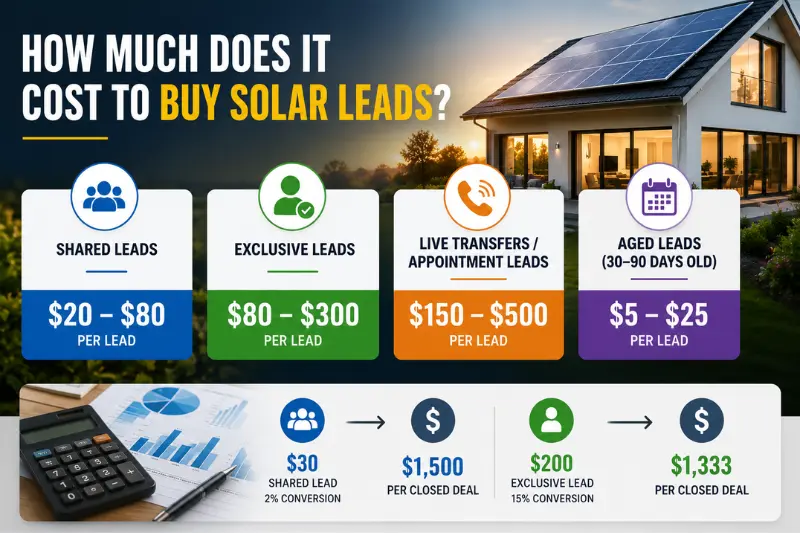
Pricing varies widely based on lead type, location, and exclusivity. Here’s a realistic breakdown:
Shared leads:
$20 to $80 per lead
Exclusive leads:
$80 to $300 per lead
Live transfers / appointment leads:
$150 to $500 per lead
Aged leads (30–90 days old):
$5 to $25 per lead
Keep in mind that cost per lead is not the same as cost per sale. A $30 shared lead that converts 2% of the time costs you $1,500 per closed deal. A $200 exclusive lead that converts 15% of the time costs you about $1,333 per closed deal — and it’s a much better experience for your team.
Always calculate your cost per acquisition (CPA), not just your cost per lead.
Pros of Buying Solar Leads
Here’s why so many growing solar companies choose to buy solar leads as their primary growth channel:
You get immediate pipeline
There’s no waiting six months for SEO to kick in. When you buy solar leads, you can have qualified contacts in your CRM within hours.
Your ROI is trackable
Unlike broad brand marketing, purchased leads give you a clear data trail. You know exactly how much you spent and how many deals closed.
You can scale up or down quickly
If you have capacity, increase your lead volume. If your install schedule is full, pause. This flexibility is hard to match with organic marketing.
Your sales team stays busy
Nothing kills morale faster than a slow pipeline. Purchased leads keep your closers working.
Cons of Buying Solar Leads
Before you buy solar leads, it’s equally important to understand the risks and limitations involved.
Quality is inconsistent
Even reputable companies send bad leads sometimes. You need a clear replacement or refund policy in writing before you sign anything.
Shared leads mean competition
If the same lead goes to three other companies, you need to be the fastest to call and the most compelling on the phone. Speed matters — leads contacted within five minutes of submitting a form are significantly more likely to convert.
You can become dependent on them
If you stop buying leads, your pipeline goes quiet. Companies that only buy leads without building any organic presence are vulnerable.
Some companies are dishonest
Recycled leads, fake form fills, and offshore call centers that fabricate interest are real problems in this industry. We’ll cover how to spot them below.
What Your Competitors Don’t Tell You: Red Flags to Watch For
Most articles tell you to “buy from a reputable company.” That’s not useful advice on its own. Here’s what to actually watch for:
Vague lead sourcing
If a company can’t tell you exactly how and where they generate their leads — which platforms, which ads, which landing pages — walk away. Transparency is non-negotiable.
No replacement policy
Every legitimate lead company offers some form of credit or replacement for invalid leads (disconnected numbers, renters, fake submissions). If they don’t, you have no recourse when you receive garbage.
Locked-in contracts with no performance benchmarks
Avoid long-term contracts that don’t include performance guarantees. A company confident in their leads will let you test on a smaller batch first.
Leads that are already old
Some companies sell you leads as “fresh” when they’re actually weeks old. Always ask when the lead was generated and insist on a timestamp for every contact.
Too-good-to-be-true pricing
If someone is offering exclusive solar leads for $15 each, those leads are not what they claim. Legitimate exclusive leads require real advertising spend to generate.
How to Evaluate a Solar Lead Company Before You Buy
Ask these questions before you commit to buy solar leads from any provider:
- How do you generate your leads? (Specific platforms and methods)
- Are these leads exclusive or shared? How many buyers per lead?
- What is your average lead age at the time of delivery?
- What are your qualification criteria?
- What is your replacement or refund policy for invalid leads?
- Can I start with a test batch of 20 to 50 leads before committing to volume?
- Do you have verifiable reviews or case studies from solar companies in my region?
- What is your average contact rate and close rate across your client base?
The due diligence you do before you buy solar leads is directly proportional to the ROI you’ll see afterward.
A company that hesitates on any of these questions is a company worth avoiding.
Tips to Maximize ROI After You Buy Solar Leads
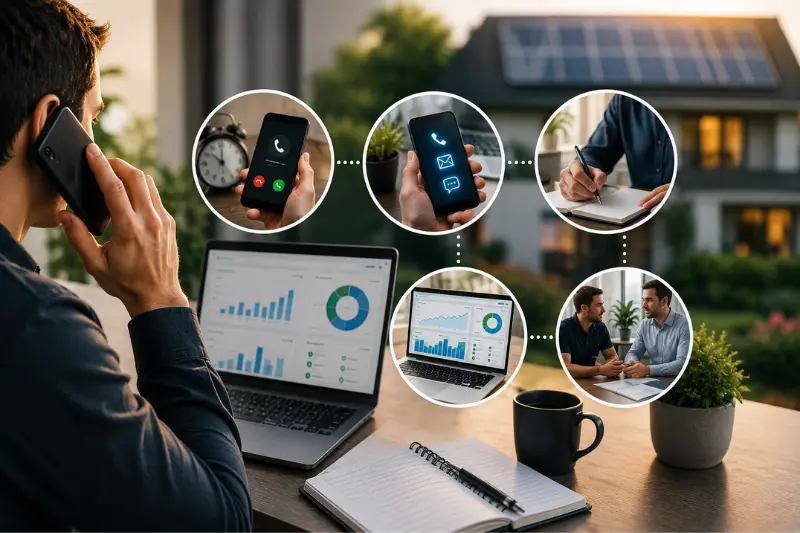
The companies that consistently profit when they buy solar leads aren’t just getting better leads — they’re running a tighter follow-up process than their competitors.
The companies that consistently profit when they buy solar leads aren’t just getting better contacts — they’re running a tighter follow-up process than their competitors. How your team handles them determines whether you profit or lose money.
Call within five minutes
Studies consistently show that leads contacted within five minutes of submitting a form are dramatically more likely to engage. Set up real-time delivery notifications to your sales team.
Use a multi-touch follow-up sequence
Most leads don’t convert on the first call. Build a follow-up cadence that includes calls, texts, and emails over a 14-day window. Many closers follow up seven to ten times before a prospect commits.
Personalize your opener
Reference the specific reason the lead inquired. If they mentioned high electricity bills, start there. Generic openers get hung up on.
Track everything
Use a CRM to log every interaction. You need to know which lead sources are producing closed deals and which ones are wasting your team’s time. Cut what doesn’t work.
Optimize your pitch for the medium
A live transfer requires a different conversation starter than a lead that filled out a form 48 hours ago. Train your team accordingly.
Should You Buy Solar Leads or Generate Your Own?
The honest answer: most successful solar companies do both.
Buying solar leads gives you immediate, predictable pipeline. Generating your own leads — through content marketing, SEO, referrals, and social media — gives you lower-cost, higher-quality contacts over time.
Think of purchased leads as fuel you buy at the gas station, and organic lead generation as building a solar panel on your own roof. Both produce energy. One costs you every time; the other pays dividends long-term.
If you’re a newer business or in a growth phase, buying leads makes sense while you build your organic presence. If you rely exclusively on purchased leads forever, your margins will always be under pressure.
Frequently Asked Questions
What is the average conversion rate when you buy solar leads?
When you buy solar leads through a reputable provider, shared leads typically convert at 1% to 5% into closed deals… Shared leads typically convert at 1% to 5% into closed deals. Exclusive leads can convert at 10% to 20%, depending on how quickly you follow up and how strong your sales process is. Live transfer leads often convert even higher.
How quickly should I call a purchased solar lead?
As quickly as possible — ideally within five minutes of receiving the lead. Research shows that response time is one of the biggest factors in lead conversion. After 30 minutes, your chances of reaching the prospect drop significantly.
Are exclusive solar leads worth the higher price?
In most cases, yes. When you’re the only company contacting that homeowner, you control the conversation and avoid a bidding war. The higher upfront cost is usually offset by a much better close rate.
Can I get a refund for bad solar leads?
Most reputable lead companies offer credits or replacements for invalid leads — disconnected numbers, renters, or contacts outside your service area. Always confirm this policy in writing before purchasing.
How do I know if a solar lead company is legitimate?
Look for verifiable reviews on Google or Clutch, ask for references from solar companies in your region, and request a small test batch before committing to volume. Legitimate companies welcome scrutiny.
What is a live transfer solar lead?
A live transfer is when a lead generation company calls a homeowner, confirms their interest in solar, and then patches them directly through to your sales rep. You’re speaking with a qualified prospect in real time, which is why these leads convert at the highest rates.
What’s the difference between a solar lead and a solar appointment?
A solar lead is a contact who has expressed general interest — usually a form fill or phone inquiry. A solar appointment is a scheduled meeting or call where the homeowner has agreed to hear your proposal. Appointments are more valuable because they represent a higher level of commitment.
How many times should I follow up with a purchased lead?
Most industry experts recommend following up at least seven times over a two-week period, using a mix of calls, texts, and emails. The majority of conversions happen after the third or fourth contact, not the first.
Is it worth it for a small solar company to buy solar leads?
Absolutely. Small and mid-sized solar companies often benefit the most when they buy solar leads because it removes the need for a large marketing department. Even purchasing 20–30 leads per month can meaningfully fill your pipeline while you build organic traffic over time.
Final Thoughts
Choosing to buy solar leads can accelerate your business faster than almost any other strategy — but only if you do it with your eyes open. Know what type of leads you’re buying, vet your providers thoroughly, follow up with speed and consistency, and track your data religiously.
Every time you buy solar leads, you’re making a calculated investment — and like any investment, the return depends on how well you manage what you receive. The solar industry is competitive, and homeowners have more choices than ever. The companies winning in this market are the ones that treat leads as relationships to be earned, not numbers to be dialed.
Buy smart, follow up faster than your competition, and let your results guide every future decision.