
Switching to solar is no longer just an environmental statement for businesses — it is a strategic financial decision. And the commercial solar company you choose to partner with determines everything: the quality of your system, the size of your savings, and the level of support you receive for the next 25 to 30 years.
This guide gives business owners and facility managers everything they need — what a commercial solar company actually does, what your system will cost, which incentives are still available in 2026, what red flags to avoid, and exactly how to evaluate and choose the right commercial solar company for your business.
What Is a Commercial Solar Company?
A commercial solar company designs, installs, and maintains solar energy systems for businesses, industrial facilities, warehouses, schools, hospitals, retail locations, and other non-residential properties. Unlike residential solar installers who handle smaller home systems, a commercial solar company specializes in larger, more complex projects that require:
- Custom system design and engineering for high energy demand environments
- Commercial-grade equipment rated for continuous heavy-duty performance
- Navigating commercial building permits, utility interconnection agreements, and zoning requirements
- Coordination with property managers, landlords, and multiple stakeholders
- Understanding of commercial tax incentives, depreciation schedules, and financing structures
The best commercial solar company does not just install panels — it acts as a long-term energy partner, helping your business maximize savings, stay compliant, and keep your system performing at full capacity for decades.
Why More Businesses Are Choosing a Commercial Solar Company in 2026
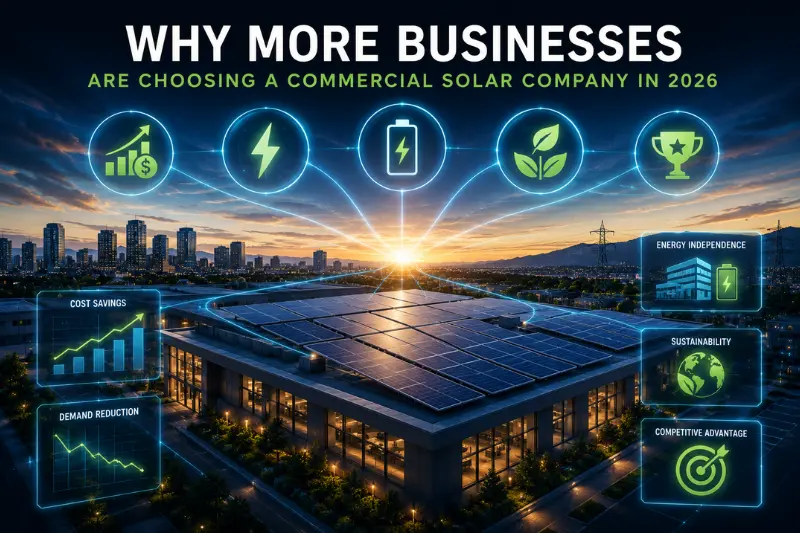
The business case for commercial solar has never been stronger. Here is what is driving the shift:
Rising electricity costs Commercial electricity rates have increased significantly across the United States, and they continue to rise. Every business that generates its own solar power locks in predictable, low-cost energy and shields itself from future utility rate increases.
Demand charges — the hidden cost solar eliminates Most commercial utility bills include demand charges — fees based on your peak power usage during any 15-minute window in a billing period. A well-designed commercial solar system reduces peak demand, cutting this often-overlooked cost significantly. Most competitor guides never mention demand charges — but for many businesses, eliminating or reducing demand charges is the single biggest financial benefit of going solar.
Energy independence and resilience Power outages cost businesses money. A commercial solar company that also offers battery storage gives your facility the ability to continue operations during grid outages — a business continuity advantage that is increasingly valuable.
Sustainability and ESG goals Corporate sustainability commitments, customer expectations, and regulatory pressure are all pushing businesses toward clean energy. Working with a commercial solar company gives you verifiable renewable energy data for ESG reporting, sustainability certifications, and customer-facing communications.
Competitive advantage Businesses that reduce their energy costs structurally gain a real competitive advantage over competitors still paying full retail electricity rates. Lower overhead means more pricing flexibility, better margins, or both.
Commercial Solar System Types: What a Commercial Solar Company Can Install
A reputable commercial solar company offers multiple system configurations depending on your facility, energy needs, and budget:
Rooftop Commercial Solar The most common configuration. Panels are mounted on the commercial building’s roof — flat roofs use ballasted or penetrating racking systems, while pitched roofs use similar mounting hardware to residential installations. Rooftop systems minimize land use and often qualify for the strongest incentives.
Ground-Mounted Commercial Solar Ideal for businesses with available land adjacent to their facility. Ground-mounted systems are easier to maintain, can be optimally angled for maximum production, and scale easily as energy needs grow.
Solar Carports An increasingly popular option for businesses with large parking areas — retail centers, car dealerships, warehouses, and corporate campuses. Solar carports generate electricity while providing shade and weather protection for vehicles, adding a visible sustainability statement at the facility entrance.
Building-Integrated Photovoltaics (BIPV) Solar panels integrated directly into building materials — facades, skylights, and roofing membranes. More complex and expensive, but increasingly used in new commercial construction where aesthetics and sustainability certifications matter.
Commercial Solar + Battery Storage Many businesses now pair rooftop or ground-mounted solar with commercial battery storage systems. This combination maximizes the value of every kilowatt-hour your system produces and provides backup power during outages.
How Much Does a Commercial Solar Company Charge?
Commercial solar costs vary significantly based on system size, equipment quality, location, and complexity. Here is what to expect in 2026:
System size and cost:
- Small commercial system (25–50 kW): $50,000–$100,000 before incentives
- Mid-size commercial system (50–250 kW): $100,000–$500,000 before incentives
- Large commercial or industrial system (250 kW+): $500,000–$2,000,000+
Cost per watt (installed):
- $2.50–$3.50 per watt is the typical range for commercial systems in 2026
- Larger systems generally achieve lower per-watt costs due to economies of scale
Payback period: Most commercial solar projects in 2026 achieve payback within 6 to 10 years. With panels lasting 25 to 30 years, this leaves 15 to 20 years of near-free electricity after payback — a compelling financial case for any business.
Annual savings potential: A 100 kW system in a good solar location generating $15,000–$25,000 in annual electricity savings is a realistic baseline. Larger systems with higher local electricity rates can generate $50,000–$200,000+ in annual savings.
Commercial Solar Incentives Still Available in 2026
This is where most competitor guides either give outdated information or skip the nuances entirely. Here is the accurate picture for 2026:
Federal Investment Tax Credit (ITC) — Section 48E The residential federal solar tax credit expired for homeowner-owned systems on December 31, 2025. However, the commercial ITC under Section 48E remains in effect for businesses in 2026. This credit allows eligible businesses to deduct a significant percentage of their commercial solar system cost directly from their federal tax liability. Consult a tax professional for your specific eligibility.
MACRS Accelerated Depreciation Businesses can depreciate commercial solar assets over a 5-year Modified Accelerated Cost Recovery System (MACRS) schedule, significantly improving early-year cash flow. This is often as financially valuable as the ITC itself — and it is consistently overlooked by homeowners and business owners alike.
Bonus Depreciation In addition to standard MACRS, bonus depreciation provisions may allow businesses to depreciate a large percentage of their solar investment in year one, further accelerating financial returns.
State and local incentives Many states, utilities, and municipalities offer additional rebates, performance incentives, and tax exemptions for commercial solar. Net metering policies — which credit businesses for surplus power exported to the grid — also vary significantly by state and utility. A knowledgeable commercial solar company navigates all of this on your behalf.
Property Tax Exemptions Many states exempt commercial solar installations from property tax assessments. This means your property value can increase with solar without triggering a higher tax bill.
Commercial Solar Financing Options
A great commercial solar company presents every financing option and helps you choose the one that matches your business’s financial position:
Cash Purchase The highest upfront cost but the strongest long-term return. You own the system, claim all available tax incentives, and enjoy full savings from day one.
Commercial Solar Loan You own the system, claim the ITC and depreciation benefits, and spread the cost over monthly payments. Many businesses structure loans so that monthly energy savings exceed the loan payment — creating positive cash flow from the first month.
Solar Lease The commercial solar company owns the system and charges you a fixed monthly fee. Lower upfront cost, but you do not claim tax incentives and your long-term savings are smaller.
Power Purchase Agreement (PPA) You pay for the electricity the system produces rather than a fixed fee. Zero upfront cost, no ownership responsibilities, but again — no tax incentives and reduced long-term savings.
Commercial Property Assessed Clean Energy (C-PACE) Financing A powerful and underused option that most competitor guides do not mention. C-PACE allows businesses to finance commercial solar through a property assessment, repaid over 10–25 years through property tax bills. The financing stays with the property — not the owner — making it ideal for businesses that may sell the facility before the solar loan is paid off.
8 Things to Look For in a Commercial Solar Company
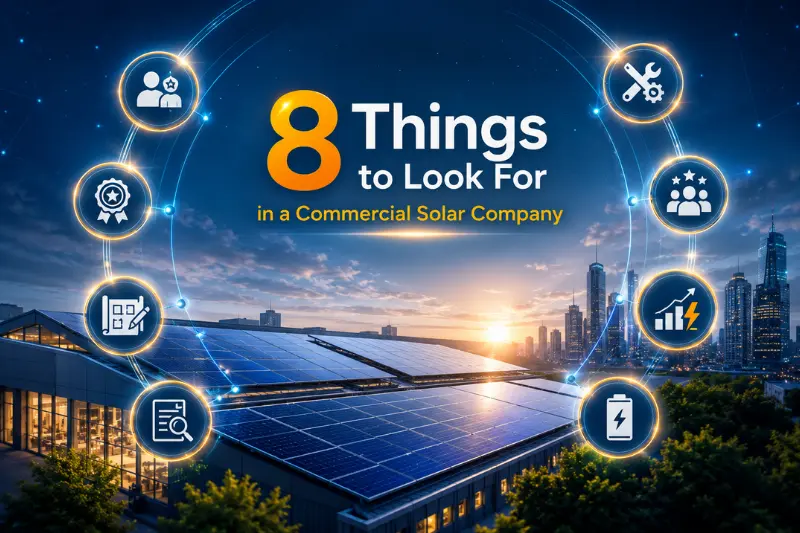
- 1. Commercial-specific experience Commercial solar is fundamentally different from residential solar in scale, complexity, and permitting requirements. Ask specifically how many commercial projects the company has completed — and at what system sizes. A company with only residential experience is not equipped for your facility.
- 2. NABCEP certification The North American Board of Certified Energy Practitioners certification is the gold standard in the solar industry. Any commercial solar company you seriously consider should employ NABCEP-certified engineers and installers.
- 3. In-house engineering and design The best commercial solar companies design systems in-house — not through a third-party subcontractor. Custom commercial system design requires direct communication between your facility management team and the engineers who understand your energy consumption patterns.
- 4. Transparent, detailed proposals A quality commercial solar company provides proposals that include a full system design, expected annual production figures, projected savings by year, all incentive calculations, and a clear breakdown of costs — before and after incentives. Vague “all-in” numbers without engineering documentation are a red flag.
- 5. Long-term service and maintenance agreements Your relationship with your commercial solar company should last the life of your system. Ask specifically what ongoing service they provide — system monitoring, cleaning, inspection, and repair. A company that disappears after installation is not a real commercial solar partner.
- 6. References from similar businesses Ask for references from businesses in your industry with similar system sizes. A commercial solar company that has successfully installed solar for a warehouse, school, or manufacturing facility similar to yours demonstrates directly relevant experience.
- 7. Understanding of demand charge reduction As mentioned earlier, demand charges are a major cost for many commercial electricity customers. A sophisticated commercial solar company analyzes your utility bills, understands your demand charge structure, and designs your system to maximize demand charge reduction — not just kilowatt-hour savings.
- 8. Battery storage capability Whether or not you add batteries now, choose a commercial solar company that has genuine battery storage experience. Your energy needs will evolve, grid reliability may become more important, and the option to add storage later should be part of your system’s design from the start.
Red Flags to Avoid When Choosing a Commercial Solar Company
- Pressure to sign quickly — any legitimate commercial solar company gives you time to review proposals, compare options, and consult your accountant and legal team
- No site visit before proposal — a credible commercial solar company never provides a final proposal without physically assessing your facility, roof, electrical infrastructure, and energy bills
- Subcontracted installation — ask directly whether the company installs using its own certified crews or subcontracts the work to third parties
- Missing warranty documentation — demand clear, written warranties for panels, inverters, workmanship, and performance before signing anything
- No mention of demand charges or incentive details — a company that gives you a savings estimate without discussing demand charges or walking you through current incentives does not understand commercial solar at the level your business needs
Frequently Asked Questions About Commercial Solar Companies
What does a commercial solar company do?
A commercial solar company designs, installs, and maintains solar energy systems for businesses and non-residential facilities. Unlike residential installers, commercial solar companies handle larger, more complex systems requiring custom engineering, commercial permitting, utility interconnection agreements, and specialized knowledge of business tax incentives and financing structures.
How much does commercial solar cost in 2026?
Commercial solar systems typically cost $2.50–$3.50 per watt installed. Small systems (25–50 kW) run $50,000–$100,000 before incentives. Mid-size systems (50–250 kW) range from $100,000–$500,000. Large industrial systems cost $500,000 and above. Available tax incentives and depreciation benefits significantly reduce the net cost.
Are commercial solar incentives still available in 2026?
Yes. The federal Investment Tax Credit for commercial solar (Section 48E) remains in effect for businesses in 2026. MACRS accelerated depreciation and bonus depreciation also apply, often matching or exceeding the ITC in financial value. Many states offer additional rebates, net metering, and property tax exemptions. Consult a tax professional for your specific situation.
What is the payback period for commercial solar?
Most commercial solar projects in 2026 achieve payback within 6 to 10 years, depending on system size, local electricity rates, available incentives, and financing structure. With panels lasting 25 to 30 years, businesses typically enjoy 15 to 20 years of near-free electricity after reaching payback.
What is C-PACE financing for commercial solar?
Commercial Property Assessed Clean Energy (C-PACE) financing allows businesses to fund commercial solar installations through a property assessment repaid over 10–25 years via property tax bills. The financing stays with the property rather than the owner, making it ideal for businesses that may sell the facility before the loan is repaid.
What is a demand charge and how does commercial solar reduce it?
A demand charge is a utility fee based on your peak power usage during any 15-minute window in a billing period. Many commercial electricity bills include significant demand charges on top of per-kilowatt-hour energy charges. A well-designed commercial solar system reduces peak demand, cutting demand charges substantially — often delivering as much financial benefit as the energy savings themselves.
How do I know if a commercial solar company is legitimate?
Verify NABCEP certification, state electrical contractor licensing, and current insurance coverage. Ask for references from similar commercial projects. Request detailed proposals with engineering documentation. Any legitimate commercial solar company provides clear contracts, transparent pricing, and documented warranty terms before you sign anything.
Should my business add battery storage with commercial solar?
Battery storage significantly increases energy independence, reduces demand charges, and provides backup power during grid outages. Whether to add batteries now or later depends on your business’s energy usage patterns, local utility rate structure, and continuity requirements. Choose a commercial solar company that designs your system to accommodate future battery integration even if you do not add storage immediately.
Final Thoughts
Choosing the right commercial solar company is one of the most important financial decisions your business can make. The right partner designs a system that matches your actual energy needs, maximizes every available incentive, and stands behind their work for the full life of your investment.
Do not rush the process. Request detailed proposals. Compare engineering, equipment, warranties, and service agreements — not just price. Ask about demand charges, C-PACE financing, and battery storage. And choose a commercial solar company that treats your business the way a long-term energy partner should.
The savings are real. The incentives are strong. The technology is proven. The only variable is the company you choose to work with.