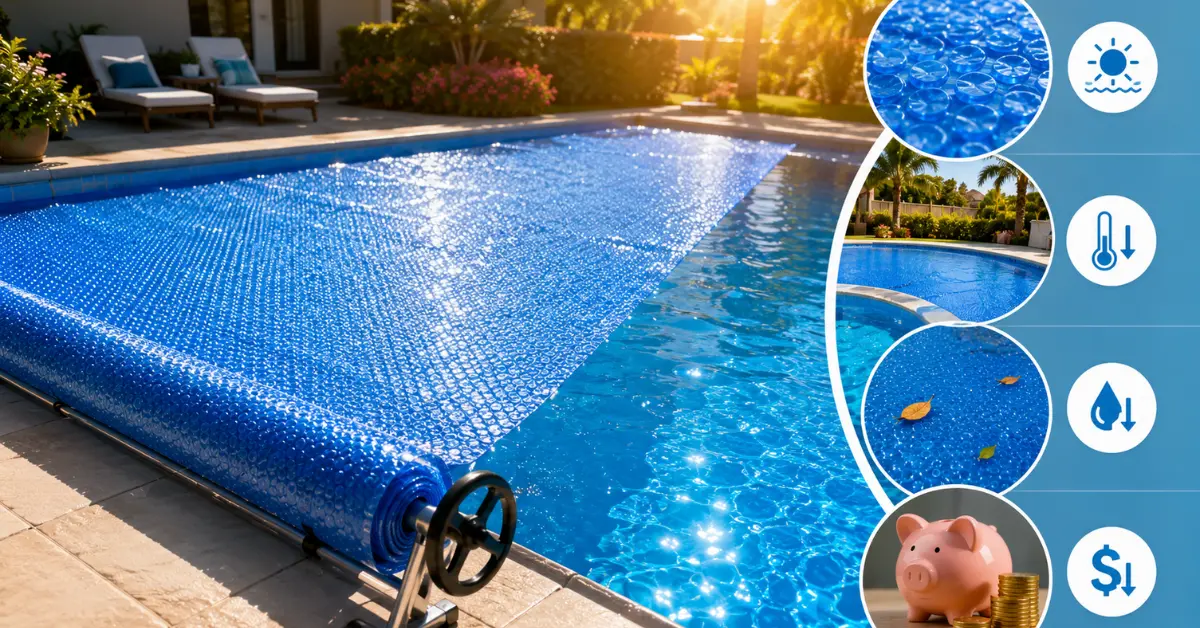
Owning a pool is one of life’s great pleasures — but keeping that water warm and clean can quietly drain your wallet. Between rising energy costs, constant water refills, and weekly chemical top-ups, pool maintenance adds up faster than most people expect. That is exactly where a pool solar blanket steps in and changes the game.
A pool solar blanket is a simple, bubble-covered sheet that floats on your pool’s surface and uses the power of the sun to heat your water naturally. No electricity, no complicated setup, no ongoing costs. Just lay it down, let the sun do its work, and enjoy noticeably warmer water within hours. It also locks in heat overnight, so the warmth you build up during the day does not simply disappear by morning.
But a pool solar blanket does far more than just heat your water. It reduces evaporation by up to 95%, which means less water wasted, fewer chemicals needed, and a cleaner pool with less debris getting in. For most pool owners, it cuts heating costs by 50% or more — making it one of the highest-return pool accessories you can buy.
Whether you are a first-time buyer or looking to upgrade your current cover, this guide gives you everything you need. We break down how pool solar blankets work, which thickness suits your climate, the difference between clear and blue covers, how to use and care for one, and the mistakes you want to avoid. Let’s dive in
If you own a pool, you already know how fast it loses heat overnight — and how quickly your water bill climbs when evaporation goes unchecked. A pool solar blanket is one of the smartest, most affordable investments you can make. It heats your water using free sunlight, slashes evaporation by up to 95%, and extends your swimming season by weeks.
But not all solar blankets are created equal. This guide walks you through everything you need to know — from how they work to which thickness to pick — so you make the right choice the first time.
What Is a Pool Solar Blanket?
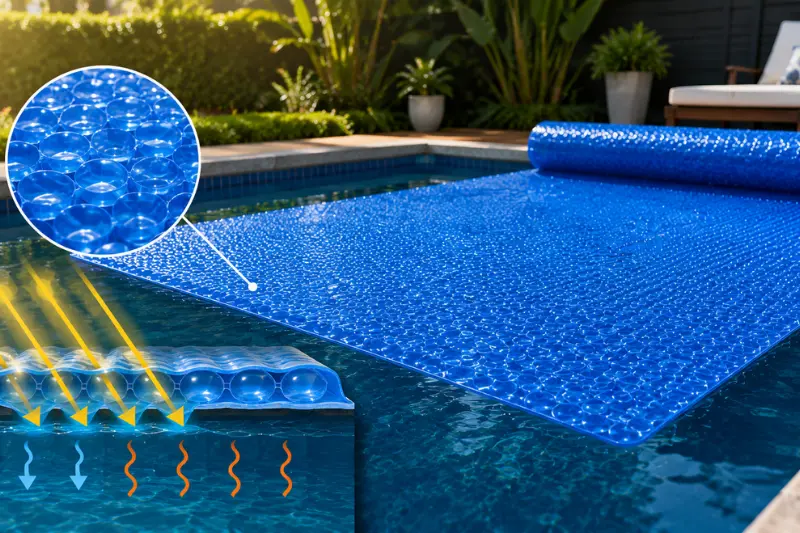
A pool solar blanket (also called a solar pool cover) is a large sheet of bubble-wrap-like material that floats on top of your pool. Those tiny bubbles are not just for looks — they do two important jobs:
- They trap heat. The bubbles act as mini magnifying lenses, capturing sunlight and transferring warmth into the water below.
- They insulate. At night, the same bubbles form a barrier that slows heat from escaping the surface.
The result? Your pool stays warmer longer — without running your heater as much.
How Does a Pool Solar Blanket Work?
Think of a pool solar blanket as a giant greenhouse sitting on top of your water. Here is what happens when you lay one down:
1. Sunlight passes through the cover and warms the water directly
2.The bubble layer traps heat between the cover and the water surface.
3.Evaporation drops sharply, so warm water stays in the pool instead of floating away into the air.
4.Chemical loss slows down because evaporation carries away pool chemicals. Less evaporation means fewer chemicals needed
because evaporation carries away pool chemicals. Less evaporation means fewer chemicals needed.
Most quality pool solar blankets can raise your water temperature by 10 to 18°F over several days of consistent use. Paired with a pool heater or heat pump, the savings on your energy bill add up fast.
Pool Solar Blanket Thickness: Which Mil Is Right for You?
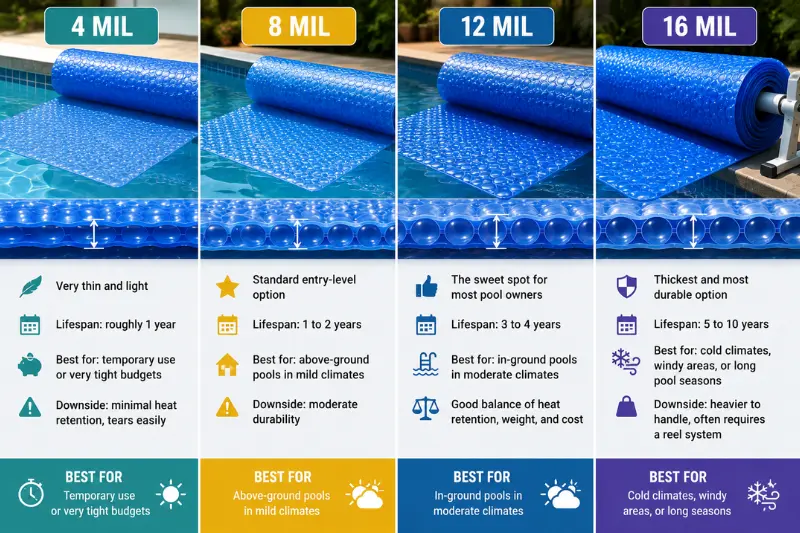
This is the detail most buyers overlook — and it matters more than color or brand. Pool solar blankets are measured in “mil,” which equals one-thousandth of an inch.
Here is a simple breakdown:
4 mil
- Very thin and light
- Lifespan: roughly 1 year
- Best for: temporary use or very tight budgets
- Downside: minimal heat retention, tears easily
8 mil
- Standard entry-level option
- Lifespan: 1 to 2 years
- Best for: above-ground pools in mild climates
- Downside: moderate durability
12 mil
- The sweet spot for most pool owners
- Lifespan: 3 to 4 years
- Best for: in-ground pools in moderate climates
- Good balance of heat retention, weight, and cost
16 mil
- Thickest and most durable option
- Lifespan: 5 to 10 years
- Best for: cold climates, windy areas, or long pool seasons
- Downside: heavier to handle, often requires a reel system
Pro tip from pool owners: Most experts recommend 12 mil to 16 mil for the best heat retention, UV resistance, and long-term value. Do not let the lower price of a thinner cover fool you — it often costs more in replacements over time.
Clear vs. Blue Pool Solar Blanket: Which Works Better?
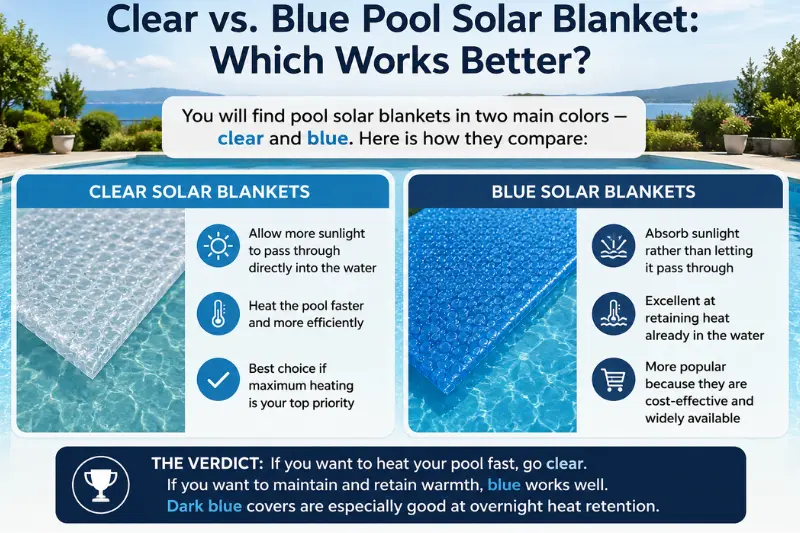
You will find pool solar blankets in two main colors — clear and blue. Here is how they compare:
Clear solar blankets:
- Allow more sunlight to pass through directly into the water
- Heat the pool faster and more efficiently
- Best choice if maximum heating is your top priority
Blue solar blankets:
- Absorb sunlight rather than letting it pass through
- Excellent at retaining heat already in the water
- More popular because they are cost-effective and widely available
The verdict: If you want to heat your pool fast, go clear. If you want to maintain and retain warmth, blue works well. Dark blue covers are especially good at overnight heat retention.
5 Benefits of Using a Pool Solar Blanket (That Go Beyond Heat)
Most articles stop at “it heats your pool.” Here is what they leave out:
1. It cuts your water bill Evaporation is the number one way pools lose water. A good pool solar blanket reduces evaporation by up to 95%, meaning you refill less often. Over a summer, this adds up to thousands of gallons saved.
2. It reduces chemical usage When water evaporates, it takes chlorine and other chemicals with it. Less evaporation means your chemical balance stays stable longer, so you spend less on chlorine, pH adjusters, and algaecides.
3. It keeps your pool cleaner Leaves, dust, pollen, and insects land in your pool constantly. A pool solar blanket acts as a physical barrier, keeping debris out. Less debris means less vacuuming, less filter cleaning, and fewer algae problems.
4. It extends your swimming season By holding in heat, a solar blanket can extend your usable pool season by 4 to 6 weeks on either end of summer — especially important in cooler climates.
5. It reduces heating costs If you use a gas heater or heat pump, your pool solar blanket does part of the work for free. Many pool owners report cutting their heating costs by 50% to 70% after adding a solar cover.
How to Use a Pool Solar Blanket Correctly
Getting the most out of your pool solar blanket comes down to proper use and placement.
Step 1: Lay it bubble-side down The bubbles face the water, not the sky. This is the most common mistake beginners make. Bubble-side down maximizes heat transfer into the water.
Step 2: Cover as much of the pool as possible Even partial coverage helps, but full coverage gives you the best results. If your pool has an unusual shape, you can trim your solar blanket with scissors or a utility knife to fit it perfectly.
Step 3: Use it during the day and overnight Leave your pool solar blanket on when the pool is not in use — day and night. Remove it only when swimmers are in the water.
Step 4: Store it properly UV rays will degrade your cover faster if you leave it crumpled in a pile. Roll it up on a solar reel or fold it neatly and store it in a shaded spot.
Step 5: Clean it regularly Rinse your solar blanket with fresh water every couple of weeks. Avoid high-pressure washing, which can damage the bubbles. Keep it away from extremely high chlorine levels when the cover is on, as this shortens its life.
Do You Need a Solar Reel?
A solar reel is a rotating bar that holds your rolled-up solar blanket. It is not required, but it makes life much easier — especially for larger pools or heavier 16 mil covers.
You probably need a reel if:
- Your pool is larger than 16 x 32 feet
- Your blanket is 12 mil or thicker
- You remove and replace the cover daily
- You have a bad back or joint pain
You can skip a reel if:
- Your pool is small (above-ground round pools under 18 feet)
- Your blanket is light (8 mil or thinner)
- You do not mind manually folding the cover
How to Size a Pool Solar Blanket for Your Pool
Sizing is straightforward:
- Rectangular pools: Measure length x width. Buy the closest standard size and trim to fit.
- Round pools: Measure the diameter. Standard sizes go from 12 feet to 33 feet.
- Oval pools: Measure the longest and widest points. Many brands offer oval cuts.
- Irregular shapes: Buy a rectangular blanket larger than your pool and trim it to fit using the pool edge as a guide.
Always buy slightly larger than your pool — you can trim down, but you cannot add material back.
How Long Does a Pool Solar Blanket Last?
Lifespan depends mostly on thickness and how well you care for it:
| Thickness | Average Lifespan |
|---|---|
| 4 mil | ~1 year |
| 8 mil | 1–2 years |
| 12 mil | 3–4 years |
| 16 mil | 5–10 years |
Signs it is time to replace your cover: the bubbles start breaking down, the material becomes brittle or discolored, or pieces begin flaking into the pool.
Pool Solar Blanket vs. Other Pool Covers: What Is the Difference?
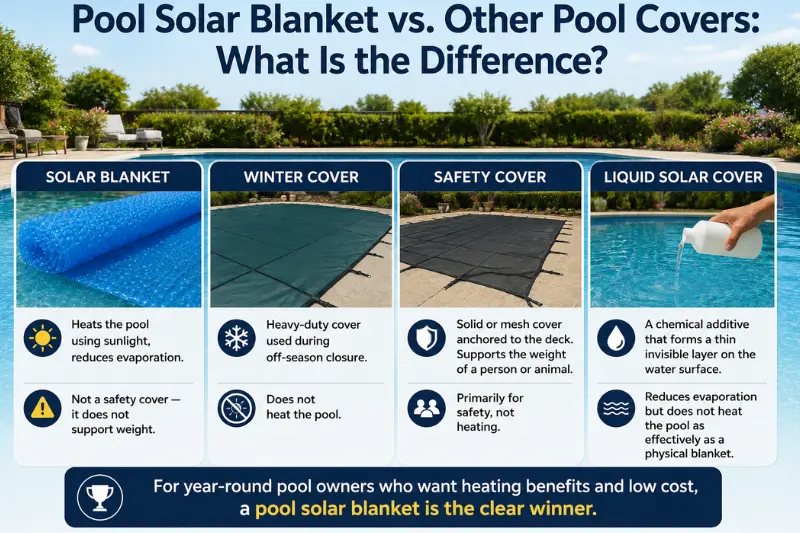
Solar blanket
Heats the pool using sunlight, reduces evaporation. Not a safety cover — it does not support weight.
Winter cover
Heavy-duty cover used during off-season closure. Does not heat the pool.
Safety cover
Solid or mesh cover anchored to the deck. Supports the weight of a person or animal. Primarily for safety, not heating.
Liquid solar cover
A chemical additive that forms a thin invisible layer on the water surface. Reduces evaporation but does not heat the pool as effectively as a physical blanket.
For year-round pool owners who want heating benefits and low cost, a pool solar blanket is the clear winner.
Common Mistakes to Avoid With a Pool Solar Blanket
Even experienced pool owners get these wrong:
- Leaving it on during heavy chemical treatments-High-dose chlorine shocking can damage the blanket. Always remove it before shocking.
- Storing it in direct sunlight-UV exposure breaks down the material faster. Store it shaded or in a cover bag.
- Bubble-side up-Always bubbles down. Bubbles up loses efficiency significantly.
- Ignoring pool chemistry-A solar blanket slows evaporation, which means chemicals can become more concentrated. Test your water regularly.
- Buying too thin to save money-A 4 mil cover at $30 replaced every year costs more than a 12 mil cover at $120 that lasts four years.
Frequently Asked Questions
Do I leave the pool solar blanket on during the day?
Yes. Leaving it on during sunny hours is when it does its best work — capturing heat and transferring it to your water. Remove it only when you are swimming.
Can I use a pool solar blanket with a pool heater?
Absolutely. In fact, it makes your heater far more efficient. The blanket traps the heat your heater produces, so the heater runs less often. Many pool owners cut heating costs by half.
How long does it take for a pool solar blanket to heat the water?
It depends on sunlight, pool size, and blanket thickness. In sunny conditions, you can see a noticeable temperature rise within 6 to 12 hours. Over 2 to 3 days of consistent use, water temperatures can rise by 10 to 18°F.
Is a pool solar blanket safe for children?
A solar blanket is not a safety cover and should never be used as one. Always remove the cover completely before anyone enters the pool. Never let children walk or play on a solar blanket.
Can I trim a pool solar blanket to fit my pool?
Yes. Most pool solar blankets can be easily trimmed with sharp scissors or a utility knife. Lay it over the pool, mark the edges, and cut along the pool’s shape for a custom fit.
Which side of the pool solar blanket faces down?
The bubble side always faces down, touching the water. The flat side faces up toward the sun.
How do I store a pool solar blanket when not in use?
Roll it onto a solar reel or fold it loosely and store it in a cool, shaded area. Avoid leaving it in a tight ball or in direct sunlight for extended periods, as this shortens its lifespan.
Does a pool solar blanket work on above-ground pools?
Yes. Solar blankets work just as well on above-ground pools as in-ground pools. Make sure to choose the correct shape (round or oval) and the right diameter.
How often should I remove my pool solar blanket?
Remove it whenever people are swimming. You should also remove it before shocking your pool with high-dose chlorine, as concentrated chemicals can degrade the material faster.
What happens if I leave my pool solar blanket on too long?
If left on for very long periods without checking water chemistry, chemical levels can become unbalanced. Algae can also grow underneath the cover if circulation is poor. Check and run your pump regularly, even with the cover on.
Final Thoughts
Without question — yes. A quality pool solar blanket is one of the highest-return investments you can make for your pool. For a one-time cost of $75 to $225, you get warmer water, lower heating costs, less chemical use, and a cleaner pool throughout the season.
The key is choosing the right thickness for your climate and needs. If you swim regularly and want something that lasts, go with a 12 mil or 16 mil cover. Pair it with a solar reel for easy handling, and you will wonder how you ever managed without one.
Your pool works hard all season — a pool solar blanket helps it work smarter.