If you own or manage commercial property, you have probably noticed the question coming up more often: “Do you have EV charging?” Whether that question comes from a tenant, a job candidate, a shopper, or your own fleet manager, the answer is increasingly tied to whether people choose your property over the one down the street.
This guide walks through everything you actually need to know before installing a commercial EV charging station — not the marketing-brochure version, but the practical one: what the equipment costs, what trips people up during installation, how to pick the right commercial EV charging station for your specific site, and what is happening with incentives right now.
Quick Answer: What Is a Commercial EV Charging Station?
A commercial EV charging station is a charger installed on business or institutional property — rather than a private home — for use by employees, customers, tenants, residents, or fleet vehicles. A commercial EV charging station differs from residential chargers in three important ways: it is built for higher usage volume and outdoor durability, it is almost always networked (connected to software for payment, access control, and monitoring), and its installation must account for commercial electrical service, code requirements, and accessibility rules that do not apply to a garage outlet.
There are two main categories of commercial EV charging: Level 2 AC chargers, which add roughly 10–40 miles of range per hour and suit locations where vehicles park for a while, and DC fast chargers, which can add 60–200+ miles in 20–30 minutes and suit locations where drivers need to charge quickly and leave. Choosing the right commercial EV charging depends almost entirely on how long vehicles actually sit at your site — that is the first thing to figure out before you look at a single spec sheet.
Why Businesses Are Adding a Commercial EV Charging Station Now
The reasons businesses install a commercial EV charging fall into a few buckets, and most properties have more than one driving the decision:
Attracting and Retaining People Retail centers and grocery stores use a commercial EV charging station to extend dwell time — a driver who is plugged in for 25 minutes is a driver who is still browsing your store. Multifamily and office properties use a commercial EV charging as a leasing amenity that is now expected rather than novel in many markets. Employers increasingly hear about charging access during recruiting conversations, especially from younger hires.
Turning Parking Into a Revenue Line A commercial EV charging can generate direct revenue through per-session or per-kWh fees, or indirect revenue through higher occupancy, longer dwell time, and premium lease rates for EV-ready units. Whether you charge for it at all is a strategic choice — some properties intentionally offer a commercial EV charging station as a free amenity rather than a profit center, and that is a completely valid approach too.
Fleet Electrification If your business runs delivery vans, service vehicles, or a motor pool, a commercial EV charging at your depot or yard is no longer optional once you start adding EVs to the fleet. Depot charging needs are different enough from public-facing charging that they deserve their own planning process.
Getting Ahead of Code and Compliance Requirements A growing number of cities and states now require new commercial construction and major renovations to include EV-capable or EV-ready parking spaces. If you are building or renovating, check your local code before you finalize electrical plans — retrofitting a commercial EV charging later is dramatically more expensive than building it in from the start.
Level 2 AC vs. DC Fast Charging: Which Commercial EV Charging Station Does Your Business Need?
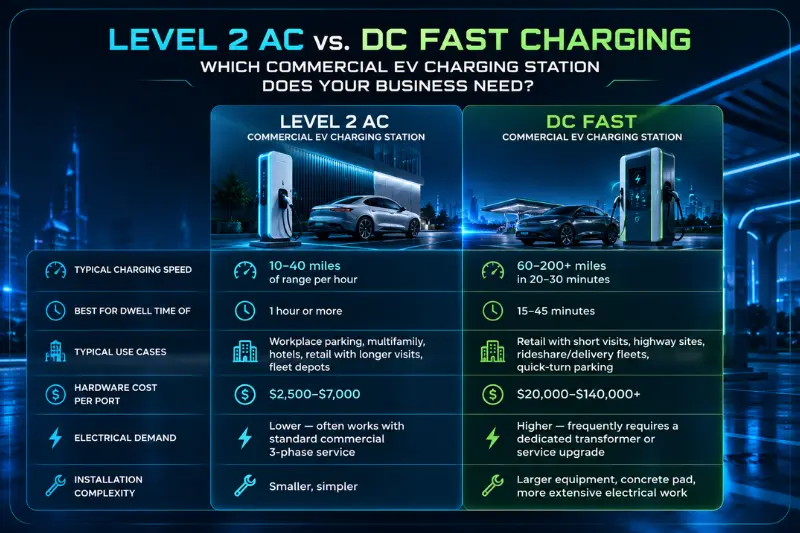
This is the single most consequential decision in the entire process, and it is driven by one question: how long do vehicles typically stay parked at your location?
| Level 2 AC Commercial EV Charging Station | DC Fast Commercial EV Charging Station | |
|---|---|---|
| Typical charging speed | 10–40 miles of range per hour | 60–200+ miles in 20–30 minutes |
| Best for dwell time of | 1 hour or more | 15–45 minutes |
| Typical use cases | Workplace parking, multifamily, hotels, retail with longer visits, fleet depots | Retail with short visits, highway sites, rideshare/delivery fleets, quick-turn parking |
| Hardware cost per port | $2,500–$7,000 | $20,000–$140,000+ |
| Electrical demand | Lower — often works with standard commercial 3-phase service | Higher — frequently requires a dedicated transformer or service upgrade |
| Installation complexity | Smaller, simpler | Larger equipment, concrete pad, more extensive electrical work |
A common mistake is assuming faster is always better. For a workplace where employees park for eight hours, a DC fast commercial EV charging is a waste of money — you would be paying for speed nobody needs, and you will fit far fewer ports into your budget. Conversely, installing only a Level 2 commercial EV charging at a gas station or quick-service retail site will not satisfy drivers who need to be back on the road in 20 minutes. Many larger commercial sites end up installing a mix: a few DC fast commercial EV charging near the entrance for quick-turn visitors, and a bank of Level 2 commercial EV charging in longer-stay sections of the lot.
How Much Does a Commercial EV Charging Station Actually Cost?
Most pages on this topic quote a hardware price and stop there, which is misleading — hardware is often the smaller line item. Here is the fuller picture.
Hardware: Level 2 commercial EV charging units typically run $2,500–$7,000 per port depending on connectivity features, number of ports, and enclosure type. DC fast commercial EV charging range from around $20,000 for a basic 50 kW unit to well over $100,000 for high-power 150–350 kW units.
Installation: This is where estimates diverge wildly, because it depends entirely on your site’s existing electrical infrastructure. A Level 2 commercial EV charging station installation where the panel already has spare capacity might run $1,500–$5,000 per port. If you need a panel upgrade, trenching, or a long conduit run, that figure can climb to $10,000–$25,000 per port. A DC fast commercial EV charging station installation frequently requires a new transformer or utility service upgrade, which alone can cost $50,000–$150,000+ and may involve a multi-month lead time with your utility — this is consistently the most underestimated part of any commercial EV charging station project.
Costs competitors’ pages tend to leave out entirely:
Demand charges: Commercial electricity rates often include a charge based on your peak power draw, not just total energy used. A single DC fast commercial EV charging station pulling 150 kW can spike your demand charge enough to noticeably affect your monthly electric bill — even if very few cars actually use it. Ask your utility about your rate structure and demand charge exposure before you commit to a fast commercial EV charging station, and ask your charger vendor whether their system supports load management to cap your peak draw.
Network and software subscription fees: A networked commercial EV charging station typically carries an annual or monthly software fee per port, often $200–$700 per year, on top of the hardware.
Payment processing fees: If you charge drivers directly for using your commercial EV charging station, standard payment processing fees apply.
ADA-compliant paving, signage, and accessible route requirements: These are easy to underbudget if you are treating the commercial EV charging station as a standalone equipment purchase rather than a small construction project.
Maintenance and warranty terms: Find out what is covered, for how long, and what an after-warranty commercial EV charging station service call costs before you sign anything — uptime is usually what determines whether a site host is happy with their investment two years in.
Ownership Models: Who Pays, Who Owns, and Who Is on the Hook for Repairs
There are three broad models for a commercial EV charging station, and the right one depends on your capital availability, appetite for risk, and whether you want charging to be a revenue source or simply an amenity.
1. Buy and Operate You purchase the commercial EV charging station hardware, pay for installation, and manage the software and billing yourself. You keep all the revenue and full control over pricing and access, but you also own the maintenance burden and the upfront capital outlay.
2. Charging-as-a-Service (CaaS) A vendor finances the commercial EV charging hardware and installation, and you pay a monthly fee — sometimes flat, sometimes tied to usage. This lowers the upfront cost significantly and usually includes maintenance, but you will pay more over the equipment’s lifetime than an outright purchase, and you may have less flexibility to switch providers later.
3. Host Model (Turnkey, Vendor-Owned) A charging network installs, owns, operates, and maintains a commercial EV charging on your property at no cost to you, and either pays you a small revenue share or simply treats the installation as a value-add for your tenants and customers. This is the lowest-risk, lowest-cost option, but you have the least control — you cannot easily set your own pricing, branding, or access rules, and you are dependent on that network continuing to operate in your market.
| Buy and Operate | CaaS | Host Model | |
|---|---|---|---|
| Upfront cost | Highest | Low to none | None |
| Ongoing cost | Maintenance only | Monthly fee | None (revenue share, if any) |
| Revenue potential | Full | Partial (after fees) | Minimal or none |
| Control over pricing and branding | Full | Often full | Limited |
| Risk if vendor exits | None | Some | Significant |
If your goal is steady ancillary revenue and you have capital available, buying a commercial EV charging station outright makes sense. If you want a commercial EV charging available with minimal cash outlay and do not need it to be profitable, the host model is the path of least resistance. CaaS sits in between and suits businesses that want predictable budgeting without a large capital expense.
How to Choose the Right Commercial EV Charging Station and Software Platform
Beyond AC vs. DC, these are the factors that actually determine whether your commercial EV charging station works well two years from now:
Connector Standard With the US market consolidating around the NACS connector alongside the older CCS1 standard, look for a commercial EV charging that either supports both or can be adapted — a single-standard commercial EV charging installed today risks turning away a growing share of drivers within a few years.
Open Protocol vs. Proprietary System A commercial EV charging station that uses OCPP (Open Charge Point Protocol) can connect to multiple software backends, which protects you from being locked into one vendor’s pricing and roadmap forever. A closed, proprietary commercial EV charging station can be cheaper upfront but harder to leave later.
Load Management This lets a system intelligently share available power across multiple commercial EV charging station ports so you do not need to oversize your electrical service to support every port running at full power simultaneously — often the difference between needing an expensive utility upgrade and not.
Access and Payment Method Decide whether you want app-based payment, RFID cards for employee-only or fleet access, free open access, or a mix. This should match how your commercial EV charging station space is actually used.
Reporting and Remote Monitoring You want to know if your commercial EV charging station goes offline without waiting for a complaint. Ask to see the actual dashboard before buying, not just a feature list.
UL Listing Make sure your commercial EV charging station hardware carries UL 2594 or UL 2231 certification — required for permitting and insurance in the US.
The Commercial EV Charging Station Installation Process, Step by Step
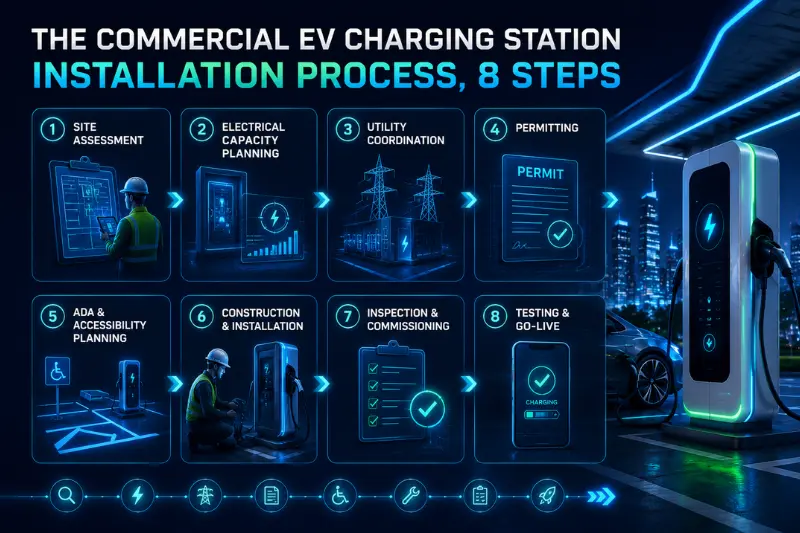
Step 1:
Site Assessment A qualified electrician or commercial EV charging station vendor evaluates your existing electrical service, available panel capacity, and the physical layout of your parking area.
Step 2:
Electrical Capacity Planning If your panel does not have spare capacity, you will need either a panel upgrade or a plan to manage load across fewer simultaneous commercial EV charging station ports. This step alone can take weeks if utility coordination is required.
Step 3:
Utility Coordination A DC fast commercial EV charging station or multi-port deployment often requires coordination with your utility for a new transformer or service upgrade — budget extra lead time here.
Step 4:
Permitting Your local Authority Having Jurisdiction (AHJ) will require an electrical permit, and the commercial EV charging station install must comply with National Electrical Code Article 625 along with any local amendments.
Step 5:
ADA and Accessibility Planning At least one accessible charging space with appropriate signage, route, and clearances is typically required once you install multiple commercial EV charging station ports — plan this into your site layout from the start.
Step 6:
Construction and Installation Trenching, conduit, mounting, and electrical termination for your commercial EV charging station.
Step 7:
Inspection and Commissioning Local inspection sign-off, plus commissioning of the commercial EV charging station’s network connectivity and software.
Step 8:
Testing and Go-Live Confirm charging sessions, payment processing, and remote monitoring all function correctly before opening your commercial EV charging station to the public or employees.
For a straightforward Level 2 commercial EV charging station installation with adequate existing electrical capacity, expect 4–8 weeks from contract to go-live. For a DC fast commercial EV charging station requiring a utility service upgrade, 4–9 months is common — plan your budget and marketing timelines accordingly.
Permits, Codes, and Standards for a Commercial EV Charging Station
- NEC Article 625 governs commercial EV charging station installation in the US and is the baseline your electrician will be working from
- Local AHJ permitting is required for essentially every commercial EV charging station install
- UL 2594 or UL 2231 listing on the equipment itself — confirm this in writing with your vendor
- ADA parking and accessibility requirements scale with the number of commercial EV charging station spaces installed
- Fire code clearances are particularly relevant for DC fast commercial EV charging stations, which generate more heat
Tax Credits and Incentives for a Commercial EV Charging Station
The federal Section 30C Alternative Fuel Vehicle Refueling Property Credit has historically covered 6% of commercial EV charging station equipment and installation costs — or 30% if prevailing wage and apprenticeship requirements are met — capped at $100,000 per port for qualifying business installations in eligible census tracts. However, this credit is scheduled to expire for any commercial EV charging station placed in service after June 30, 2026, with no extension currently expected from Congress.
Practically, that means: if you are reading this close to that date, time is genuinely short, and you should talk to your tax advisor and your commercial EV charging station installer immediately about whether you can get a qualifying installation operational before the deadline.
Beyond the federal credit, state, utility, and regional incentive programs for a commercial EV charging are a much bigger and more durable opportunity than most businesses realize. Many electric utilities offer rebates specifically for commercial EV charging station infrastructure, sometimes covering a meaningful share of installation costs. Check the US Department of Energy’s Alternative Fuels Data Center incentives database and contact your local utility’s business programs team directly before finalizing your commercial EV charging budget — do not rely on a vendor’s incentive estimate alone.
How to Maximize Revenue and ROI From Your Commercial EV Charging Station
- Price by time, not just energy, in high-turnover locations — an idle or overstay fee encourages drivers to move along once charged, keeping your commercial EV charging station spaces available for new customers
- Consider time-of-use pricing that is higher during peak grid demand hours and lower overnight, which can manage your demand charges and nudge fleet users toward cheaper hours
- Look into demand response and V2G program participation where available — some utilities pay commercial EV charging station operators to reduce charging load during grid stress events
- Pair your commercial EV charging station with on-site marketing or promotions in retail and hospitality settings — the 20–30 minutes a driver spends at your commercial EV charging station is a real, captive marketing opportunity
- Track utilization data from day one — most networked commercial EV charging stations report session length, frequency, and revenue per port — use this data to decide whether to expand
7 Mistakes Businesses Make When Installing a Commercial EV Charging Station
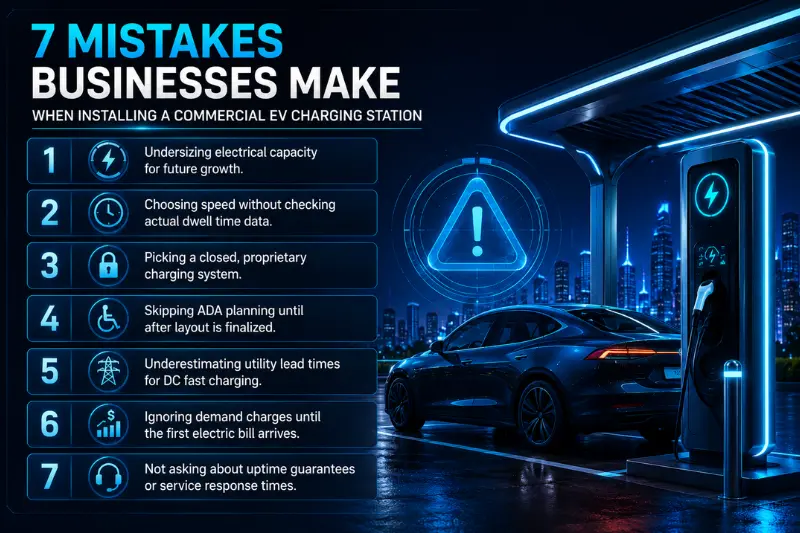
- Undersizing electrical capacity for future growth. Installing exactly enough capacity for today’s two commercial EV charging station ports means an expensive redo when you want to add four more next year. Plan conduit and panel capacity for growth even if you install fewer ports initially.
- Choosing speed without checking actual dwell time data. Guessing how long customers stay is common — pulling actual parking duration data is better before committing to a DC fast commercial EV charging station.
- Picking a closed, proprietary commercial EV charging system to save money upfront. This can lock you into one vendor’s subscription pricing indefinitely.
- Skipping ADA planning until after layout is finalized, which often forces a costly commercial EV charging station site redesign.
- Underestimating utility lead times for a DC fast commercial EV charging station, which can derail a marketing or leasing timeline built around an assumed go-live date.
- Ignoring demand charges until the first electric bill arrives after your commercial EV charging station goes live.
- Not asking about uptime guarantees or service response times before signing — a commercial EV charging that is broken half the time is worse for your reputation than having no charger at all.
Future-Proofing Your Commercial EV Charging Station Investment
- Bidirectional charging (V2G) capability is moving from pilot programs toward mainstream availability — choosing a commercial EV charging station that is at least V2G-capable protects your investment as utility programs expand
- Connector standardization around NACS is reshaping the market — a commercial EV charging station that supports both NACS and CCS1, or can be retrofitted, is the safer long-term bet
- Modular, scalable commercial EV charging station hardware lets you add capacity incrementally rather than replacing entire units as demand grows
- Software-upgradable commercial EV charging station systems mean new features like dynamic pricing, demand response participation, and fleet management tools can often be added without swapping hardware
Frequently Asked Questions
What is a commercial EV charging station?
A commercial EV charging is a charger installed on business, institutional, or multifamily property for use by employees, customers, tenants, or fleet vehicles — as opposed to a charger installed at a private single-family home.
How much does it cost to install a commercial EV charging station?
Hardware alone ranges from roughly $2,500 per port for a Level 2 commercial EV charging to well over $100,000 for a high-power DC fast commercial EV charging. Installation costs can range from a few thousand dollars to well over $100,000 if a utility service upgrade is required.
Is there still a tax credit for a commercial EV charging station?
this writing, the federal Section 30C credit for a commercial EV charging station is scheduled to expire for installations placed in service after June 30, 2026. State and utility incentive programs vary by location and are generally a better long-term bet — check with your utility and state energy office directly.
Do I need a permit to install a commercial EV charging station?
A commercial EV charging station installation requires an electrical permit from your local Authority Having Jurisdiction and must comply with NEC Article 625.
Should I install a Level 2 or DC fast commercial EV charging station?
It depends on how long vehicles typically stay at your site. Use a Level 2 commercial EV charging for dwell times of an hour or more — workplaces, multifamily, hotels. Use a DC fast commercial EV charging for quick-turn visits of 15–45 minutes — retail with short stays, fleet quick-turn, highway-adjacent sites.
Can I charge customers a fee to use my commercial EV charging station?
Yes. Most networked commercial EV charging stations support per-session, per-kWh, or time-based billing. Whether to charge at all is a business decision — some properties treat their commercial EV charging purely as a free amenity to drive traffic or leasing, while others run it as a revenue line.
How long does a commercial EV charging station installation take?
A straightforward Level 2 commercial EV charging station installation with existing electrical capacity typically takes 4–8 weeks from contract to go-live. A DC fast commercial EV charging station installation requiring a utility upgrade commonly takes 4–9 months.
Who maintains a commercial EV charging station after installation?
This depends on your ownership model. If you buy the hardware outright, you are typically responsible for commercial EV charging station maintenance unless you purchase a service contract. Charging-as-a-Service and host models generally include maintenance as part of the arrangement — confirm exactly what is covered before signing.
Final Thoughts
The businesses that get the most value out of a commercial EV charging station are the ones that start with their site’s actual usage pattern — how long vehicles stay, how many drivers they are realistically serving, and what their electrical infrastructure can support — rather than starting with a charger model and working backward.
Get a proper site assessment before you commit to a commercial EV charging station. Ask hard questions about demand charges and utility lead times upfront. Treat the software and ownership model decisions with as much care as the equipment itself. A commercial EV charging station done right pays for itself in customer loyalty, employee satisfaction, or direct revenue — usually all three.
This article is for general informational purposes and does not constitute tax, legal, or engineering advice. Confirm current incentive eligibility, code requirements, and site-specific electrical capacity with a licensed professional before proceeding.