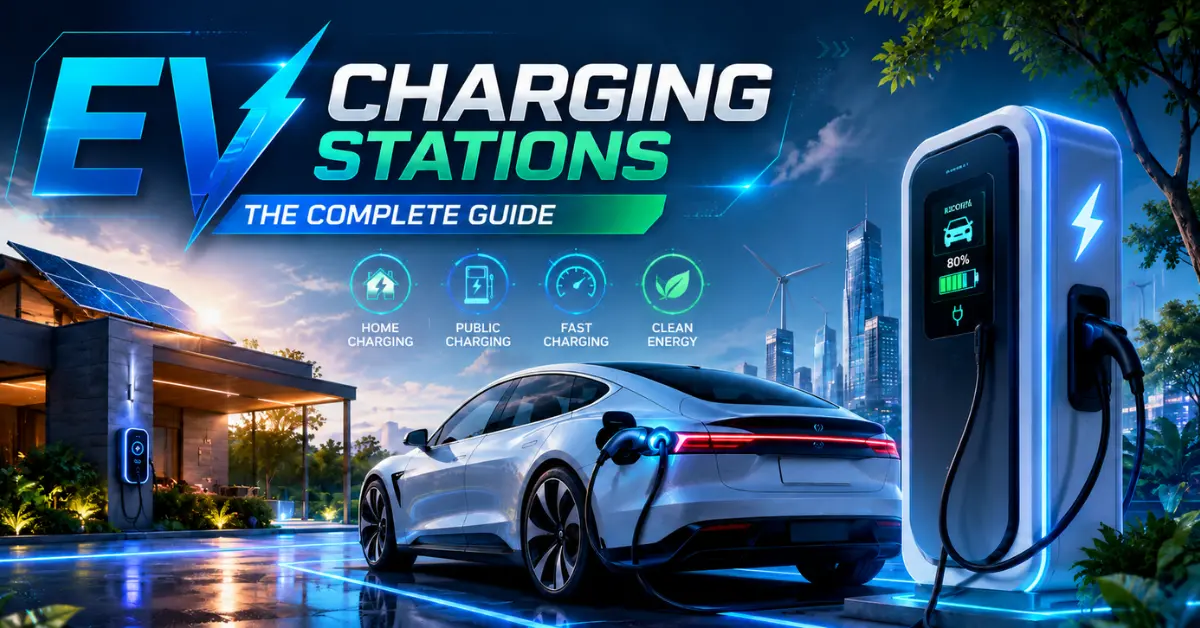
Electric vehicles are no longer a niche product — they are the present, and EV charging stations are the infrastructure that makes them work. Whether you are buying your first electric vehicle, already driving one, or managing a business property looking to add charging, understanding how EV charging stations work — and how to use them smartly — makes a real difference to your cost, convenience, and overall experience.
This guide covers everything: the three levels of charging, real costs, home vs. public station comparisons, major charging networks, connector standards, business installation, incentives still available, and the tips that will save you the most money over the life of your EV.
What Are EV Charging Stations?
EV charging stations are devices that supply electricity to recharge electric vehicle batteries. They connect to the electrical grid and deliver power through a charging cable into your vehicle’s battery system — functionally similar to how a gas station refuels a conventional car, but with electricity instead of fuel.
As of early 2026, the United States has over 80,000 public EV charging stations with more than 248,000 individual charging ports — a network that has grown dramatically over the past three years and continues to expand rapidly.
EV charging stations fall into three levels based on power output and charging speed. Understanding these levels is the foundation of everything else in this guide.
The Three Levels of EV Charging Stations
Level 1: Standard Household Outlet Charging
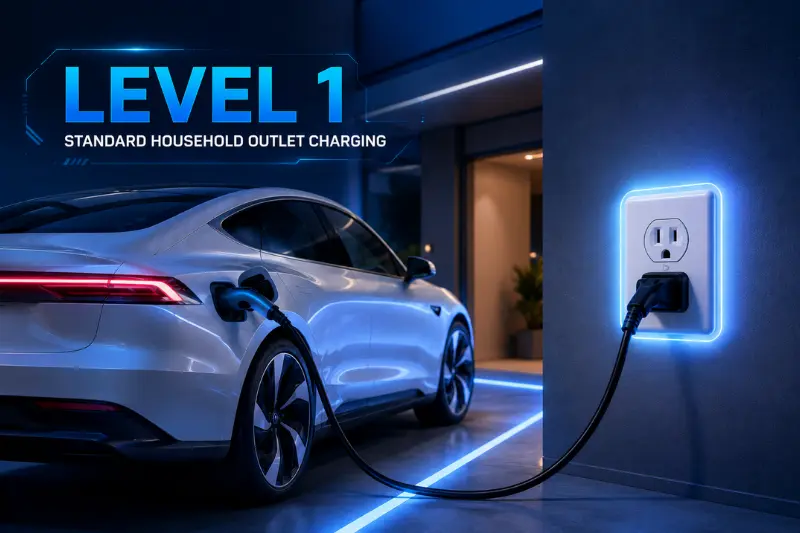
What it is: A standard 120-volt household outlet — the same outlet you plug a lamp into.
Charging speed: Adds approximately 3–5 miles of range per hour of charging.
Full charge time: 20–50+ hours depending on your vehicle’s battery size.
Cost of equipment: No additional equipment needed beyond the cable that comes with your EV. Cost is essentially zero upfront.
Best for:
- Plug-in hybrid electric vehicles (PHEVs) with smaller batteries
- Drivers who travel fewer than 30–40 miles per day and have overnight charging time
- Temporary or backup charging when Level 2 is not available
The honest reality: Level 1 charging is genuinely impractical for most full battery electric vehicle (BEV) owners. Charging at 3–5 miles per hour means a vehicle with a 300-mile range would take 60–100 hours to charge from empty. It works as a supplemental option but should not be your primary charging strategy.
Level 2: The Standard for Home and Business EV Charging Stations
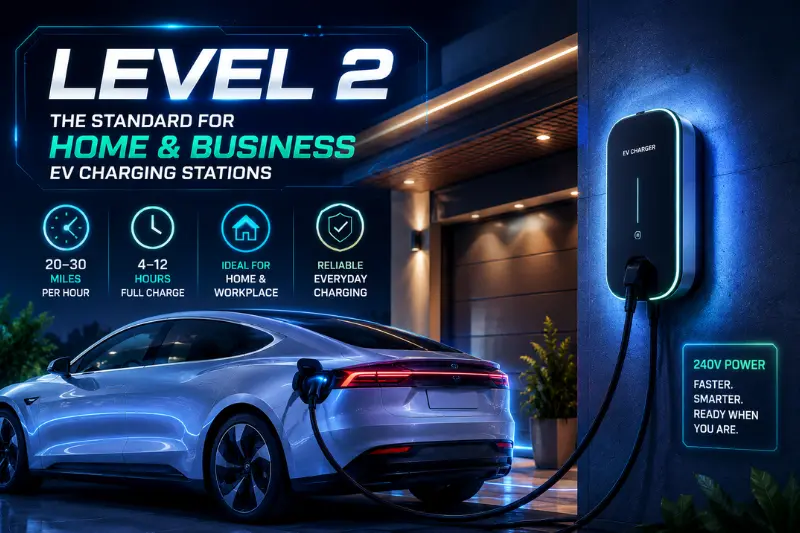
What it is: A 240-volt circuit — the same voltage as a clothes dryer or electric oven. Requires dedicated charging equipment (EVSE) and a professional electrical installation.
Charging speed: Adds approximately 20–30 miles of range per hour of charging. Most EVs charge from 10% to 80% in 4–8 hours.
Full charge time: 4–12 hours depending on vehicle battery size and charger power output.
Home installation cost:
- Charger unit: $300–$800
- Professional installation: $500–$2,000 depending on your electrical panel’s current capacity and distance from the panel to the installation location
- Total typical cost: $800–$2,800
Public Level 2 charging cost: $0.20–$0.40 per kWh, or $1–$3 per hour at networks like ChargePoint. Some retail locations, workplaces, and hotels offer free Level 2 charging.
Best for:
- Home overnight charging for the vast majority of EV owners
- Workplace charging (employees charge during the full workday)
- Retail and hospitality destinations where customers dwell for 2–4+ hours
The bottom line on Level 2: For most EV owners, a Level 2 home charger is the single best investment you can make. You wake up every morning to a full battery without thinking about charging at all.
Level 3: DC Fast Charging Stations (DCFC)
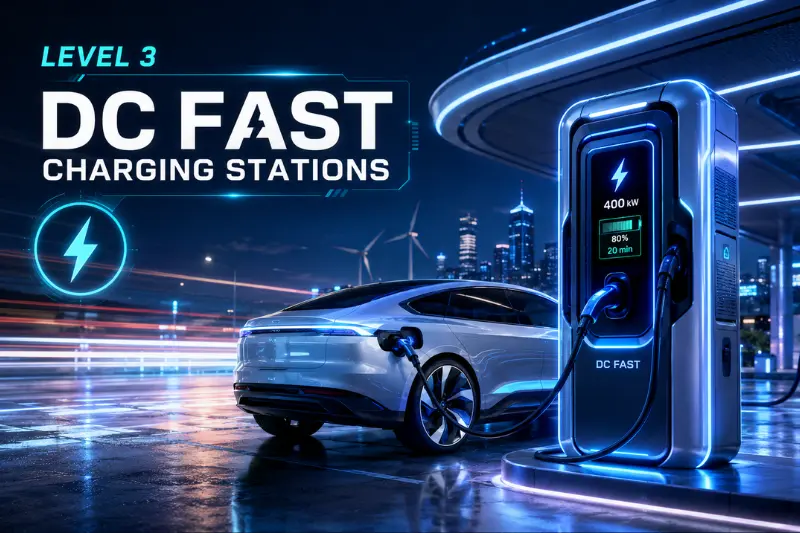
What it is: Direct current (DC) fast chargers that bypass the vehicle’s onboard charger and deliver power directly to the battery at very high voltages (up to 400 kW or beyond in the latest installations).
Charging speed: Adds 100–200+ miles of range in 20–30 minutes. Some ultra-fast stations can add significant range in as little as 10–15 minutes.
Full charge equivalent: Most EVs charge to 80% in 20–30 minutes. Charging from 80–100% slows significantly — battery management systems deliberately slow charging in the upper range to protect battery longevity.
Cost of public DC fast charging: $0.30–$0.60 per kWh. A 20-minute road trip top-up typically costs $10–$25. Tesla Supercharger rates average $0.53 per kWh for non-Tesla vehicles.
Commercial installation cost: $50,000–$200,000+ per station, including equipment and electrical infrastructure. DC fast chargers require significant electrical upgrades at most sites.
Best for:
- Highway travel and long road trips
- Short dwell time locations (convenience stores, quick service restaurants, highway rest stops)
- Emergency top-ups when your battery is low and you need range quickly
Important warning: Relying on DC fast charging for daily charging is both expensive and bad for your battery over time. Most EV manufacturers recommend limiting DC fast charging to road trips and using Level 2 charging at home for daily top-ups to preserve long-term battery health.
The Real Cost of EV Charging stations: Home vs. Public
This is the comparison most EV owners want answered honestly, and most guides give incomplete numbers. Here is the complete picture:
Home charging (Level 2, off-peak rates):
- Cost per kWh: $0.11–$0.16 with off-peak time-of-use pricing
- Annual cost for average driver (13,489 miles): approximately $302–$480
- Cost per mile: approximately $0.04
Public Level 2 charging:
- Cost per kWh: $0.25–$0.40
- Annual cost if used exclusively: approximately $963
- Cost per mile: approximately $0.07–$0.10
Public DC fast charging:
- Cost per kWh: $0.30–$0.60
- Annual cost if used exclusively: approximately $2,144
- Cost per mile: approximately $0.12–$0.18
Gasoline comparison:
- Cost per mile (28 mpg vehicle, $3.50/gallon gas): approximately $0.125
- Annual fuel cost: approximately $1,400–$1,700
Major EV Charging Networks
Understanding the major networks helps you plan where to charge on road trips and how to minimize public charging costs.
Tesla Supercharger Network Over 3,088 stations with more than 37,428 ports across the United States. Once exclusively Tesla-only, Superchargers are now open to non-Tesla vehicles with an adapter. Rates average $0.53 per kWh for non-Tesla drivers — slightly higher than Tesla-vehicle rates. The Tesla network remains the most dense and reliable fast-charging network in North America.
Electrify America The largest non-Tesla DC fast charging network in the US, with stations at Walmart locations and major highway corridors. Pass+ membership saves approximately $0.10 per kWh compared to non-member rates. Strong coverage along interstate travel routes.
ChargePoint The largest network of Level 2 EV charging stations in the United States, with stations at workplaces, retail centers, parking garages, and multifamily buildings. Pricing varies by location — $0.20–$0.35 per kWh or $1–$3 per hour. ChargePoint’s network is particularly strong for workplace and destination charging.
EVgo Focused on DC fast charging in urban areas. Monthly membership plans reduce per-kWh costs. Strong coverage in California and major East Coast cities.
Blink Network Level 2 and DC fast charging stations at hotels, retail locations, and parking facilities. Billing options include per-minute ($0.04–$0.06) or per-session fees depending on location.
Free Charging Locations Many EV owners underestimate how much free Level 2 charging is available. Target, Whole Foods, many Marriott and Hilton hotels, and various workplace campuses offer free Level 2 charging. Planning road trips and regular routes around free Level 2 stations during longer stops is one of the smartest cost-saving strategies available to EV owners.
EV Charging Connector Standards: What You Need to Know
Connector standards have been a source of significant confusion for EV owners, particularly as standards have shifted in 2024–2026.
J1772 (Type 1) The universal AC charging standard for Level 1 and Level 2 charging in North America. All non-Tesla EVs sold in North America include a J1772 port. Tesla vehicles use an adapter to connect to J1772 stations.
NACS (North American Charging Standard / Tesla Connector) Originally Tesla’s proprietary connector, NACS has become the emerging North American standard. As of 2024–2026, Ford, GM, Rivian, Honda, Nissan, and most major automakers have announced adoption of NACS on their EVs. New NACS-equipped EVs can use Tesla Superchargers natively without an adapter.
CCS (Combined Charging System) The previous multi-standard DC fast charging connector widely deployed across Electrify America, EVgo, Blink, and other networks. CCS ports on EVs are being phased out as NACS adoption grows, but CCS stations will remain relevant for years due to the installed base.
CHAdeMO A Japanese DC fast charging standard used by older Nissan Leaf models. Being phased out in North America — CHAdeMO stations are becoming harder to find.
Home EV Charging Stations: What to Install and Why
For most EV owners, a home Level 2 charger is the single most important purchase you make alongside your vehicle itself. Here is what to consider:
Top recommended home EV charging stations in 2026:
- Lectron V-Box 48A ($304): Best overall speed and value — delivers up to 48 amps and charges most EVs at maximum onboard AC charging speed
- Emporia Energy Smart ($429): Best budget smart charger with WiFi connectivity, scheduling, and energy monitoring — lets you set charging to off-peak hours automatically
- Grizzl-E Classic ($300): Most durable build quality — excellent for cold-weather climates and outdoor installations
What to know before installation:
- Most homes need a 240-volt, 40–60 amp dedicated circuit for a Level 2 charger
- Older homes with 100-amp electrical panels may need a panel upgrade before installation, adding $1,500–$4,000 to the total cost
- Hire a licensed electrician — this is not a DIY project and most charger warranties require professional installation
- Get multiple installation quotes — labor costs vary significantly between electricians
Apartment and renter charging: If you rent, do not assume charging is impossible. Several US states including California and Colorado have “right to charge” laws that require landlords to permit EV charger installation. Point out to your landlord that EV chargers increase property value by $5,000–$15,000 according to Department of Energy research — this often changes the conversation.
Business EV Charging Stations: The Case for Commercial Installation
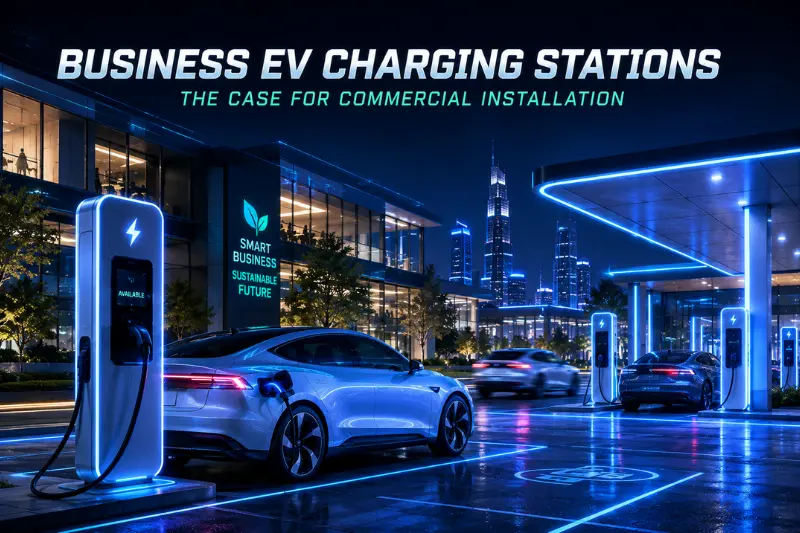
Businesses, property managers, and employers adding EV charging stations in 2026 are making a strategic investment — not just an environmental one.
Why businesses install EV charging stations:
- Attract and retain EV-driving employees and customers — a growing majority of new car buyers
- Generate revenue through paid charging (typically $0.20–$0.40 per kWh for Level 2)
- Increase property value and tenant satisfaction for commercial real estate
- Meet corporate sustainability and ESG reporting requirements
- Position ahead of accelerating EV adoption — projections estimate 50% of new US car sales will be electric by 2030
Commercial installation costs:
- Level 2 per port: $3,000–$7,000 fully installed, including equipment and electrical work
- DC fast charger per station: $50,000–$200,000+ depending on power level and site conditions
- Federal tax credits and utility incentives can cover up to 30% of upfront costs
Dwell time is the key decision driver: Choose Level 2 for locations where customers or employees dwell for 2+ hours — offices, hotels, apartment complexes, gyms, and retail destinations. Choose DC fast charging for short-stop locations — highway rest stops, convenience stores, and quick service restaurants.
EV Charging Incentives and Programs
Federal Commercial Tax Credit (Section 30C) The Alternative Fuel Vehicle Refueling Property Credit (Section 30C) provides a tax credit for commercial EV charging station installation. Consult a tax professional for current eligibility and rates in 2026 — this program has been subject to legislative changes.
NEVI Program The National Electric Vehicle Infrastructure (NEVI) program continues funding state-administered grants for public EV charging stations along designated highway corridors. Stations built with NEVI funding must accept credit cards without requiring app downloads and must display clear per-kWh pricing — improving usability for all drivers.
Utility rebates Many US utilities offer rebates on home Level 2 charger installation. These vary significantly by state and utility — check your specific utility’s website or ask your EV charger installer. Rebates of $200–$500 on equipment and installation are common.
Time-of-use (TOU) electricity rates Most utilities offer time-of-use plans that reduce electricity costs by 30–50% during off-peak hours (typically overnight, 9 PM–6 AM). Enrolling in your utility’s TOU plan and scheduling your home charger to charge overnight is the single most effective way to minimize EV charging stations costs.
10 Smart Tips to Save Money on EV Charging
- Charge at home overnight on a time-of-use plan. Off-peak rates reduce your effective cost to $0.11–$0.16 per kWh — the cheapest charging available anywhere.
- Get a smart charger with scheduling. Set it once and forget it — your car charges automatically during off-peak hours without you thinking about it.
- Use network memberships for public charging. Electrify America Pass+, EVgo memberships, and ChargePoint subscriptions all offer meaningfully lower per-kWh rates than non-member pricing.
- Find free Level 2 charging. Target, Whole Foods, many hotels, and workplace lots offer free Level 2 — use these during longer stops instead of paying at fast chargers.
- Limit DC fast charging to road trips. Fast charging costs more money and accelerates battery degradation over time. Use it when you need it, not as your daily charging method.
- Charge to 80%, not 100%, for daily use. EV battery management systems work most efficiently in the 20–80% range. Reserve 100% charges for days when you need maximum range.
- Pre-condition your battery before DC fast charging. Many EVs have a “navigate to charger” feature that warms or cools the battery to optimal temperature before arrival, significantly speeding up your fast charging session.
- Plan road trips with PlugShare or A Better Route Planner. These apps show real-time charger availability and help you find the fastest and cheapest charging stops for any route.
- Take advantage of hotel charging. Many hotels with EV charging stations offer free overnight Level 2 as a guest perk — request an EV-friendly room when booking.
- Check for utility EV rebates before installation. Your local utility may rebate part of your Level 2 charger equipment or installation cost. A five-minute check can save $200–$500.
FAQs
How long does it take to charge an electric vehicle?
It depends entirely on the charging level. Level 1 (standard outlet) adds 3–5 miles of range per hour — impractically slow for most drivers. Level 2 adds 20–30 miles per hour and charges most EVs overnight in 4–12 hours. DC fast chargers add 100–200 miles in 20–30 minutes. For daily home charging, Level 2 is the practical standard.
How much does it cost to charge an EV at a public station?
Public Level 2 charging typically costs $0.25–$0.40 per kWh, or $1–$3 per hour. DC fast charging costs $0.30–$0.60 per kWh — a 20-minute road trip top-up typically runs $10–$25. Some retail, workplace, and hotel locations offer free Level 2 charging. Home charging at off-peak rates ($0.11–$0.16 per kWh) remains significantly cheaper than any public option.
How many EV charging stations are there in the US in 2026?
As of early 2026, there are over 80,000 public EV charging stations with more than 248,000 individual charging ports across the United States. This includes over 3,088 Tesla Supercharger stations with more than 37,428 ports — the largest single fast-charging network in the country.
What is the difference between Level 1, Level 2, and Level 3 charging?
Level 1 uses a standard 120-volt household outlet and charges slowly (3–5 mph). Level 2 uses a 240-volt circuit and charges at 20–30 mph — the standard for home and commercial charging. Level 3 (DC fast charging) delivers 100–200+ miles in 20–30 minutes and is found at public stations. Most EV owners use Level 2 at home and DC fast charging on road trips.
Is it cheaper to charge an EV than to fill a gas tank?
Yes — significantly. Home charging costs approximately $302 per year for the average driver, compared to $1,400–$1,700 in gasoline for a conventional vehicle. That is a saving of over $1,000 annually, not counting lower maintenance costs. Even public Level 2 charging ($963 per year average) is cheaper than gas. Only DC fast charging as an exclusive daily strategy approaches gas costs.
What EV charging connector do I need in 2026?
If you are buying a new EV in North America in 2026, NACS (the North American Charging Standard, originally Tesla’s connector) is the recommended choice — it gives you access to the largest and most reliable fast-charging network. Most major automakers have adopted NACS. CCS connectors are still common on existing EVs, with adapters available for most charging networks.
Can I install an EV charging station at home?
Yes. A Level 2 home charger requires a 240-volt, 40–60 amp dedicated circuit installed by a licensed electrician. The charger unit costs $300–$800, and professional installation typically adds $500–$2,000 depending on your home’s electrical setup. Total cost is usually $800–$2,800. Check your local utility for rebates on equipment and installation.
Can apartments and renters install EV chargers?
In many cases, yes. Several states including California and Colorado have right-to-charge laws that require landlords to permit EV charger installation. For landlords in other states, presenting Department of Energy research showing EV chargers increase property value by $5,000–$15,000 often helps make the case. Public Level 2 chargers at nearby retail and workplace locations are also a viable daily charging strategy for apartment dwellers.
Final Thoughts
EV charging stations have moved from a novelty to a genuine infrastructure — and in 2026, the network, the technology, and the pricing all favor the EV driver more than ever before. Over 80,000 public stations. Home charging at a fraction of gasoline cost. Smart chargers that schedule themselves. Networks that cover virtually every highway corridor in the country.
The keys to getting the most from EV charging stations are simple: charge at home overnight on an off-peak plan, use public Level 2 when you have time, reserve DC fast charging for road trips, and use network memberships to cut public charging costs. Follow those principles and your total annual charging cost will likely run under $400 — leaving $1,000 or more in your pocket each year compared to a gasoline vehicle.
The infrastructure is here. The savings are real. The only question is how smartly you use them.