Switching to an electric vehicle is one of the best decisions you can make — for your wallet, your commute, and the planet. But if charging is inconvenient, the experience quickly sours.
Installing a home EV charging station changes everything. Instead of hunting for a public charger, you wake up every morning with a full battery. A home EV charging station provides convenience, faster charging speeds, and long-term savings.Whether you’re buying your first electric vehicle or upgrading your setup, choosing the right home EV charging station can dramatically improve your ownership experience. Instead of hunting for a public charger, you wake up every morning with a full battery. No waiting. No detours. No surprise fees.
This guide covers everything you need to know about home EV charging stations — from the basics of how they work to exactly which unit you should buy, how much installation will cost, and the money-saving tips most guides skip entirely.
What Is a Home EV Charging Station?
A home EV charging station — also called an Electric Vehicle Supply Equipment (EVSE) — is a dedicated device that safely delivers electricity from your home’s electrical system to your car’s battery.
It’s different from simply plugging your EV into a standard wall outlet. A proper charging station manages voltage, current, and communication between your car and your electrical panel, resulting in faster, safer, and more reliable charging.
The connector type matters: Most non-Tesla EVs in North America use the SAE J1772 standard for Level 2 AC charging. Tesla vehicles use the NACS (North American Charging Standard) connector, but adapters are widely available — and since 2023, most major automakers have announced a switch to NACS, so compatibility is improving across the board.
Level 1 vs Level 2 vs DC Fast Charging: Which Do You Need?
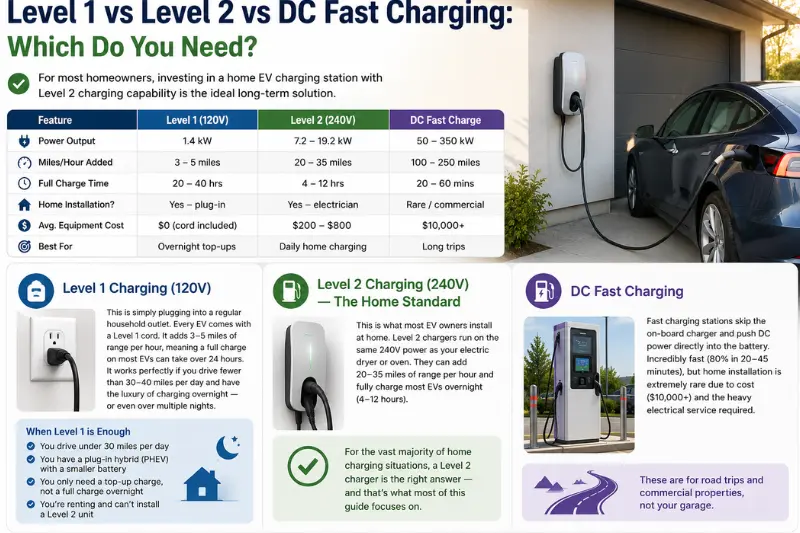
For most homeowners, investing in a home EV charging station with Level 2 charging capability is the ideal long-term solution.
There are three types of EV charging, and understanding the difference is the most important decision you’ll make:
| Feature | Level 1 (120V) | Level 2 (240V) | DC Fast Charge |
| Power Output | 1.4 kW | 7.2 – 19.2 kW | 50 – 350 kW |
| Miles/Hour Added | 3 – 5 miles | 20 – 35 miles | 100 – 250 miles |
| Full Charge Time | 20 – 40 hrs | 4 – 12 hrs | 20 – 60 mins |
| Home Installation? | Yes – plug-in | Yes – electrician | Rare / commercial |
| Avg. Equipment Cost | $0 (cord included) | $200 – $800 | $10,000+ |
| Best For | Overnight top-ups | Daily home charging | Long trips |
Level 1 Charging (120V)
This is simply plugging into a regular household outlet. Every EV comes with a Level 1 cord. It adds 3–5 miles of range per hour, meaning a full charge on most EVs can take over 24 hours. It works perfectly if you drive fewer than 30–40 miles per day and have the luxury of charging overnight — or even over multiple nights.
| When Level 1 is Enough You drive under 30 miles per day You have a plug-in hybrid (PHEV) with a smaller battery You only need a top-up charge, not a full charge overnight You’re renting and can’t install a Level 2 unit |
Level 2 Charging (240V) — The Home Standard
This is what most EV owners install at home. Level 2 chargers run on the same 240V power as your electric dryer or oven. They can add 20–35 miles of range per hour and fully charge most EVs overnight (4–12 hours).
For the vast majority of home charging situations, a Level 2 charger is the right answer — and that’s what most of this guide focuses on.
DC Fast Charging
Fast charging stations skip the on-board charger and push DC power directly into the battery. Incredibly fast (80% in 20–45 minutes), but home installation is extremely rare due to cost ($10,000+) and the heavy electrical service required. These are for road trips and commercial properties, not your garage.
How to Choose the Right Home EV Charging Station
Selecting the right home EV charging station depends on your driving habits, vehicle compatibility, electrical panel capacity, and budget.
Once you’ve committed to a Level 2 charger, here are the six factors that actually matter:
Amperage & Charging Speed
Chargers are rated by amperage: 16A, 24A, 32A, 40A, or 48A. Higher amperage = faster charging. The most popular sweet spot for home use is 32A–48A.
Pro tip: Your car’s onboard charger determines the maximum rate it can accept. Buying a 48A unit when your car can only accept 32A won’t make it charge faster — but it future-proofs you for your next vehicle.
Hardwired vs Plug-In
Plug-in units connect to a NEMA 14-50 outlet (the same type as an RV or electric range). They’re slightly easier to install and you can take them when you move, but the connection point itself can wear over time with high-amperage use.
Hardwired units connect directly to your electrical panel and are generally more reliable for permanent home installations. If you’re running 48A continuously, hardwired is the safer long-term choice.
| If You Go Plug-In at High Amperage… Choose a charger that includes a built-in temperature sensor on the plug. Faulty or loose NEMA connections can overheat at 48A. A temp sensor cuts power automatically if heat is detected — this is a genuine safety feature, not a gimmick. |
Smart Features & Wi-Fi Connectivity
Smart chargers connect to your home Wi-Fi and let you schedule charging, monitor energy use, and receive notifications via a smartphone app. For most people, this is genuinely useful — not just a nice-to-have.
Key smart features to look for:
- Scheduled charging (to charge during off-peak rate windows)
- Energy usage tracking (to see exactly what charging costs you each month)
- Remote start/stop
- Over-the-air firmware updates
- Integration with smart home platforms (Alexa, Google Home, Apple HomeKit)
- Utility rebate eligibility (some smart chargers qualify for additional rebates)
Dynamic Load Management
This is the feature most articles don’t explain properly Dynamic Load Management (DLM) allows the charger to monitor your home’s total electricity demand in real time and reduce charging power when other appliances are running heavy loads (dryer, oven, HVAC).
Why it matters: Without DLM, a 48A charger plus your electric dryer running simultaneously can exceed your electrical panel’s capacity and trip breakers — or worse, require a costly panel upgrade. With DLM, you may be able to install a faster charger without any panel work, saving $1,500–$4,000.
Best DLM chargers: Emporia Pro, ChargePoint Home Flex, Wallbox Pulsar Plus.
Outdoor Rating (NEMA Enclosure Rating)
Look for at least a 3-year warranty on the unit. Top brands — ChargePoint, Emporia, Wallbox, and JuiceBox — typically offer 3 years, with some offering optional extended coverage. Avoid no-name units with 1-year or limited warranties; repair or replacement costs quickly exceed the initial savings.
Best Home EV Charging Station Options
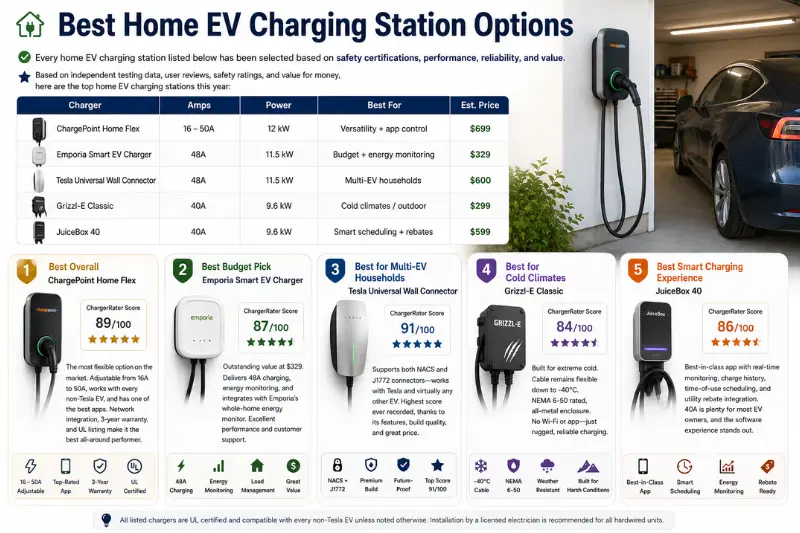
Every home EV charging station listed below has been selected based on safety certifications, performance, reliability, and value.
Based on independent testing data, user reviews, safety ratings, and value for money, here are the top home home EV charging station this year:
| Charger | Amps | Power | Best For | Est. Price |
| ChargePoint Home Flex | 16 – 50A | 12 kW | Versatility + app control | $699 |
| Emporia Smart EV Charger | 48A | 11.5 kW | Budget + energy monitoring | $329 |
| Tesla Universal Wall Connector | 48A | 11.5 kW | Multi-EV households | $600 |
| Grizzl-E Classic | 40A | 9.6 kW | Cold climates / outdoor | $299 |
| JuiceBox 40 | 40A | 9.6 kW | Smart scheduling + rebates | $599 |
Best Overall: ChargePoint Home Flex
The ChargePoint Home Flex is the most flexible home EV charging station on the market. It’s field-adjustable from 16A to 50A, works with every non-Tesla EV, and has one of the best companion apps in the industry. ChargePoint’s charging network integration also means you get a single account for home and public charging. The 3-year warranty and UL listing seal the deal. It’s pricier than budget options, but if you want the best all-around performer, this is it.
Best Budget Pick: Emporia Smart EV Charger
The Emporia is the most impressive value in EV charging right now. At roughly $329, it delivers 48A charging speed, a solid app with energy monitoring, and — critically — it integrates with Emporia’s whole-home energy monitor for basic load management. Its ChargerRater score of 87/100 puts it ahead of chargers costing twice as much. Emporia’s customer support has also earned consistently strong reviews.
Best for Multi-EV Households: Tesla Universal Wall Connector
Tesla’s Universal Wall Connector ($600) is notable for supporting both NACS and J1772 connectors — meaning it works with Tesla vehicles and virtually any other EV on the market. If your household has two different EVs, this is a smart future-proof choice. It also earned the highest ChargerRater score ever recorded at 91/100, largely thanks to its sub-$500 street price relative to its features and build quality.
Best for Cold Climates: Grizzl-E Classic
If you live somewhere that sees -30°C winters, the Grizzl-E Classic is in a class of its own. Its cable remains pliable down to -40°C — most competitor cables stiffen and crack in extreme cold. The all-metal enclosure is rated NEMA 6-50, built for Canadian winters. It lacks smart features (no Wi-Fi, no app), but for rugged simplicity in brutal conditions, nothing beats it.
Best Smart Charging Experience: JuiceBox 40
JuiceBox’s app is widely considered the most polished in the industry. Real-time energy monitoring, detailed charge history, time-of-use scheduling, and utility rebate integration (JuiceBox qualifies for many utility programs) are all well-executed. The 40A rating is slightly below some competitors, but for most EV owners it’s more than sufficient, and the software experience justifies the premium.
How Much Does a Home EV Charging Station Cost to Install?
The installation cost of a home EV charging station varies depending on your home’s electrical infrastructure.
Installation cost is the question most buyers underestimate. The charger itself is often the smallest part of the total investment.
| Cost Item | Low Estimate | High Estimate | Notes |
| EVSE Unit (Level 2) | $200 | $800 | Smart chargers cost more |
| Electrical Panel Upgrade | $1,500 | $4,000 | Only if needed |
| Wiring / Conduit | $200 | $1,000 | Depends on panel distance |
| Electrician Labour | $300 | $1,000 | Varies by region & complexity |
| Permit Fee | $50 | $300 | Required by most municipalities |
| Total Range | $750 | $7,100 | Average is ~$1,200 – $1,800 |
The most common scenario: If your electrical panel already has capacity and the charger is installed in an attached garage near the panel, total cost is usually $800–$1,500. If your panel is older (below 150A service) or the charger needs to go on an exterior wall far from the panel, budget $2,000–$3,500.
| How to Reduce Installation Costs Get 3 quotes from licensed electricians — prices vary dramatically. Ask your electrician if Dynamic Load Management can eliminate the need for a panel upgrade. Check if your utility offers free or discounted installation through a rebate program. If you’re renovating, install the wiring rough-in now even if you’re not buying a home EV charging station yet — adding conduit during a renovation costs a fraction of doing it later. Bundle with other electrical work (new circuits, panel work) — electricians often discount per-item when doing multiple jobs. |
Step-by-Step: Installing a Home EV Charging Station
Proper installation ensures your home EV charging station operates safely and efficiently for years.
Here’s the complete process from decision to first charge:
Check your electrical panel
Locate your main breaker panel and note the total service amperage (typically printed on the main breaker — 100A, 150A, or 200A). A dedicated 240V circuit for a 48A home EV charging station requires a 60A breaker. If your panel is at capacity, you may need an upgrade — or a charger with Dynamic Load Management.
Choose your home EV charging station
Use the criteria in Section 3. Confirm your car’s maximum AC onboard charging rate (found in the owner’s manual) so you don’t over- or under-buy.
Get an electrician to assess
Have a licensed electrician (or two or three — get multiple quotes) visit and assess the run from your panel to the install location, confirm panel capacity, and estimate work needed.
Pull a permit
In most jurisdictions, a 240V electrical circuit requires a permit. Your electrician can handle this. Don’t skip this step — it protects you legally if there’s ever an electrical issue and is required to collect many rebates.
Install the home EV charging station
The electrician installs the circuit breaker, runs conduit and wiring, and mounts and wires the EVSE. For a straightforward job, expect 3–6 hours of work.
Inspection
A city inspector will check the installation (required with a permit). Your electrician typically schedules this.
Activate smart features
Download the companion app, connect to Wi-Fi, create an account, and set up your charging schedule.
First charge
Plug in and enjoy waking up to a full battery every morning.
The Money Side: Savings, Rebates & Tax Credits
How Much Will You Save on Fuel Costs?
The average American drives about 14,000 miles per year. At the US average electricity rate of ~$0.16/kWh, and assuming an EV uses ~3.5 miles per kWh:
- Annual electricity cost to charge at home: approximately $640
- Annual gasoline cost for equivalent mileage (at 28 MPG, $3.50/gallon): approximately $1,750
Annual savings: roughly $1,100. That means your home EV charging station and installation typically pays for itself in under two years.
Federal Tax Credit (US)
The Alternative Fuel Vehicle Refueling Property Credit (IRS Form 8911) allows homeowners to claim 30% of the cost of purchasing and installing a home home EV charging station, up to $1,000. This credit was renewed and expanded under the Inflation Reduction Act through 2032.
Important: The property must be in a low-income or rural census tract for residential properties, under current rules. Consult a tax professional to confirm eligibility.
State & Utility Rebates
Many state programs and electric utilities offer additional rebates, often $100–$500 on the charger itself, and sometimes free installation. Top programs include:
- California: SMUD, PG&E, SCE all offer charger rebates ($500–$800 in some programs)
- New York: NYSERDA Drive Clean Rebate
- Colorado: Xcel Energy’s rebate programs
- Massachusetts: MassSave EV Charging Program
Find your local programs at: pluginamerica.org/charging-rebates or your utility’s website.
Time-of-Use (TOU) Rates
Many utilities offer Time-of-Use rate plans where electricity is cheaper during off-peak hours (typically midnight to 6am). Charging on a TOU plan can cut your per-kWh charging cost by 30–50%, saving an additional $200–$400 per year. Smart chargers make scheduling overnight charging completely automatic.
Getting More From Your Home EV Charging Station
Modern home EV charging station models offer smart scheduling, energy monitoring, and utility integration.
Smart charging is where home EV charging gets genuinely sophisticated — and genuinely valuable. Here’s what the technology can do for you:
Scheduled Charging
Set your home EV charging station to only charge between 11pm and 6am (or whatever your utility’s cheapest window is). You plug in when you get home, but the charger waits until rates drop. Every major smart charger offers this feature.
Solar Integration
If you have rooftop solar, some chargers — notably the Emporia Pro and Wallbox Quasar 2 — can be configured to prioritize charging from solar generation during daylight hours, effectively letting you charge for free from the sun. Vehicle-to-Home (V2H) technology (where your EV battery powers your house during an outage) is still emerging, but the Wallbox Quasar 2 and Ford Intelligent Backup Power system support it today.
Dynamic Load Balancing in Practice
Imagine it’s 7pm. You arrive home, plug in your EV, and your spouse is running the dishwasher, the dryer is going, and the oven is preheating. Without DLM, your 48A charger adds to all of that load simultaneously — potentially tripping your main breaker.
With DLM, the charger’s current sensor (typically a clamp installed on your main panel) monitors total draw in real time. When the household load spikes, the charger throttles back to 16A or even 8A temporarily. When the big appliances finish, it ramps back up. The result: your car still charges overnight, your circuits don’t trip, and you didn’t need to upgrade your panel.
Utility Demand Response Programs
Some utilities are now offering paid demand response programs where you allow the utility to briefly pause or reduce your home EV charging station during grid peak events. In return, you receive bill credits. JuiceBox and ChargePoint both participate in demand response programs in multiple states. It’s essentially getting paid to help stabilize the grid.
Home EV Charging for Renters & Apartment Dwellers
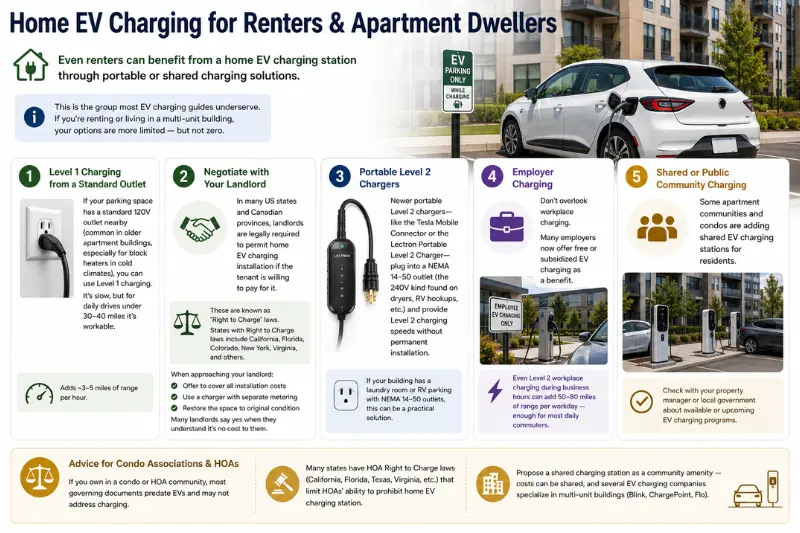
Even renters can benefit from a home EV charging station through portable or shared charging solutions.
This is the group most EV charging guides underserve. If you’re renting or living in a multi-unit building, your options are more limited — but not zero.
Option 1: Level 1 Charging from a Standard Outlet
If your parking space has a standard 120V outlet nearby (common in older apartment buildings, especially for block heaters in cold climates), you can use Level 1 charging. It’s slow, but for daily drives under 30–40 miles it’s workable.
Option 2: Negotiate with Your Landlord
In many US states and Canadian provinces, landlords are legally required to permit home EV charging station installation if the tenant is willing to pay for it. These are known as ‘Right to Charge’ laws. States with Right to Charge laws include California, Florida, Colorado, New York, Virginia, and others.
When approaching your landlord, offer to cover all installation costs, use a charger with a separate metering capability (so they’re not subsidizing your electricity), and restore the space to its original condition when you leave. Many landlords say yes when they understand it’s no cost to them.
Option 3: Portable Level 2 Chargers
Newer portable Level 2 chargers — like the Tesla Mobile Connector or the Lectron Portable Level 2 Charger — plug into a NEMA 14-50 outlet (the 240V kind found on dryers, RV hookups, etc.) and provide Level 2 charging speeds without permanent installation. If your building has a laundry room or RV parking with NEMA 14-50 outlets, this can be a practical solution.
Option 4: Employer Charging
Don’t overlook workplace charging. Many employers now offer free or subsidized EV charging as a benefit. Even Level 2 workplace charging during business hours can add 50–80 miles of range per workday — enough for most daily commuters to rarely need home charging at all.
| Advice for Condo Associations & HOAs If you own in a condo or HOA community, most governing documents predate EVs and may not address charging. Many states have HOA Right to Charge laws (California, Florida, Texas, Virginia, etc.) that limit HOAs’ ability to prohibit home EV charging station. Propose a shared charging station as a community amenity — costs can be shared, and several EV charging companies specialize in multi-unit buildings (Blink, ChargePoint, Flo). |
Home EV Charging Station Safety, Maintenance & Common Mistakes to Avoid
Maintaining your home EV charging station is simple but essential for long-term safety.
Is Home EV Charging Safe?
When properly installed and maintained, home EV charging is extremely safe. Level 2 chargers are much safer than the extension cord workarounds some EV owners improvise — and proper installation with a permit and inspection adds a critical safety check.
That said, there are real risks to avoid:
The 5 Most Common Home Charging Mistakes
Using an extension cord for Level 1 charging
Never use a standard extension cord with your Level 1 cable. If you need to extend the reach, use only a heavy-duty outdoor-rated 12-gauge extension cord, and only temporarily. Heat buildup in undersized cords is a genuine fire risk.
Ignoring a warm or discoloured outlet
If your NEMA 14-50 outlet feels warm or shows any discolouration around the socket, stop using it and have an electrician inspect it immediately. Loose connections arc and generate heat.
Overloading an older electrical panel
Older 100A panels were not designed with EV charging in mind. Have a licensed electrician confirm capacity before installation.
Skipping the permit
Unpermitted electrical work can void your homeowner’s insurance and cause problems when selling your home. It’s not worth the $50–$300 saved.
Buying a non-UL-listed charger
Only purchase chargers that are UL Listed, ETL Listed, or carry another recognized safety certification. Cheap uncertified units from online marketplaces have caused fires.
Maintenance Tips
- Inspect the cable and connector every few months for cracks, fraying, or corrosion.
- Keep the connector holster clean and away from moisture when not in use.
- Update firmware when prompted — security and safety updates are often included.
- If installed outdoors, inspect the weatherproof cover annually, especially after harsh winters.
Frequently Asked Questions
How long does it take to charge an EV at home?
With a Level 2 charger at 7.2 kW (32A), most EVs with 60–80 kWh batteries will fully charge in 8–11 hours — perfect for overnight charging. At 11.5 kW (48A), you’re looking at 5–7 hours for the same battery. Level 1 charging takes 20–40+ hours for a full charge.
Do I need a special outlet for an EV charger?
For Level 2 charging, yes — you need a dedicated 240V circuit, either a NEMA 14-50 outlet or hardwired connection. Your electrician will install this. Standard 120V outlets only support Level 1 charging.
Can I install a home EV charger myself?
The charger unit itself is typically a simple wall-mount and plug-in job. However, the 240V circuit behind it must be installed by a licensed electrician in most jurisdictions, and a permit is usually required. DIY electrical work on 240V circuits without a permit is illegal in many places and genuinely dangerous.
What’s the difference between a Level 2 charger and a Tesla Wall Connector?
A Tesla Wall Connector is simply Tesla’s brand of Level 2 charger, designed for use with Tesla vehicles (though the newer Universal Wall Connector supports J1772 vehicles too). There’s no fundamental difference in technology — both use 240V AC power. The distinction is mainly connector type and brand ecosystem.
Will home EV charging increase my electricity bill significantly?
Yes, but the increase replaces what you’d spend on gasoline. Most EV owners see their electricity bill rise by $50–$120 per month, while eliminating their gas spending entirely (which for most drivers is $150–$300/month). The net result is almost always savings.
What amperage home EV charger do I need?
For most EVs and driving patterns, a 32A–48A Level 2 charger is ideal. Check your vehicle’s maximum onboard AC charging rate first: if it’s 7.2 kW, a 32A charger is sufficient. If it accepts 11.5 kW, go for 48A. When in doubt, buy the higher amperage — it future-proofs you for your next vehicle.
Can I charge two EVs on one charger?
Some chargers, like the ChargePoint Home Flex with dual-cable accessories, can serve two vehicles — but they split the available power between them, so each charges more slowly. For two-EV households, the cleanest solution is usually two separate chargers on a shared circuit with load management, or one per vehicle on dedicated circuits.
The Bottom Line
Installing a home EV charging station is one of the highest-return upgrades an EV owner can make. The convenience alone — waking up to a full battery every single day — transforms the EV ownership experience.
For most homeowners, the right move is a 32A–48A Level 2 smart charger, professionally installed on a dedicated 240V circuit. The ChargePoint Home Flex is the best all-around choice. The Emporia Smart is the best value. And if you’re in a cold climate, the Grizzl-E Classic is unbeatable.
Take the time to understand your electrical panel capacity, get multiple installation quotes, and claim every rebate available to you. For most people, the home EV charging station and installation pays for itself in fuel savings within 18–24 months.
The future of driving is electric. The future of charging is at home.