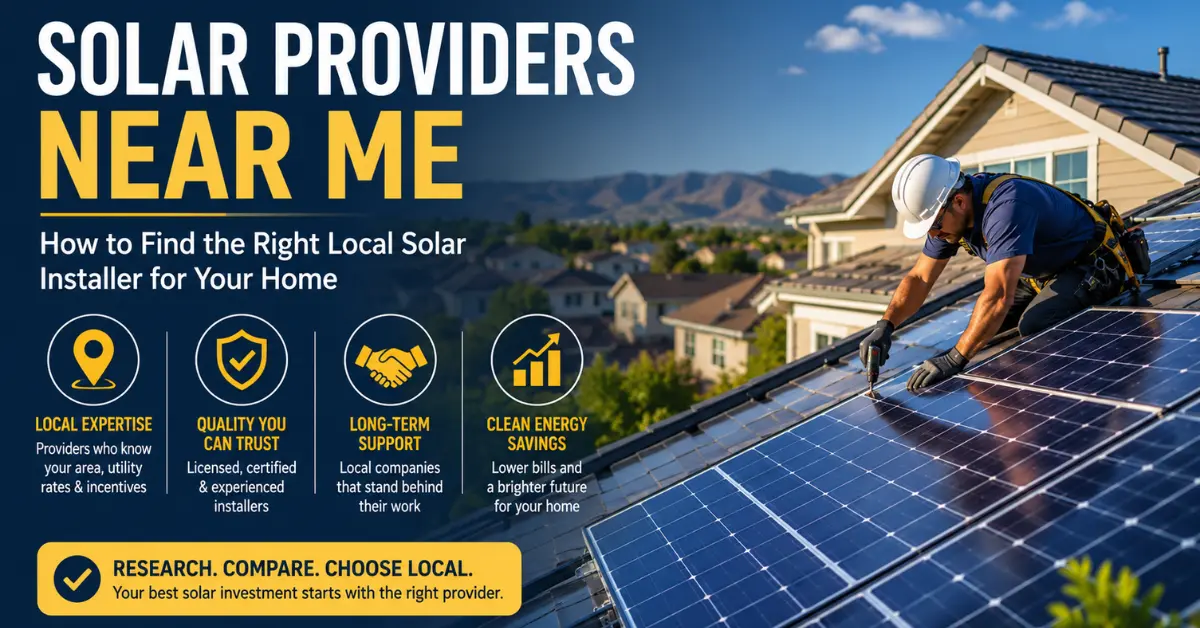
When you’re searching for solar providers near me, you’re looking for qualified local installers who can assess your home, provide accurate quotes, and handle the entire installation process. The best approach combines online research with direct outreach to 3-5 local solar companies in your area. This isn’t a decision to rush—it’s the biggest energy investment most homeowners make, and getting it right means 25-30 years of reliable, cost-saving power generation.
Start by using Google Maps or dedicated solar marketplaces (like EnergySage or your local utility company’s website) to identify certified installers within 20-30 miles of your home. Look specifically for companies with NABCEP-certified electricians (North American Board of Certified Energy Practitioners), proper electrical licensing in your state, and installation experience of at least five years. When you contact solar providers near me, ask for references from recent installations in your neighborhood—this matters because local companies understand your specific utility rates, local incentives, rebate programs, and regional weather patterns that directly impact your system’s performance. A solar system installed in Florida needs completely different design considerations than one in Colorado, and local providers know these subtleties.
The most critical factor isn’t finding the cheapest option, but finding a provider who will actually be there in 25 years when you need warranty service or maintenance. Local solar providers near me have a reputation to protect in their community, which typically translates to better long-term accountability than national chains with minimal local presence. They invest in their communities through sponsorships, employee retention, and customer relationships because their survival depends on positive word-of-mouth and repeat referrals.
Before committing to any solar provider, follow this due diligence process: compare quotes from at least three companies, verify their insurance and bonding through your state’s licensing board, call their references and ask specifically about post-installation service, and read recent customer reviews that mention installation quality, timeline accuracy, and responsiveness. Most reputable solar providers will offer a free on-site consultation and energy assessment—this should never cost you anything upfront. If a company charges for an initial consultation, it’s a red flag that they prioritize sales pressure over customer education.
Why Finding Local Solar Providers Near You Matters
The solar installation industry has exploded over the past decade, and not all solar providers near me are created equal. When homeowners search for local solar solutions, they’re often caught between big-name national companies and smaller local installers. Understanding why location-specific research matters is crucial to making the right decision.
The first reason is expertise tailored to your region. Your local utility company sets specific rates, net-metering policies, and interconnection requirements that vary significantly by geography. A solar provider operating in your area understands these nuances intimately. They know whether your utility offers 1:1 net metering (which credits you fairly for excess power) or capped net metering (which limits your credits). This isn’t academic—it can mean the difference between saving $30,000 or $15,000 over 25 years. Additionally, regional incentives vary dramatically. Some states offer 10% tax credits, others offer nothing beyond the federal 30% credit. Local solar providers near me navigate these programs daily and help you capture every available incentive.
Second, local solar providers near me understand your climate and weather patterns. If you live in a region with heavy snowfall, a competent local installer designs systems differently than someone in Arizona. They know your peak sun hours (typically 4-6 hours daily, varying by location), typical weather patterns, seasonal variation in production, and how heavy snow loads affect mounting systems. They’ve installed hundreds of systems in conditions identical to yours, not theoretical conditions based on climate models. This local knowledge translates directly to more accurate production estimates and realistic expectations about your system’s annual output.
Third, accountability matters deeply. When a company operates in your community with local employees and a physical office you can visit, they have genuine skin in the game. Their reputation directly affects their ability to survive and thrive. This creates an inherent motivation to do quality work, respond to service requests promptly, and honor warranties even after 10-15 years. National companies operating through call centers are significantly easier to ignore if problems arise. You can’t show up at their office demanding answers about a faulty installation or unresponsive warranty process.
Finally, local solar providers typically offer superior customer service through accessible channels. When you need a service appointment or have questions about your system, you’re not waiting on hold with an overseas call center. You’re talking to someone who understands your specific installation, your roof type, your utility’s interconnection quirks, and local climate. This accessibility becomes increasingly valuable as your system ages and you need occasional maintenance or troubleshooting.
the most important point is to cleaning solar on time.
How to Find Solar Providers Near You: A Practical Framework
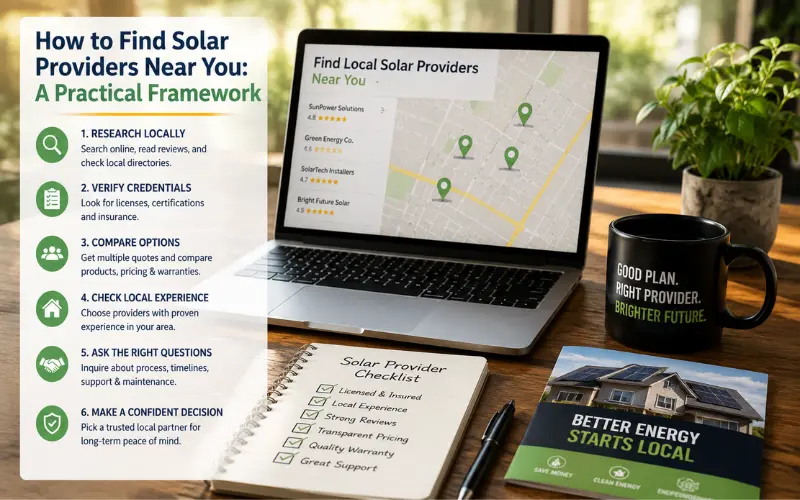
Finding the right solar providers near me requires a systematic approach. Most homeowners spend more time researching a car purchase than a solar installation, which is backward considering solar is a larger investment with much longer-term implications.
Start with online research
Google search “solar installers near [your city]” and “solar companies [your zip code]” to see which companies rank locally and maintain active web presences. Look at their Google Business profiles, which show customer reviews, service areas, average response times, and photos of completed work. This matters because it reveals how seriously they take their reputation and customer communication. Next, check your utility company’s website—many major utilities maintain lists of approved solar installers or partner networks. These aren’t endorsements per se, but they indicate companies that have passed basic vetting and understand your utility’s specific interconnection requirements.
Use solar marketplaces strategically
Platforms like EnergySage, Solar.com, and similar services collect multiple quotes from local providers automatically. This is useful because it gives you a baseline of who operates in your area and what typical pricing looks like, though remember these platforms take a cut from the installers (typically 5-15%), which sometimes inflates pricing slightly. Think of these as starting points, not your only research avenue.
Verify credentials before outreach
Check your state’s electrical licensing board (usually through your state’s Secretary of State website) to verify that any company you’re considering is properly licensed. Look for NABCEP certifications on their website—this is the industry gold standard. Call the Better Business Bureau to check for unresolved complaints, and cross-reference their name with the state attorney general’s office for consumer complaints.
Request multiple consultations
Contact at least three local solar providers near me and request in-home consultations. Legitimate companies will never charge for these initial visits. During the consultation, observe how they communicate. Do they pressure you into a decision, or do they educate you? Do they use aggressive sales tactics or consultative approaches? The best solar providers spend 60-90 minutes examining your roof, reviewing utility bills, asking about your energy goals and budget, and only then providing a custom quote. Anyone pushing a fast decision is showing warning signs.
Evaluate quotes carefully
When you receive proposals from local solar providers near me, you’ll notice significant differences beyond just total price. Some include battery systems, others don’t. Some offer extended warranties, others standard ones. Some include roof repairs or upgrades, others don’t. These differences explain much of the price variation. What matters is comparing apples to apples—a 6kW system from Company A should be evaluated against another 6kW system from Company B, with identical equipment, same warranty terms, and comparable financing options.
Red Flags to Avoid When Evaluating Solar Providers Near Me
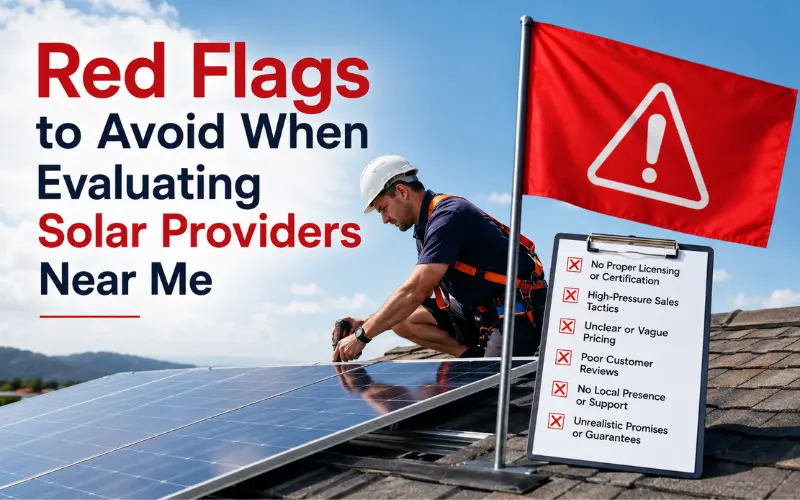
As you research solar providers near me, watch for warning signs indicating questionable business practices. Companies pressuring you to sign contracts the same day are prioritizing commissions over your interests. Vague answers about what happens if they go out of business, or evasion when asked about references, suggest they’re hiding something. Extremely low pricing compared to all other quotes (more than 20% below market rate) often indicates lower-quality equipment, inexperienced installation crews, or hidden costs that emerge later. Lack of verifiable licensing through your state’s electrical board is non-negotiable—this is the single clearest red flag that a company isn’t legitimate. Finally, avoid companies that can’t clearly explain how they’ll manage warranty claims if they go out of business. Legitimate solar providers have insurance and manufacturer relationships ensuring customer claims are honored even if the company fails.
You check per month to annual maintenance checks.
Alternative Ways to Find Solar Providers Near You
Beyond direct Google searches, several alternative channels exist for locating solar providers near me that many homeowners overlook.
Community solar cooperatives
have emerged in many regions. These are non-profit organizations that help coordinate solar installations at reduced costs by aggregating demand. They maintain vetted lists of local installers and can negotiate better pricing through volume. Search “[your state] solar cooperative” to see if one operates in your area.
Local environmental organizations
often maintain lists of recommended installers. Groups focused on sustainability frequently vet solar providers and feature their top recommendations on websites or in newsletters. These organizations have no financial incentive to recommend poor performers.
Employer and utility programs
sometimes offer partnership discounts with specific solar providers. Your workplace might have negotiated rates with local installers, or your utility company might offer rebates specifically for customers who use particular approved providers.
Peer recommendations remain invaluable
Ask neighbors who’ve gone solar which company they used, what their experience was, and whether they’d use them again. Drive around your neighborhood and notice which companies’ trucks you see most frequently—high local volume usually indicates satisfied customers generating referrals.
Frequently Asked Questions
Q1: How much should I expect to pay per watt from local solar providers near me?
A: The national average for residential solar installation is between $2.26 and $3.40 per watt (before incentives). In 2026, this typically translates to $13,500 to $20,400 for a 6kW system, which is the median residential size. Pricing varies significantly by region. California installations tend toward the higher end due to labor costs and higher permitting fees, while rural areas sometimes quote higher per-watt pricing despite lower labor rates due to less competitive markets. When evaluating quotes from solar providers near me, always compare the total installed cost and the per-watt price together. A quote that seems cheap per watt but uses lower-quality equipment might cost more in the long run through reduced productivity and earlier degradation. The 30% federal tax credit applies to qualified installations, so your actual out-of-pocket cost is 30% less than the quoted system price (assuming you have sufficient tax liability to claim it).
Q2: What qualifications should I look for when evaluating solar providers near me?
A: Legitimate solar providers near me should have at least these credentials: state electrical contractor licensing (non-negotiable), NABCEP certification for at least one technician, evidence of general liability insurance and bonding, and a minimum of five years operating history. Beyond these basics, look for certifications from specific equipment manufacturers—Enphase, SunPower, Tesla, and QCells offer installer certification programs indicating ongoing training and competency. Check whether they’re registered with the Better Business Bureau and whether they have an A+ rating. Ask about their service team—do they employ technicians directly, or do they outsource service to third parties? Companies that employ service teams in-house typically provide better ongoing support. Finally, request references from customers whose installations are at least two years old. Talking to someone with 24+ months of experience reveals real-world performance and whether the company honors warranties.
Q3: How do I compare quotes from different solar providers near me?
A: Comparing solar quotes requires standardizing several variables because seemingly similar proposals can differ dramatically in actual value. First, confirm the system size (kilowatts), equipment being used (exact panel models, inverter type), and projected annual production in kilowatt-hours. Request the per-watt installed cost, which normalizes for system size differences. Compare warranty terms—panels (typically 25 years), inverters (5-15 years), and workmanship/labor (typically 5-15 years). Look at financing options offered: cash purchase, solar loans, leases, and power purchase agreements each have different implications for your finances and home value. Check what’s included in the price—some installers include roof repair or upgrades, permits, and interconnection fees, while others bill these separately. Request a detailed breakdown showing equipment costs, labor, permitting, and fees separately. Finally, ask about additional costs: maintenance programs, monitoring fees, or battery upgrades. Once you’ve standardized the proposals, the decision becomes clearer.
Q4: Do I need to use solar providers near me, or can I work with national companies?
A: You can work with both. Many national solar companies operate successfully in local markets, typically through franchises or local branch offices rather than as truly national entities. The trade-off is clear: national companies often have streamlined processes, established financing relationships, and purchasing power enabling lower pricing. However, local solar providers near me typically offer superior personalized service, deeper local knowledge, and easier access to decision-makers if issues arise. A practical approach: use national companies’ quotes as price benchmarks, but prioritize working with local providers who can match national pricing while maintaining superior service quality.
Q5: What’s the difference between solar providers near me and solar marketplaces?
A: Solar marketplaces are middlemen platforms that collect multiple quotes from installers in your area. They’re useful for generating baseline quotes quickly without contacting each company individually. However, they monetize by taking referral fees (usually 5-15% of installer contract value), which installers often pass through to customers in slightly higher pricing. Additionally, marketplace companies sometimes recommend installers based on profitability rather than quality. Direct contact with solar providers near me often yields better pricing because there’s no middleman margin. However, marketplaces serve a useful screening function—if a local installer doesn’t participate in major marketplaces, this sometimes suggests limited scale or customer satisfaction issues.
Q6: How long does it take from contacting solar providers near me to system activation?
A: Typical timeline from first contact to active system is 3-6 months for local solar providers near me. Initial consultation and quote preparation takes 2-4 weeks. Equipment ordering takes 2-4 weeks depending on supply chain status. Permitting takes 2-8 weeks depending on your locality—some municipalities are streamlined, others extremely slow. Installation happens in 1-3 days. After installation, the utility performs interconnection inspections and authorizes grid connection, which adds 1-4 weeks. When evaluating solar providers near me, ask for their typical timeline from quote to activation—reliable companies provide honest estimates.
Q7: What questions should I ask during consultations with solar providers near me?
A: Ask these critical questions: “What’s your typical timeline from consultation to system activation?” “How is ongoing maintenance handled—do you employ service technicians or outsource?” “What happens if equipment fails after I’ve relied on it for five years?” “How do you handle permit denials or utility interconnection delays?” “What financing options do you offer, and what’s the typical interest rate?” “Can you provide references from customers with systems at least two years old?” “What equipment do you install, and why?” “How do you handle roof repairs if my roof needs work?” “How long have you operated locally?” “How do you stay current with code changes?” “What’s your warranty coverage?” These reveal whether you’re dealing with professionals or amateurs.
Q8: Should I prioritize lower cost or higher quality when choosing among solar providers near me?
A: Your solar system will generate electricity for 25-30 years. A cheaper system using lower-quality equipment that degrades faster ultimately costs more. However, you don’t want to overpay for features you don’t need. The sweet spot is finding solar providers near me offering high-quality equipment (from established manufacturers) at fair market pricing. “Cheap” installations (bottom 15% of market pricing) often come from installers with high churn rates and poor satisfaction. Mid-market pricing (middle 60% of quotes) typically represents good value. Premium pricing should only be accepted if you receive demonstrably superior equipment, warranty terms, or service. Compare at least three local providers. If one quote is significantly lower than others, inquire why—it might be legitimate or problematic.
Q9: What happens after installation with local solar providers near me?
A: After your system activates, reputable solar providers near me should offer ongoing support including system monitoring, annual maintenance checks, and responsive support for issues. Most offer optional maintenance plans (typically $200-400 annually) covering inspection, cleaning, and minor repairs. Systems require minimal maintenance. Panels don’t wear out significantly, though inverters typically need replacement around year 10-15. The best local solar providers proactively reach out for maintenance appointments rather than requiring you to request service. They monitor your system’s performance and alert you if output drops unexpectedly. After 10 years, quality systems continue producing at 85-90% of original capacity.
Q10: How do solar providers near me handle equipment failures or warranty claims?
A: Quality solar providers near me should make warranty claims seamless. Under equipment warranties, the installer typically manages the claim process with manufacturers—you shouldn’t navigate this yourself. When equipment fails, the installer coordinates replacement at no cost within warranty periods. The challenge arises when companies go out of business. When evaluating solar providers near me, ask specifically “How would warranty claims be handled if you go out of business?” Honest companies have insurance arrangements ensuring customer claims are honored even if they shut down.
Final Thought
Choosing among solar providers near me is one of the largest decisions most homeowners make outside of mortgages. The financial implications are substantial—$15,000-$20,000 in system cost, but potentially $35,000-$50,000 in energy bill savings over 25 years. More importantly, this decision affects your home’s value, your energy independence, and your household’s environmental impact.
The best solar provider isn’t always the cheapest. It’s the company combining fair pricing with proven expertise, demonstrated accountability, and genuine commitment to your long-term success. When you evaluate solar providers near me, you’re purchasing 25 years of partnership, not just a product. A company prioritizing customer relationships, investing in employee training, maintaining local presence, and responding when you need them is worth a modest premium over the absolute lowest bidder.
Start your process today by identifying three local solar providers through Google, your utility company, and peer recommendations. Schedule consultations with each, ask the questions outlined above, and compare their proposals using the framework provided. Trust your instincts about company culture and responsiveness—these intangibles often predict real-world customer satisfaction better than price alone.
Your solar journey starts with finding the right solar providers near me. Take your time, do thorough research, and make the decision you’ll feel confident about for the next 25 years.