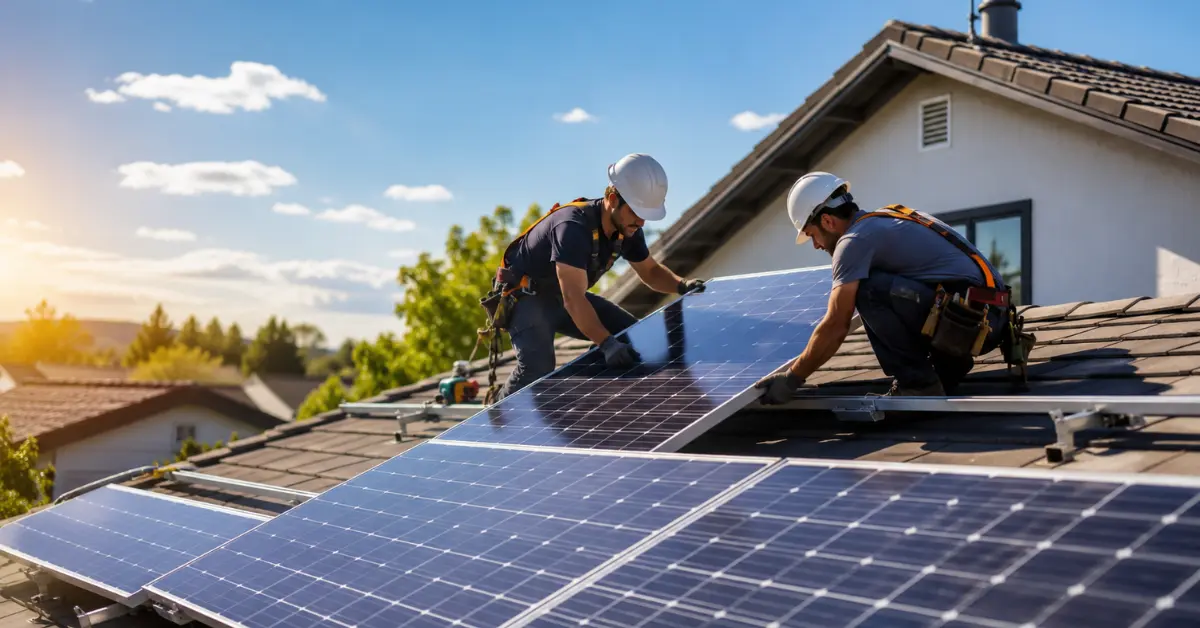
Solar panel installation services are complete turnkey solutions that handle the entire journey from system design through 25-year maintenance. Professional solar installation services encompass site assessment, permitting, equipment selection, structural installation, electrical connection, and grid activation—eliminating the complexity homeowners face when attempting DIY approaches.
Here’s what happens during solar panel installation services:
Solar Installation Timeline:
Week 1-2: Site Assessment & Design
Week 3-4: Permitting & Utility Approval
Week 5-6: Equipment Procurement
Week 7-8: Physical Installation (2-3 days actual work)
Week 9: Inspection & Grid Connection
The critical difference between DIY and professional solar panel installation services: installers carry $1-2M liability insurance, hold C-46 Solar Contractor licenses (California), and provide 25-year workmanship warranties. A single roofing error during installation can cost $8,000-$15,000 in water damage repairs. That’s why 94% of California homeowners choose licensed solar installation services over self-installation.
Why Solar Panel Installation Services Matter: The Real Cost of Mistakes
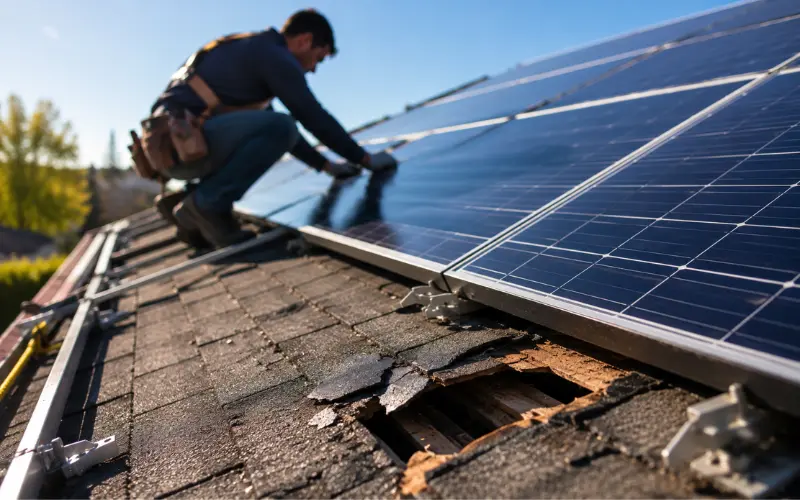
Most homeowners underestimate solar panel installation services complexity. They see the panels and think: “Just bolt them down.” That’s dangerously wrong.
The permitting alone requires AHJ-compliant engineering drawings, structural calculations, electrical one-lines, and utility interconnection requests that vary by municipality. Los Angeles differs dramatically from San Francisco’s requirements. A single permitting error delays your project 8-12 weeks and costs $2,000-$5,000 in redesigns.
Professional solar installation services navigate these jurisdictional differences automatically. Experienced installers maintain relationships with local building departments, know which inspectors are strict, and understand utility-specific requirements (PG&E, SCE, LADWP all have different net metering rules). This insider knowledge compresses your timeline from 6-9 months down to 3-4 months.
Beyond permitting, proper solar installation services include thermal imaging to detect roof degradation before installation (replacing a 10-year-old roof now costs $8,000 but prevents $12,000+ in water damage claims later). They also calculate actual system performance using proprietary shading analysis tools that account for tree growth over 25 years—not just current shade patterns.
The financial stakes are real: a correctly sized system saves you $30,000-$50,000 over 25 years. An undersized system (common when homeowners self-design) saves only $12,000 but cost the same $15,000 to install. That’s a $18,000-$38,000 mistake nobody talks about.
How Professional Solar Panel Installation Services Work
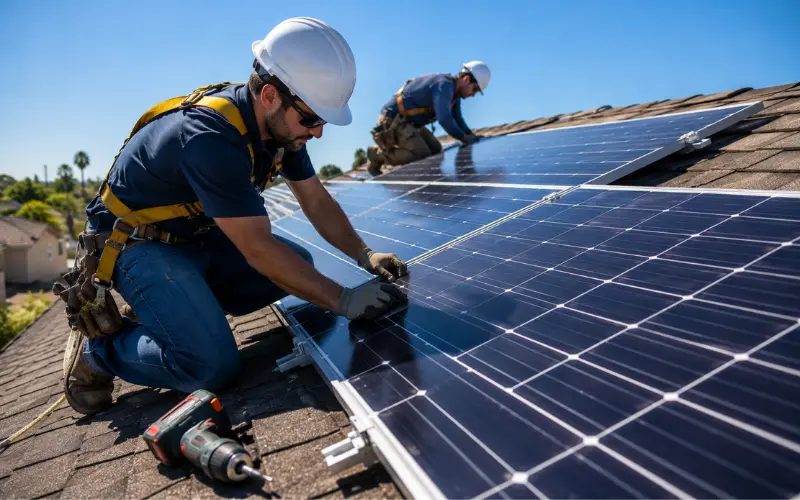
Legitimate solar installation services follow a structured methodology that protects you from the three most common failure points: undersizing, poor roof penetration, and utility interconnection delays.
Step 1: Detailed Site Assessment
Professional solar installation services dispatch engineers who measure roof dimensions, document orientation angle, photograph shading patterns at different seasons, and assess structural capacity. They pull historical building permits to verify roof age, material type, and load-bearing capacity. This isn’t the 20-minute walk-through competitors offer—it’s a 2-3 hour technical evaluation that generates a detailed site report.
Step 2: System Design with Production Modeling
Quality solar panel installation services use NREL data paired with local weather patterns to project annual production. They don’t use generic calculators; they model month-by-month output accounting for winter angle changes, seasonal cloud cover, and inverter efficiency losses. This precision allows them to right-size your system to match your actual usage (not your utility bill, which includes heating/cooling inefficiency).
Step 3: Permitting & Utility Coordination
This is where most solar installation services fail. Experienced providers submit PE-stamped designs that anticipate inspector questions, reducing back-and-forth delays. They also handle utility interconnection applications in parallel with building permits—shaving 6 weeks off typical timelines. Many solar panel installation services now guarantee permits approved within 21 days or credit your account.
Step 4: Installation with Quality Control
Licensed crews under professional solar installation services use mechanical attachments (not adhesive) for permanent installations, install flashing that exceeds code requirements (preventing water intrusion), and conduct megohm testing to verify electrical safety before system activation. They also photograph every connection point for warranty documentation.
Step 5: Long-term Monitoring & Support
Top-tier solar installation services include real-time monitoring platforms showing daily production, identifying malfunctioning panels before you notice energy loss, and triggering maintenance alerts. This proactive approach catches issues when they’re $200 repairs instead of $5,000 replacements.
Alternative Solar Panel Installation Services Models: Choosing Your Approach
Not all solar panel installation services operate identically. Understanding the differences helps you avoid expensive mistakes.
Solar provider can play important role in installation.
Traditional EPC (Engineering, Procurement, Construction) Model
This is the gold standard for commercial solar installation services. One company manages design, equipment procurement, installation, and warranties. Your single point of contact eliminates finger-pointing if issues arise. Drawback: typically $2.70-$3.10 per watt (premium pricing).
Marketplace Aggregator Model
Home Depot and Lowe’s connect you with regional solar installation services subcontractors. Pros: convenience and financing flexibility. Cons: variable quality, poor accountability when problems emerge. Your complaint reaches Home Depot customer service—not the actual installer.
Solar-as-a-Service (Sunrun, Vivint)
These companies own your system; you buy the power they generate. Zero upfront cost. Con: You’re locked into 25-year contracts at rates that may exceed future grid rates. You don’t own the system, so you can’t claim the 30% federal tax credit.
Local Certified Installer
Small teams operating in specific regions. Pro: accountability and personal relationships. Con: limited financing options and smaller warranty backing. Good for California homeowners; poor if you move and local certified installer.
Why Solar Panel Installation Services Vary So Dramatically in Cost
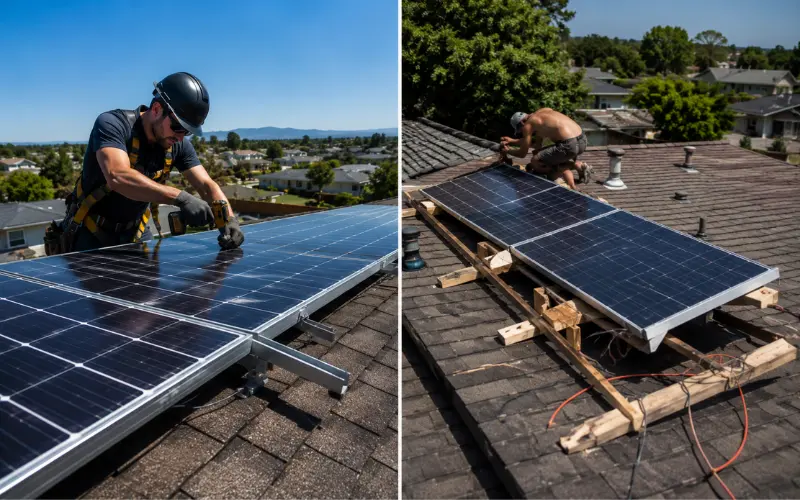
Most homeowners see quotes ranging $2.00-$4.15 per watt and wonder where the $2 difference comes from. It’s not the panels (that’s only $0.30-$0.50/W cost variance). It’s solar panel installation services overhead.
Premium solar installation services invest in:
- In-house design teams vs. outsourced contractors
- Thermal imaging and drone site surveys
- Workmanship guarantees beyond 10 years
- Real-time monitoring platforms (not generic NREL estimates)
- Direct installation crews (not subcontractors)
Budget solar panel installation services use:
- Generic online design tools
- Smartphone photos for site assessment
- Subcontractor networks
- Limited monitoring
- 5-year workmanship warranties
The math: $1,500 system markup × 100 installations/year = $150,000 annual difference per installer. That’s why budget providers often disappear after 3-5 years (bankruptcy or rebranding). You’ll be calling them for warranty claims and get disconnected numbers.
Frequently Answer Questions
Q1: How long does professional solar panel installation services actually take?
A: Site assessment to activation typically spans 8-16 weeks. Actual installation work (panels + wiring + permits passing inspection) requires only 3-5 days. The delay is permitting, not installation. Accelerated solar installation services companies guarantee 21-day permits by using pre-approved designs.
Q2: What’s the difference between STC and PTC ratings on solar panels offered through installation services?
A: STC (Standard Test Conditions) assumes ideal 77°F weather. PTC (PVUSA Test Conditions) reflects real-world 122°F conditions. Professional solar panel installation services calculate system size using PTC ratings, not STC, which prevents undersizing. Budget installers use STC to inflate projected output and lock you into undersized systems.
Q3: Do solar installation services include roof repairs if damage is discovered during installation?
A: Top-tier solar installation services include thermal imaging pre-assessment and budget $2,000-$4,000 for minor repairs. Many companies now offer integrated roofing options, replacing old roofs before solar installation for coordinated warranties. Always clarify this in writing—it’s a $5,000-$10,000 hidden cost.
Q4: Can solar installation services handle my electrical panel upgrade if my home requires it?
A: Quality solar panel installation services employ licensed electricians who can upgrade panels (150A to 200A upgrade = $3,000-$5,000). Budget installers subcontract this, adding weeks of coordination delays. Insist on in-house electrical crews if your panel is older than 20 years.
Q5: What happens if solar installation services company goes out of business?
A: This is why warranty backing matters. Premium solar installation services backed by major equipment manufacturers honor warranties even if the installer fails. Check if your installer has surety bonding or insurance that protects warranty claims. Budget companies often disappear; your warranty becomes worthless.
Q6: How do solar installation services calculate your net metering eligibility?
A: This varies by utility and state policy. California’s NEM 3.0 (implemented April 2023) dramatically reduced export credits—making battery storage essential. Expert solar installation services resize systems assuming battery storage and net metering limitations. Generic online calculators assume NEM 2.0 and overestimate savings by 40-50%.
Q7: Can solar installation services install systems on old or metal roofs?
A: Yes, but costs vary wildly. Metal roofs: $200-$400 mounting cost. Asphalt shingles: $100-$200. Tile roofs: $400-$800. Flat commercial roofs: $50-$150. Professional solar panel installation services pre-assess compatibility and budget accordingly. Cheap installers often quote asphalt-roof pricing then demand $3,000 overages for tile or metal.
Q8: What’s the actual lifespan of solar panel installation services equipment?
A: Panels last 40+ years (degrading ~0.5% annually). Inverters fail after 10-15 years and need $2,500-$5,000 replacement. Batteries (if included) last 8-12 years. Top solar installation services warranty inverters for 15-25 years; budget companies use 10-year warranties. That extra 5-10 years of coverage is worth thousands.
Q9: How do solar installation services handle shading from trees and buildings?
A: Budget approaches: ignore future tree growth, underestimate shade impact. Quality solar panel installation services use 3D modeling accounting for 5-year, 10-year, and 25-year tree growth projections. They also model neighboring building construction (new homes blocking southern exposure). This prevents the common scenario where system production drops 15-20% when your neighbor adds a second story.
Q10: What certifications should solar installation services professionals hold?
A: Non-negotiables: C-46 Solar Contractor license (California) or C-10 Electrical license. NABCEP (North American Board of Certified Energy Practitioners) certification signals technical depth. Insurance: $1-2M liability + workers’ compensation. Verify all three before signing. Unlicensed installers often can’t pull permits (requiring licensed contractors to assume liability after ward), which voids your warranty.
Final Thoughts: Making Your Solar Panel Installation Services Decision
Solar panel installation services are the difference between a $40,000 system that saves you $800/year and one that saves you $1,600/year a $20,000 swing over 25 years. That advantage comes from precision in design, speed in permitting, and accountability in installation.
The most dangerous assumption: “All solar installation services are the same once you pick your financing.” They’re emphatically not. A $2.00/watt installer using 10-year inverter warranties and subcontractors isn’t cheaper they’re deferred-cost expensive. That inverter fails year 11, you’re 5 years past their warranty, and replacement costs come directly from your pocket.
The homes achieving $1,600+/year savings didn’t get there by choosing the lowest quote. They chose solar panel installation services providers willing to invest in precision. That precision is your protection against the most expensive solar mistake: buying a system that underperforms for 25 years.