Solar panels are built to last 25 to 30 years. They sit outside in rain, wind, dust, and heat without complaint. But here is the thing most homeowners do not realize until they check their energy monitoring app and see their output quietly dropping: dirty solar panels lose efficiency fast, and rain alone does not fix it.
This guide gives you everything you need to clean solar panels safely, effectively, and without voiding your warranty — including the details that most competitors leave out.
Why Cleaning Solar Panels Actually Matters
Solar panels generate electricity by absorbing sunlight. Anything sitting on the glass surface — dust, pollen, bird droppings, tree sap, or smog residue — blocks that sunlight from reaching the cells underneath. Even a thin, uniform layer of dust can reduce output by 5 to 7% annually. In dry, dusty regions like the American Southwest, losses can reach 25% or more without regular maintenance.
Here is what that looks like in real numbers: the average U.S. home solar system produces around 10,000 kWh per year. A 7% loss equals 700 kWh — roughly the electricity needed to run your refrigerator for an entire year, wasted because the panels were not cleaned.
The damage from neglect goes beyond lost output. Sustained dirty patches — especially from bird droppings — can cause hot spots. A hot spot forms when debris shades a small cluster of solar cells while the surrounding cells keep producing power. That shaded section resists the electrical current and heats up as a result. Persistent hot spots degrade panel cells over time and, in rare cases, can damage wiring or surrounding materials. Some manufacturers explicitly require routine cleaning as a condition of keeping the panel warranty valid.
How Often Should You Clean Solar Panels?
The honest answer is that it depends on where you live and what surrounds your panels. A one-size-fits-all schedule does not exist. Here is a practical framework:
Twice a year works well for most homeowners in temperate, clean solar moderate-rainfall climates. clean solar A spring cleaning removes winter buildup — pollen, road salt residue carried on wind, and any grime accumulated during dry winter months. A late-autumn cleaning clears summer dust and bird activity before panels face winter.
Every three to four months is a better schedule if you live in a dry or arid climate (desert Southwest, parts of California, Texas, and Nevada), near agricultural land with heavy dust or pesticide residue, near a busy road or industrial area, or under trees that produce heavy pollen, sap, or bird-attracting berries.
After specific weather events — a dust storm, wildfire smoke event, clean solar or a heavy pollen season — always do a visual inspection and clean if needed regardless of where you are in your scheduled cycle.
One useful tool that competitors rarely mention: your solar monitoring app. If you use Enphase, SolarEdge, or a similar monitoring platform, track your daily production against historical data. A noticeable, unexplained dip in output on clear, sunny days is often the first and clearest signal that your panels need cleaning.
Before You Start: Check Your Warranty and Manufacturer Guidelines
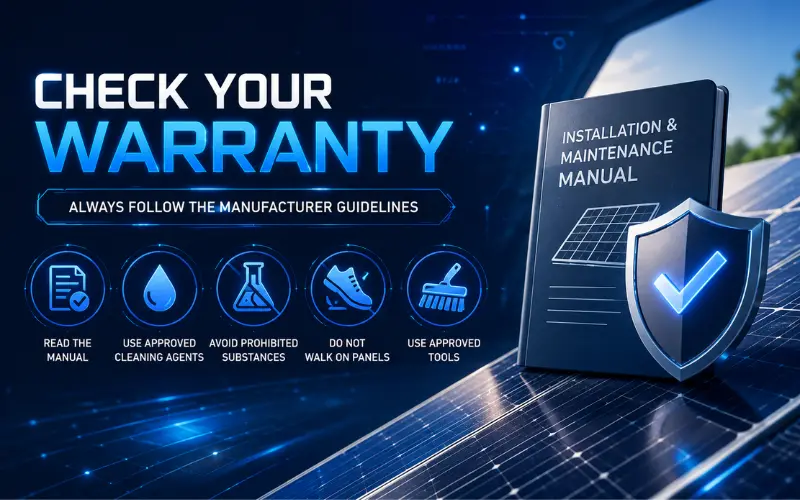
This step is non-negotiable, and most cleaning guides skip it. Many solar panel manufacturers specify approved cleaning methods, approved cleaning products, and water quality requirements in their installation manuals. Using the wrong product — even a mild household cleaner — can void your warranty if it damages the anti-reflective coating on the glass.
Before you clean solar, look up your panel’s installation or maintenance manual (usually available as a PDF on the manufacturer’s website) and note:
- Approved cleaning agents (most specify deionized or purified water, mild dish soap, or manufacturer-approved solutions)
- Prohibited substances (hydrofluoric acid, alkaline cleaners, acetone, and industrial solvents are common prohibitions)
- Whether or not the glass can be walked on (almost always it cannot)
- Any specific brush or pad requirements
If your clean solar panels are leased or part of a power purchase agreement (PPA), contact the system owner before touching anything. Under most lease agreements, the company that owns the panels is responsible for their maintenance, and DIY cleaning may breach your contract.
What You Need: Tools and Supplies for Solar Panel Cleaning
You do not need expensive specialized equipment to clean solar panels well. Here is what works:
A garden hose with a gentle spray nozzle handles the initial rinse and most light cleaning jobs. Never use a pressure washer — the force can break the seals around the panel frame and drive water into the panel housing, causing internal damage and voiding the warranty.
A soft-bristle brush or microfiber mop head attached to an extension pole lets you scrub from the ground or from a safe position on the roof without applying pressure to the glass. Avoid anything abrasive — steel wool, rough sponges, or stiff-bristle scrub brushes will scratch the glass surface and reduce light transmission permanently.
A mild soap solution — a few drops of liquid dish soap (like Dawn) in a bucket of warm water — handles most organic buildup including pollen, clean solar dust, and bird droppings. Use sparingly and rinse thoroughly.
A squeegee or microfiber cloth for drying prevents water spots and streaks. This step matters more than most people think. Tap water contains dissolved minerals that, when left to evaporate, deposit a thin film of calcium and magnesium on the glass — exactly the kind of buildup you were trying to remove.
Purified or deionized water is the professional standard for the final rinse for this exact reason. clean solar If your tap water is hard (high mineral content), using purified water for the final rinse makes a noticeable difference in how clean the panels look after drying.
Ladder with stabilizer feet if you are accessing roof-mounted panels, plus non-slip shoes and a safety harness if your roof pitch is steep.
How to Clean Solar Panels: Step-by-Step
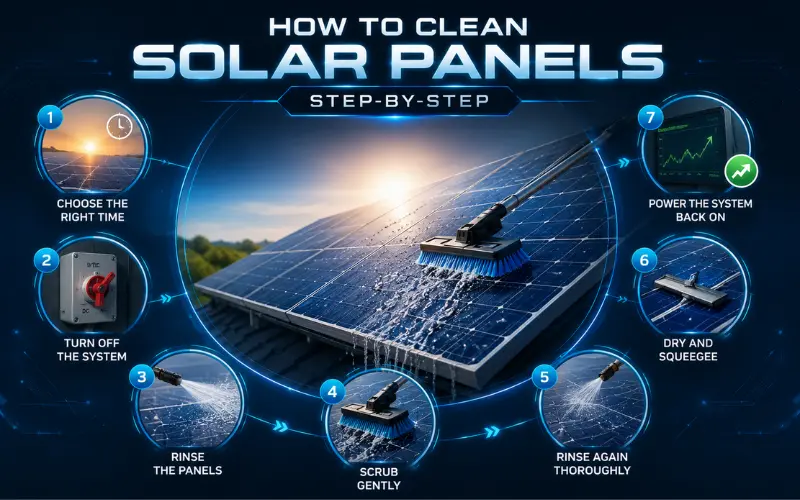
Step 1 — Choose the Right Time
Clean your panels in the early morning or late evening. Panels that have been in direct sun all day reach temperatures of 120°F to 150°F (49°C to 65°C). Rinsing hot glass with cool water causes thermal shock — a rapid temperature change that stresses the glass and can cause micro-cracks. clean solar Beyond safety, cleaning mid-day also causes water to evaporate instantly, leaving streaks and mineral deposits behind. Early morning is ideal: panels are cool, humidity is slightly higher, and you have the whole day’s sun ahead to monitor production after the clean.
Step 2 — Turn Off the System
Shut down your solar inverter before you start. Water and electricity are a dangerous combination. Follow your inverter manufacturer’s shutdown procedure — most systems have a clearly labeled AC/DC isolator switch. clean solar Allow the panels to cool for at least 30 minutes after sunset or before the morning sun hits them before you begin.
Step 3 — Rinse the Panels
Start with a gentle rinse using your garden hose on a low-pressure setting. Hold the nozzle at an angle rather than pointing directly at the panel surface. clean solar This removes loose dust and debris that would otherwise scratch the glass when you start scrubbing. Let the water run off completely before moving to the next step.
Step 4 — Scrub Gently
Dip your soft brush or microfiber mop into the soapy water, wring out the excess so it is damp rather than dripping, and work across the panel surface using smooth, even strokes. Apply light pressure — the goal is to lift debris, not scrub through it. Work from top to bottom so dirty water runs down and away from already-cleaned sections.
For stubborn bird droppings, tree sap, clean solar or thick pollen buildup, do not scrub dry. Let the damp cloth or mop sit on the area for 30 to 60 seconds. The moisture softens the residue, and it wipes away cleanly without the force that would risk scratching.
Step 5 — Rinse Again Thoroughly
Once you have scrubbed the entire surface, rinse again with clean water, making sure to flush all soap residue from the panel and from the edges around the frame. Soap residue left on the glass attracts dust and makes panels get dirty faster.
Step 6 — Dry and Squeegee
Use a squeegee or clean solar microfiber cloth to remove standing water. If you are using tap water, follow with a final rinse using purified or deionized water before squeegee-ing. Work quickly so water does not dry on the surface.
Step 7 — Power the System Back On
Only restore power once every panel surface is completely dry. Check your solar monitoring app within a few hours to confirm output has improved. Most homeowners see a noticeable jump in production the same day they clean.
Dealing With Stubborn Stains: What Competitors Do Not Cover in Enough Detail
Hard water spots are the most common problem homeowners face after cleaning. They appear as white or grey circular marks where water droplets evaporated and left mineral deposits behind. A 5 to 10% white vinegar solution mixed with purified water dissolves mineral deposits safely. clean solar Apply, let sit for 60 seconds, and rinse thoroughly. Avoid using undiluted vinegar — the higher acidity can damage some panel coatings over time.
Tree sap is particularly stubborn. Warm, soapy water with a few minutes of dwell time handles light sap. Heavier sap deposits respond well to a small amount of rubbing alcohol (70% isopropyl) applied to a microfiber cloth and used with gentle, circular pressure. Always rinse the area thoroughly with water afterward and check your manufacturer guidelines first.
Moss and algae appear on panels in heavily shaded areas or under persistent tree cover. A diluted isopropyl alcohol solution (1 part alcohol to 4 parts deionized water) applied with a soft brush kills moss and algae and breaks them loose from the glass. Specialty lichen and algae removers formulated for solar panels are also available and tend to be safer on panel coatings than homemade solutions.
Smoke and pollution film from wildfire smoke or industrial air pollution creates a thin, oily film that a standard rinse does not remove. A mild degreasing dish soap solution applied with a microfiber cloth handles this effectively. This is particularly important after major wildfire events — even if the panels do not look visibly dirty, a smoke film significantly reduces light transmission.
DIY vs. Professional Solar Panel Cleaning
Cleaning your own panels saves money but carries real risks. Here is an honest comparison:
DIY cleaning makes sense if your panels are on a single-story home with a gentle roof pitch, you already own a ladder and the right tools, your roof surface is safe to work near, and your local utility and HOA do not require licensed contractors for panel maintenance.
Hire a professional if your panels are on a multi-story home or a steep roof, you are not comfortable working at heights, your system is under a lease or PPA agreement, your local regulations require a licensed contractor, or your panels show visible damage, hot spot discoloration, or electrical issues that need a simultaneous inspection.
Professional solar panel cleaning typically costs $10 to $20 per panel, or $100 to $300 for a standard residential system. Many professional cleaners use deionized water systems that leave zero mineral residue and soft robotic brushes on larger installations. clean solar Some also offer thermal imaging inspections during the cleaning visit — a significant value-add that can identify developing hot spots or micro-cracks before they become expensive problems.
Ask your original solar installer for cleaning referrals. clean solar Many installers have preferred cleaning partners or offer maintenance packages that include annual cleaning clean solar alongside system inspections.
FAQs
Does rain clean solar panels?
Partially. Rain removes loose, surface-level dust on panels with a steep enough angle. However, rain water carries airborne particles and, when it dries, leaves mineral deposits behind. Bird droppings, pollen, and sap are not removed by rain. Regular manual cleaning still produces measurably better results than relying on rain alone.
Can I use a pressure washer on solar panels?
No. Pressure washers force water past the seals around the panel frame, causing internal moisture damage and corrosion. They can also crack the glass surface or strip the anti-reflective coating. Always use a low-pressure garden hose.
Will cleaning solar panels void my warranty?
Using the wrong products or methods can void your warranty. Always check your manufacturer’s cleaning guidelines before you start. Using approved products and methods — typically mild soap and soft brushes with purified water — protects your warranty.
How much energy will I recover by cleaning my panels?
It depends on how dirty they were before cleaning. Studies by the National Renewable Energy Laboratory show average annual losses of around 7% from soiling in the U.S., rising sharply in arid climates. Most homeowners report a visible production improvement on the same day they clean after a period of buildup.
Is it safe to clean solar panels yourself?
For single-story homes with gentle roof pitches, yes, with proper safety precautions — non-slip shoes, a secured ladder, and ideally a safety line if you need to get close to the panels. For steeper roofs, multi-story homes, or anyone not comfortable with heights, professional cleaning is the safer choice.
What is the best time of year to clean solar panels?
Spring (after pollen season peaks) and late autumn (before winter) are the most effective times for annual cleaning. In dry climates, add a mid-summer clean to the schedule.
Can dirty solar panels cause a fire?
Dirty panels can develop hot spots that degrade the cells and in very rare circumstances, if hot spots damage wiring or surrounding materials, contribute to fire risk. This is one reason routine cleaning and professional inspections matter — catching developing hot spots early prevents more serious problems.
Final Thoughts
Clean solar panels are efficient solar panels. The good news is that keeping them clean does not require expensive equipment or a lot of time. A twice-yearly cleaning with the right tools and the right approach protects your warranty, extends the life of your system, and ensures you are getting the full return on your investment.
Check your monitoring data, follow your manufacturer’s guidelines, use purified water for the final rinse, and address specific stains like hard water deposits, sap, clean solar or bird droppings with targeted solutions. Do that consistently, and your solar system will perform at its best for decades.