
Going solar is one of the biggest financial decisions a homeowner makes. The company you choose to install your system matters as much as the panels themselves. If you have been researching empire solar companies — whether that is Empire Solar Group, Empire Solar Solutions, or Empire Solar Power Energy — this guide gives you an honest, thorough breakdown of what these companies offer, what real customers say, and exactly what to look for before you sign anything.
What Is Empire Solar?
“Empire Solar” refers to several distinct solar installation companies operating under similar names in the United States. The three most visible are:
Empire Solar Group — Based in Arizona, Empire Solar Group is one of the larger and more established companies using the Empire Solar name. They are known for residential and commercial solar installation and have been recognized by Inc. Magazine for rapid growth. They operate primarily in the Southwest and have expanded to multiple states.
Empire Solar Solutions — A family-owned operation with offices in California, Arizona, New York, and Florida. They offer residential and commercial solar installation, system monitoring, maintenance services, and solar financing. According to company data, they operate in 12 states and have completed thousands of installations.
Empire Solar Power Energy — A Florida-based solar installation company focused primarily on residential solar panel installation. They emphasize their $0 down financing model and are active in the South Florida market.
Because these companies share similar names, homeowners searching for “empire solar” often encounter information about all three simultaneously. This guide covers what they share in common, where they differ, and what you should verify before choosing any of them.
Services Offered by Empire Solar Companies

Despite some differences in scale and geography, empire solar companies generally offer a consistent set of core services:
Residential Solar Panel Installation — The primary service across all three companies. This includes a home energy assessment, system design tailored to your roof and energy usage, panel installation, wiring, inverter installation, and connection to the grid.
Commercial Solar Panel Installation — Empire Solar Group and Empire Solar Solutions both serve commercial clients, including businesses, multi-family properties, and agricultural operations. Commercial installations tend to involve larger system sizes, more complex permitting, and different financing structures than residential jobs.
Solar Battery Storage — Battery backup systems (such as the Tesla Powerwall or Enphase IQ Battery) are increasingly offered alongside panel installation. A battery system lets you store excess solar energy and use it at night or during grid outages. Not all empire solar locations offer this; confirm availability at your specific location.
System Monitoring — Modern solar systems include monitoring apps that let you track daily production in real time. Empire Solar Solutions specifically lists monitoring system installation as part of their service package.
Solar System Maintenance — Panel cleaning, inverter inspections, and performance audits after installation. Some companies include maintenance in their contracts; others charge separately. Always clarify this before signing.
EPC Fulfillment (Empire Solar Group) — Empire Solar Group offers Engineering, Procurement, and Construction (EPC) services to other solar dealers and build partners. This is a business-to-business service that makes them a back-end installer for other solar sales companies, not just a direct-to-consumer operation.
Financing and Loan Brokering — Empire solar companies typically partner with solar lenders to offer $0 down financing, solar loans, and lease or power purchase agreement (PPA) options. The financing structure you choose has a major impact on your long-term savings, so understanding the options is essential.
The Empire Solar Installation Process: What to Expect Step by Step
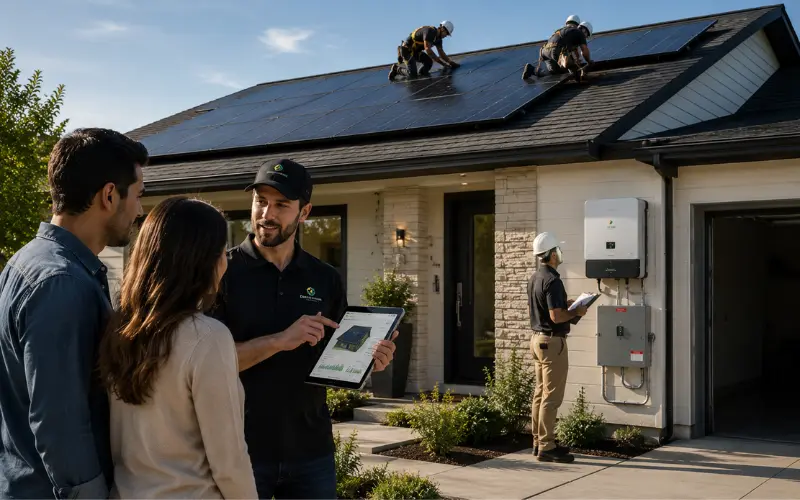
Most empire solar companies follow a similar installation process. Knowing each step in advance prevents surprises and helps you hold your installer accountable.
Step 1 — Free Consultation and Energy Assessment
A sales representative visits your home or conducts a virtual consultation to assess your energy usage, roof condition, sun exposure, and shading. They pull your electricity bills to size the system correctly. This step is free at all empire solar companies.
Ask specifically: What software do they use for roof and shading analysis? (Industry-standard tools include Aurora Solar and Helioscope. If they are eyeballing it without software, that is a red flag.)
Step 2 — System Design and Proposal
The company produces a proposed system design — number of panels, panel wattage, inverter type, expected annual production, and projected savings. They present this alongside financing options and a contract.
This is the most critical step to review carefully. Before signing, verify:
- The proposed system size covers at least 90% to 100% of your annual energy usage
- The production estimate uses real shading data, not idealized numbers
- The contract clearly states panel brand and model, inverter brand and model, and all warranty terms
- The financing terms are fully disclosed, including interest rate, total loan amount, and all fees
Step 3 — Permitting
Your installer pulls building permits from your local municipality. This step takes anywhere from one week to three months depending on your city or county. Reputable empire solar companies handle all permit applications on your behalf and do not schedule installation until permits are approved.
Never allow an installer to begin work without a permit. Unpermitted solar installations can be forced to be removed at your expense, may not qualify for tax credits, and create serious problems when you sell your home.
Step 4 — HOA Approval (If Applicable)
If your home is in an HOA, approval is required before installation in most states. Your installer should be familiar with this process and handle the submission. Most states have solar access laws that prevent HOAs from outright prohibiting solar panels, but they can regulate placement and aesthetics.
Step 5 — Installation Day
Installation typically takes one to three days for a standard residential system. A crew installs racking on your roof, mounts the panels, runs conduit and wiring, and installs the inverter inside your home or garage. Quality installers clean up completely before leaving.
After installation, the system is not yet turned on. It must pass inspection first.
Step 6 — Inspection and Permission to Operate
Your local building department inspects the installation. Your utility company then conducts a separate inspection and grants Permission to Operate (PTO) before the system can be switched on. This step can take one to eight weeks depending on your utility.
Step 7 — System Activation and Monitoring Setup
Once PTO is granted, your installer activates the system and sets up your monitoring app. You should be able to see real-time production data from day one. Confirm that the production numbers match or exceed what was promised in the proposal.
Empire Solar Reviews: What Real Customers Say
Customer reviews across platforms reveal consistent themes for empire solar companies — both positive and negative. Here is an honest summary of what verified reviewers report:
What customers praise:
- Fast installation timelines once permits are approved
- Knowledgeable and professional installation crews
- Significant reductions in electricity bills after going solar
- Responsive customer service during the sales and installation phase
- Systems that perform close to or at projected output levels
What customers complain about:
- Post-installation customer service can be slower than expected, particularly for follow-up questions or warranty claims
- Permitting delays that extended timelines well beyond initial estimates (note: some permitting delays are outside the installer’s control)
- Sales representatives overpromising on savings without accounting for utility rate changes or net metering policy shifts
- Confusion about financing terms — some customers reported not fully understanding the difference between a solar loan and a lease until after signing
The review pattern that matters most: The most reliable reviews come from customers who are 12 to 24 months post-installation, not immediately after installation day. A great installation experience means little if the company is hard to reach when something goes wrong two years later. Specifically look for reviews that mention warranty claims, service calls, or questions about monitoring data — these reveal the true quality of long-term support.
Where to find verified reviews:
- Solar Reviews (solarreviews.com) — the most solar-specific review platform
- Google Business Profile reviews
- Better Business Bureau (BBB) profile
- EnergySage marketplace reviews (if the company is listed there)
Empire Solar Pricing: What Does It Actually Cost?
Empire solar companies do not publish fixed pricing online, which is standard for the solar industry. Every quote is customized based on system size, roof type, location, and chosen equipment. However, here are realistic benchmarks to evaluate any quote you receive:
The national average cost of residential solar installation in 2025 is approximately $2.50 to $3.50 per watt before incentives. A typical 8 kW system (sufficient for most U.S. households) costs $20,000 to $28,000 before the federal tax credit.
The federal Residential Clean Energy Credit currently covers 30% of the total installed cost, bringing a $25,000 system down to $17,500 in net cost. Many states offer additional rebates or credits on top of this.
If an empire solar quote comes in significantly above $4.00 per watt, ask for an itemized breakdown of costs. If it comes in significantly below $2.50 per watt, verify that the panels and inverters are from reputable, tier-one manufacturers — not off-brand equipment that may fail to qualify for manufacturer warranties.
Financing Options: Understanding Your Choices Before You Sign
This is the area where most homeowners make avoidable mistakes, and where competitor articles consistently fall short of giving complete information.
Cash purchase — You own the system outright from day one. You receive the full 30% federal tax credit as a dollar-for-dollar reduction in your tax liability. Long-term savings are highest. Requires a significant upfront investment.
Solar loan — You borrow the money to purchase the system outright and repay it over time, typically 10 to 25 years. You still own the system and claim the federal tax credit yourself. Look carefully at the interest rate: many solar loans carry rates between 2.99% and 7.99%. A higher interest rate significantly reduces your net savings over the loan term.
Solar lease — The solar company owns the panels on your roof. You pay a fixed monthly fee to use the electricity they produce. You do not own the system, do not claim the federal tax credit, and do not build equity in the system. Leases are easier to qualify for but deliver lower long-term financial benefits. Selling your home with a lease in place requires transferring the lease to the new buyer, which some buyers resist.
Power Purchase Agreement (PPA) — Similar to a lease, but instead of paying a fixed monthly fee, you pay per kilowatt-hour for the electricity the panels produce. Again, the company owns the system. You do not claim the tax credit.
The “free solar” or “$0 down” offers that some empire solar companies advertise most commonly refer to solar loans or leases with no upfront payment required. They are not truly free — you are either taking on debt or committing to monthly payments over 20 to 25 years. Understand exactly which financing structure you are agreeing to before you sign.
What Competitors Are Not Telling You: Critical Questions to Ask Before You Hire
Most empire solar articles tell you what these companies do. They rarely help you evaluate whether a specific company deserves your business. Here are the questions to ask before signing any contract:
What panels and inverters are you installing? Insist on specific brand names and model numbers in writing. Tier-one panel manufacturers include LG, Panasonic, REC Group, Q CELLS, and SunPower. For inverters, look for Enphase, SolarEdge, or SMA.
Are you the actual installer or are you a sales organization? Some solar companies sell the system and then subcontract the installation to a third-party crew. This is not automatically a problem, but you need to know who is physically doing the work and who holds the workmanship warranty.
What does the workmanship warranty cover and for how long? Panel manufacturers typically warrant panels for 25 years. Inverter warranties range from 10 to 25 years. The installer’s workmanship warranty — covering roof penetrations, wiring, and installation quality — typically runs 5 to 10 years. Get all warranty terms in writing.
How do you handle service calls after installation? Ask specifically: if my production drops unexpectedly 18 months from now, what is the process? How quickly do you respond? Is there a service fee?
What happens to my system if your company goes out of business? Solar companies close. The panels and inverters carry manufacturer warranties that are honored regardless of the installer’s business status, but workmanship warranties disappear when a company shuts down. Ask if your installer carries errors and omissions insurance and whether your warranty is backed by a third party.
Is your company NABCEP certified? NABCEP (North American Board of Certified Energy Practitioners) certification is the gold standard for solar installation quality. While not required, it is a strong signal of professional training and competence.
Empire Solar vs. Other Solar Installers: How to Compare
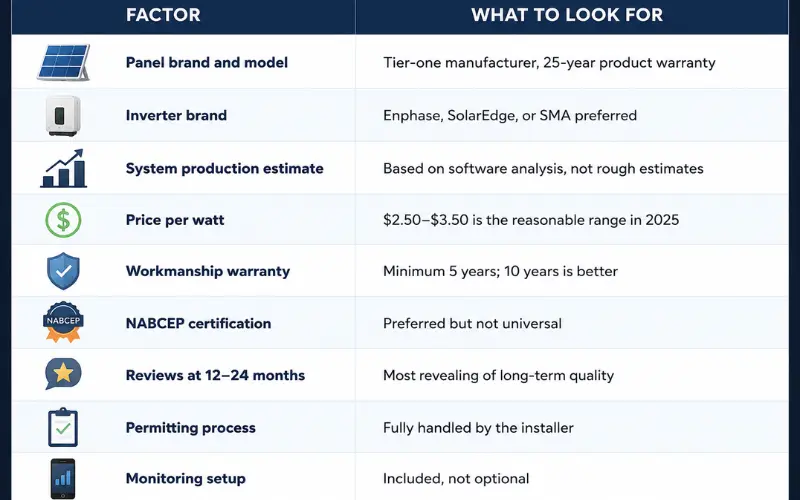
When getting multiple quotes — which you should always do — compare these specific factors across companies:
| Factor | What to Look For |
|---|---|
| Panel brand and model | Tier-one manufacturer, 25-year product warranty |
| Inverter brand | Enphase, SolarEdge, or SMA preferred |
| System production estimate | Based on software analysis, not rough estimates |
| Price per watt | $2.50–$3.50 is the reasonable range in 2025 |
| Workmanship warranty | Minimum 5 years; 10 years is better |
| NABCEP certification | Preferred but not universal |
| Reviews at 12–24 months | Most revealing of long-term quality |
| Permitting process | Fully handled by the installer |
| Monitoring setup | Included, not optional |
Do not make your decision based on the lowest price alone. A cheaper system using lower-quality panels or inverters, or installed by a crew with weak training, will cost more in the long run through reduced production and higher maintenance expenses.
Frequently Asked Questions
Is Empire Solar a legitimate company?
Yes, the empire solar companies mentioned in this guide are legitimate operating businesses. Empire Solar Group has Inc. 5000 recognition and a verifiable track record. As with any solar company, due diligence — checking reviews, verifying licenses, and getting multiple quotes — is essential before signing.
How much can I save by going solar with Empire Solar?
Savings depend on your current electricity usage, your utility’s net metering policy, and your system size. Most homeowners who size their system correctly see electricity bills reduced by 70% to 100%. Over 25 years, total savings often reach $30,000 to $60,000 depending on local electricity rates and rate increases over time.
Does Empire Solar offer battery backup systems?
Some locations do. Battery storage availability varies by company and region. Ask your specific empire solar representative what battery options they offer, which brands they install, and what the additional cost is.
How long does the Empire Solar installation process take from start to finish?
From signed contract to system activation, expect 2 to 5 months. The installation itself takes 1 to 3 days. Most of the timeline is consumed by permitting and utility interconnection approval, which varies significantly by location.
What financing options does Empire Solar offer?
Empire solar companies typically offer solar loans, leases, PPAs, and cash purchase options. The specific lenders and terms vary by location. Always compare the total cost of financing — including interest — against your projected savings before choosing a financing structure.
What happens if my Empire Solar panels stop working?
Panel and inverter failures are covered by manufacturer warranties that run 10 to 25 years. Workmanship issues (roof leaks, wiring problems) are covered by the installer’s workmanship warranty. Contact the company directly for service; most have a dedicated service department separate from the sales team.
What is the difference between a solar lease and a solar loan?
With a solar loan, you own the system, claim the federal tax credit, and build equity. With a lease, the solar company owns the system, claims the tax credit themselves, and you pay a monthly fee. Loans deliver better long-term financial results for most homeowners who can qualify.
How do I get the best price from Empire Solar?
Get at least three quotes from different installers before deciding. Bring competing quotes to your empire solar negotiation — installers will often match or beat a competitor’s price to win your business. Focus on total value (equipment quality, warranty terms, company reputation) rather than lowest price alone.
Final Thoughts
Empire solar companies offer real value for homeowners ready to make the switch to clean, renewable energy. The installation quality, equipment used, and long-term support vary enough between companies and locations that doing your homework before signing is non-negotiable.
Get multiple quotes. Verify licenses. Read reviews from customers who are at least one year post-installation. Understand your financing terms completely before you commit. Ask for the specific panel and inverter models in writing.
Done right, going solar with an empire solar company — or any reputable installer — is one of the smartest long-term investments a homeowner can make. The savings are real, the technology is proven, and the federal incentives available right now make 2025 one of the best years in history to go solar.