Your EV charging cable is the one piece of equipment you use every single day. It bridges your car and the power source, and choosing the wrong one — or managing it poorly — costs you money, damages your equipment, and creates unnecessary frustration. Yet most EV owners spend weeks researching their charger and barely five minutes thinking about the cable.
This guide changes that. It covers everything you actually need to know about EV charging cables — connector types, lengths, amperage ratings, cable care, the current connector standard shift, adapters, and the things competitors consistently get wrong or skip entirely.
Do You Actually Need to Buy an EV Charging Cable?
The short answer is almost certainly yes — and here is why most new EV owners are surprised by this.
Most public Level 2 charging stations in North America do NOT include a tethered cable. They provide a charging post with a connector port, and you supply the cable from your car. If you arrive without your EV charging cable, you simply cannot charge.
For home charging, the situation depends on your equipment. Many Level 2 home charger units come with a hardwired or tethered cable already attached. Others come as “socket only” units where you plug in your own cable. If you bought a socket-only home charger, you need to purchase an EV charging cable separately.
Beyond that, carrying a portable EV charging cable in your car means you can charge anywhere you find a compatible outlet — at a friend’s house, a hotel, a workplace — without depending entirely on public infrastructure. That flexibility has genuine real-world value.
EV Charging Cable Types: Understanding the Basics
EV charging cables are not all the same. They differ by connector type, charging mode, amperage rating, and cable length. Getting these details right before you buy is the single most important thing you can do.
Mode 2 Cable (Level 1 / Portable Charging Cable)
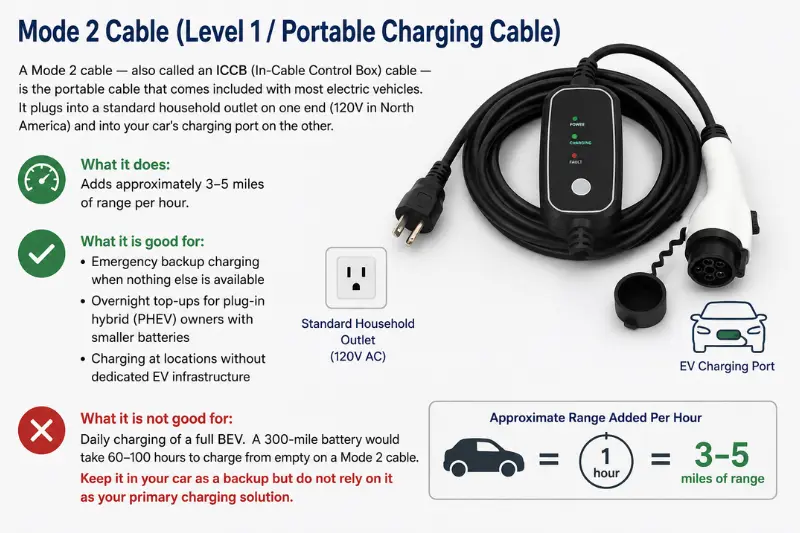
A Mode 2 cable — also called an ICCB (In-Cable Control Box) cable — is the portable cable that comes included with most electric vehicles. It plugs into a standard household outlet on one end (120V in North America) and into your car’s charging port on the other.
What it does: Adds approximately 3–5 miles of range per hour.
What it is good for:
- Emergency backup charging when nothing else is available
- Overnight top-ups for plug-in hybrid (PHEV) owners with smaller batteries
- Charging at locations without dedicated EV infrastructure
What it is not good for: Daily charging of a full BEV. A 300-mile battery would take 60–100 hours to charge from empty on a Mode 2 cable. Keep it in your car as a backup but do not rely on it as your primary charging solution.
Mode 3 Cable (Level 2 / AC Charging Cable)
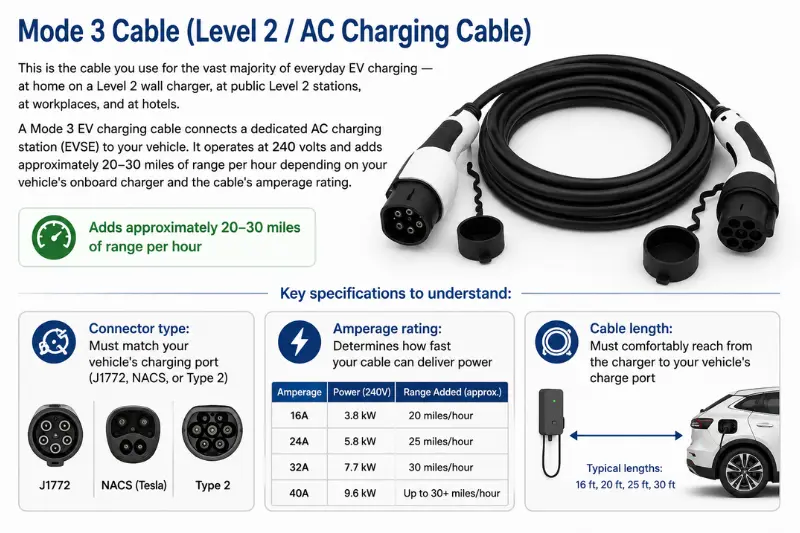
This is the cable you use for the vast majority of everyday EV charging — at home on a Level 2 wall charger, at public Level 2 stations, at workplaces, and at hotels.
A Mode 3 EV charging cable connects a dedicated AC charging station (EVSE) to your vehicle. It operates at 240 volts and adds approximately 20–30 miles of range per hour depending on your vehicle’s onboard charger and the cable’s amperage rating.
Key specifications to understand:
- Connector type: Must match your vehicle’s charging port (J1772, NACS, or Type 2)
- Amperage rating: Determines how fast your cable can deliver power
- Cable length: Must comfortably reach from the charger to your vehicle’s charge port
Mode 4 Cable (DC Fast Charging / Level 3)
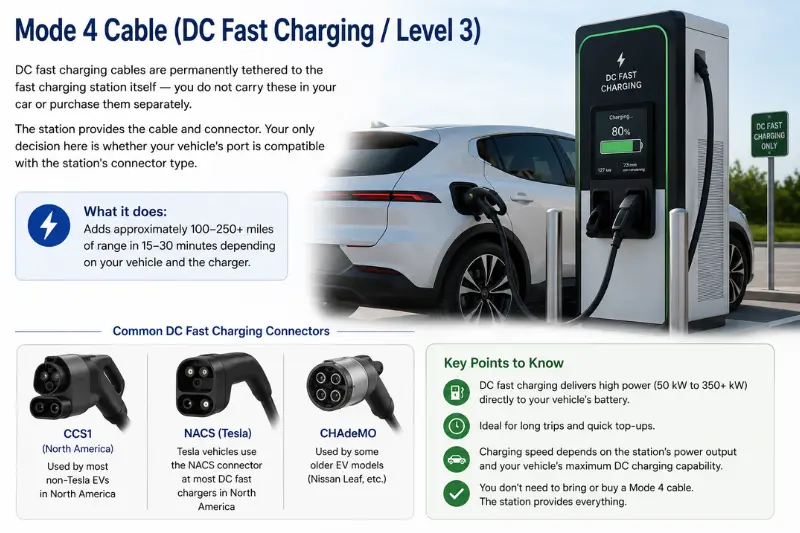
DC fast charging cables are permanently tethered to the fast charging station itself — you do not carry these in your car or purchase them separately. The station provides the cable and connector. Your only decision here is whether your vehicle’s port is compatible with the station’s connector type.
EV Charging Cable Connector Types: The Complete Guide
This is where confusion hits most EV owners hardest — and where getting it right matters most. The United States currently uses four connector standards: J1772 for Level 2 AC charging, CCS1 for DC fast charging, CHAdeMO (used only by the Nissan Leaf), and NACS, the North American Charging Standard originally developed by Tesla.
Here is what each means for your EV charging cable purchase:
J1772 (Type 1)
The J1772 plug has been the dominant standard for Level 1 and Level 2 AC electric vehicle charging in North America for over a decade. It is widely adopted across the United States, Canada, and parts of Mexico, and is compatible with vehicle brands including Ford, Chevrolet, BMW, Hyundai, Kia, Volkswagen, Nissan, Audi, Mercedes-Benz, Volvo, Polestar, and many others.
If you drive a non-Tesla EV manufactured in recent years, your Level 2 EV charging cable almost certainly uses a J1772 connector on the vehicle end. J1772 supports up to 19.2 kW AC power delivery — sufficient for most overnight home charging needs.
Who needs a J1772 cable:
- All non-Tesla EVs and PHEVs from older model years
- Including: Chevy Bolt, Nissan Leaf, Hyundai Ioniq 5, Kia EV6, BMW iX, and hundreds of others
NACS (North American Charging Standard / SAE J3400)
Tesla introduced the physical connector design with the Model S and later opened the standard to other manufacturers. SAE International formally standardized it as SAE J3400. Most major automakers have since announced plans to adopt NACS for their North American EVs, replacing the CCS1 connector.
NACS has a critical advantage over J1772: a single compact connector handles both AC Level 2 charging and DC fast charging. J1772 is limited to AC charging only and is not a DC fast-charging connector by itself.
Who needs a NACS cable:
- All Tesla vehicles (Model 3, Model Y, Model S, Model X, Cybertruck)
- Recent model year Ford, GM, Rivian, Honda, Nissan, Hyundai, Kia, BMW, Toyota, and most other major brands
The current reality: The momentum is strong, with major automakers announcing J3400 adoption timelines in the near term. We are currently in a transition period with multiple standards coexisting. If you are buying a new EV today, NACS is almost certainly your connector.
CCS1 (Combined Charging System)
CCS1 combines the J1772 AC connector with two additional high-speed DC fast charging pins below, enabling both AC and DC charging through a single port. It can deliver up to 500 amps and 1,000 volts DC, providing a maximum power output of 360 kW.
CCS1 is the DC fast charging standard for most non-Tesla EVs on the road today. For your Mode 3 Level 2 EV charging cable, the vehicle end connector is still J1772 — CCS1 only comes into play at DC fast charging stations, where the cable is tethered to the station.
Type 2 (Mennekes)
The European standard for AC charging, used across the UK, Europe, Australia, and many other markets. Type 2 is a seven-pin connector that supports both single-phase and three-phase AC charging — allowing for significantly faster AC charging than J1772 in markets with three-phase residential power.
If you are in Europe or Australia, your Mode 3 EV charging cable will use Type 2 on both the station end and the vehicle end.
Choosing the Right EV Charging Cable: The Key Specifications
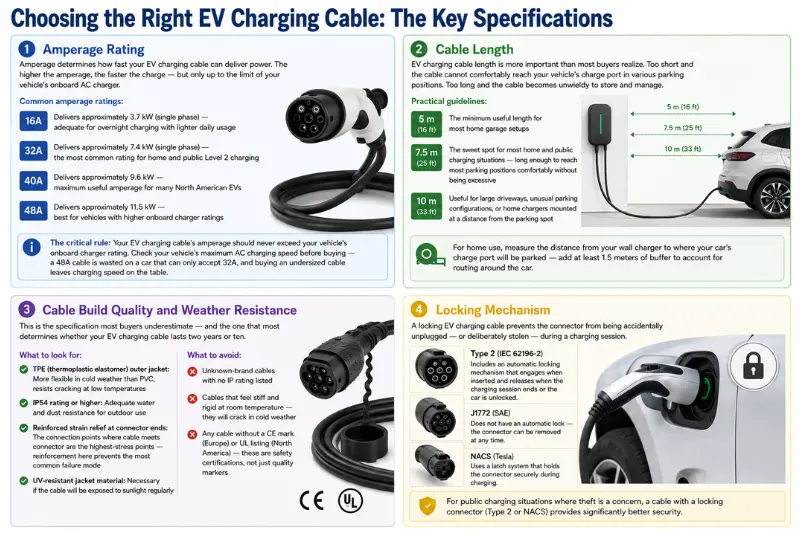
Amperage Rating
Amperage determines how fast your EV charging cable can deliver power. The higher the amperage, the faster the charge — but only up to the limit of your vehicle’s onboard AC charger.
Common amperage ratings:
- 16A: Delivers approximately 3.7 kW (single phase) — adequate for overnight charging with lighter daily usage
- 32A: Delivers approximately 7.4 kW (single phase) — the most common rating for home and public Level 2 charging
- 40A: Delivers approximately 9.6 kW — maximum useful amperage for many North American EVs
- 48A: Delivers approximately 11.5 kW — best for vehicles with higher onboard charger ratings
The critical rule: Your EV charging cable’s amperage should never exceed your vehicle’s onboard charger rating. Check your vehicle’s maximum AC charging speed before buying — a 48A cable is wasted on a car that can only accept 32A, and buying an undersized cable leaves charging speed on the table.
Cable Length
EV charging cable length is more important than most buyers realize. Too short and the cable cannot comfortably reach your vehicle’s charge port in various parking positions. Too long and the cable becomes unwieldy to store and manage.
Practical guidelines:
- 5 meters (16 feet): The minimum useful length for most home garage setups
- 7.5 meters (25 feet): The sweet spot for most home and public charging situations — long enough to reach most parking positions comfortably without being excessive
- 10 meters (33 feet): Useful for large driveways, unusual parking configurations, or home chargers mounted at a distance from the parking spot
For home use, measure the distance from your wall charger to where your car’s charge port will be parked — add at least 1.5 meters of buffer to account for routing around the car.
Cable Build Quality and Weather Resistance
This is the specification most buyers underestimate — and the one that most determines whether your EV charging cable lasts two years or ten.
What to look for:
- TPE (thermoplastic elastomer) outer jacket: More flexible in cold weather than PVC, resists cracking at low temperatures
- IP54 rating or higher: Adequate water and dust resistance for outdoor use
- Reinforced strain relief at connector ends: The connection points where cable meets connector are the highest-stress points — reinforcement here prevents the most common failure mode
- UV-resistant jacket material: Necessary if the cable will be exposed to sunlight regularly
What to avoid:
- Unknown-brand cables with no IP rating listed
- Cables that feel stiff and rigid at room temperature — they will crack in cold weather
- Any cable without a CE mark (Europe) or UL listing (North America) — these are safety certifications, not just quality markers
Locking Mechanism
A locking EV charging cable prevents the connector from being accidentally unplugged — or deliberately stolen — during a charging session.
- Type 2 connectors include an automatic locking mechanism that engages when inserted and releases when the charging session ends or the car is unlocked
- J1772 connectors do not have an automatic lock — the connector can be removed at any time
- NACS connectors use a latch system that holds the connector securely during charging
For public charging situations where theft is a concern, a cable with a locking connector is worth the additional cost.
EV Charging Cable Length for Specific Situations
Home garage (charger on wall, car parks facing in): 5–7 meters typically sufficient.
Home driveway (car parks outside, charger near door): 7.5–10 meters recommended depending on driveway length.
Apartment or street parking (portable cable from outlet): 7.5 meters minimum — you need flexibility to reach outlets in varying positions.
Public Level 2 stations (cable kept in car): 7.5 meters is the standard. Most public stations provide their own cable, but carrying your own ensures you are never stranded.
Travel and road trips: A shorter, lighter 5-meter portable cable kept in the boot/trunk specifically for travel is a smart secondary cable for many EV owners.
EV Charging Cable Adapters: What You Need to Know
The ongoing connector standard transition has made adapters a more important part of EV ownership than ever. Here is the practical adapter picture:
J1772 to NACS (Tesla to Level 2): Tesla vehicles include a J1772 adapter, allowing Tesla owners to use the massive installed base of J1772 Level 2 stations. Replacement J1772-to-NACS adapters are available from the Tesla store for approximately $50. Third-party options from brands like Lectron are typically available in the $30–50 range.
CCS1 to NACS (Tesla to DC fast charging): The Tesla CCS1 adapter costs $230 and lets Tesla owners DC fast charge at any CCS1 station at full speed up to 250 kW. It works with Model 3, Model Y, 2021+ Model S/X, and Cybertruck.
NACS to CCS1 (non-Tesla NACS vehicle to older CCS stations): Most automakers shipping NACS vehicles include or sell an adapter for access to CCS-only stations. As dual-cable NACS + CCS stations become the standard for new installations, this adapter becomes progressively less necessary.
CHAdeMO: Unless you are driving an older Japanese EV, CHAdeMO is not relevant to your charging decisions today. Nissan Leaf owners should plan routes around existing CHAdeMO stations.
Third-party cross-standard adapters: Third-party adapters that convert between incompatible DC fast charging protocols are widely considered unreliable. Stick with first-party adapters from your vehicle manufacturer — these are reliable at full speed. Third-party cross-standard adapters attempt to translate between different charging communication protocols, introducing significant compatibility risks.
EV Charging Cable Management: Protecting Your Investment
A high-quality EV charging cable can last a decade with proper care. Most premature failures come from poor storage and handling rather than electrical issues.
The most common cable damage causes:
- Driving over the cable — even once can cause internal conductor damage invisible from the outside
- Tight bends and kinks at the connector ends — the most common failure point
- Leaving the cable coiled in direct sunlight for extended periods — UV degradation
- Storing the cable wet — moisture trapped inside the cable jacket accelerates insulation breakdown
- Yanking the cable out by the wire rather than the connector body — stresses internal connections
Best practices for cable care:
At home:
- Install a wall-mounted J-hook or cable holster so the cable hangs coiled rather than lying on the floor
- Use a holster dock for the connector when not in use — this protects the electrical pins from dust, moisture, and accidental impact
- Coil the cable in loose loops (minimum 6-inch diameter) rather than tight coils — tight coiling stresses the cable jacket over time
- Never leave the cable under your vehicle’s tire overnight
On the road:
- Keep the cable in a dedicated bag or sleeve in your car rather than loose in the boot/trunk where it gets tangled with other items
- Wipe the connector pins with a dry cloth before and after use if charging in wet conditions
- Check connector pins visually every few weeks — any corrosion, bending, or debris should be addressed before it causes a charging failure
Ceiling-mounted retractable cable systems are the premium option for garages — the cable hangs from the ceiling and retracts automatically, eliminating floor clutter entirely and keeping the cable protected at all times. Cost runs $50–$150 for a quality unit.
How to Check If an EV Charging Cable Is Safe to Buy
The EV charging cable market has a significant number of low-quality products — some are unsafe. Here is how to verify quality before purchasing:
Check for safety certifications:
- CE mark (required in Europe) — confirms the product meets European safety standards
- UL listing (United States) — UL 2594 covers EV charging equipment safety
- TÜV or VDE testing (Europe) — additional quality indicators
Check the specifications honestly:
- Any cable claiming to deliver more than 22 kW on a single-phase AC connection is either wrong or misleading — physics limits single-phase power
- A cable rated for 32A should have conductors sized at minimum 6mm² for that amperage — thinner conductors overheat under sustained load
- IP ratings below IP44 are inadequate for outdoor use in rain
Check the connector quality:
- High-quality J1772 and Type 2 connectors have a solid, precise fit with no wobble or play when inserted
- Cheap connectors often have visible gaps between the housing pieces and feel plasticky rather than solid
Buy from reputable sources: Purchasing from an established EV equipment retailer or the charger manufacturer directly significantly reduces the risk of counterfeit or substandard cables reaching you.
Frequently Asked Questions
Do I need to buy an EV charging cable?
Almost certainly yes. Most public Level 2 charging stations do not provide a cable — you supply your own. For home charging, whether you need a cable depends on your charger unit. Socket-only home charger units require a separate cable; units with a tethered cable do not. Carrying a portable cable in your car is good practice regardless.
What EV charging cable connector do I need?
It depends on your vehicle. If you drive a Tesla or a recent model year EV from most major brands, you need a NACS cable. If you drive an older non-Tesla EV, you need a J1772 cable for Level 2 charging. In Europe and Australia, Type 2 is the standard. Check your vehicle’s charging port before purchasing.
What length EV charging cable should I buy?
7.5 meters (25 feet) is the most versatile length for most EV owners — long enough to reach most parking positions at home and in public without being excessive. For tight garage setups, 5 meters may be sufficient. For large driveways or unusual parking configurations, 10 meters gives you maximum flexibility.
What amperage EV charging cable do I need?
Match the cable amperage to your vehicle’s maximum onboard AC charger rating. Most EVs accept 32A (7.4 kW) as a maximum for single-phase Level 2 charging — a 32A cable serves the majority of EV owners well. Check your vehicle manual for the exact specification before purchasing.
How do I store an EV charging cable properly?
Coil the cable in loose loops rather than tight coils, hang it on a wall-mounted hook or holster, keep the connector in a holster dock when not in use, and store it dry. Never leave the cable where a vehicle could drive over it, and avoid leaving it coiled in direct sunlight for extended periods.
How long should a quality EV charging cable last?
A quality EV charging cable from a reputable manufacturer should last 5–10 years with proper care. The most common premature failure points are the strain relief areas at the connector ends and cable jacket cracking from tight storage or UV exposure. Checking these areas every few months lets you catch wear before it becomes a failure.
Are cheap EV charging cables safe?
Not always. The EV charging cable market includes low-quality products with substandard insulation, undersized conductors, and uncertified connectors. Always look for CE or UL certification, check that conductor sizing matches the amperage rating, and buy from established EV equipment retailers. An unsafe cable is a genuine fire hazard.
What is NACS and do I need a new cable?
NACS (North American Charging Standard, officially SAE J3400) is the connector standard originally developed by Tesla that is now being adopted across the North American EV industry. If you are buying a new EV today, it almost certainly has a NACS port and you will need a NACS cable. If you drive an existing J1772 vehicle, your current cable still works — you do not need to upgrade until you get a new vehicle.
Final Thoughts
Your EV charging cable is not a glamorous purchase. It is a daily-use tool that sits between your car and its power source — and like any daily-use tool, buying the right one and taking care of it properly pays off in years of trouble-free service.
Get the connector type right for your vehicle. Match the amperage to your car’s onboard charger. Choose a length that actually fits your situation. Buy from a source that provides genuine safety certifications. And store it properly so it lasts.
Done right, your EV charging cable is the last piece of charging equipment you think about — which is exactly how it should be.