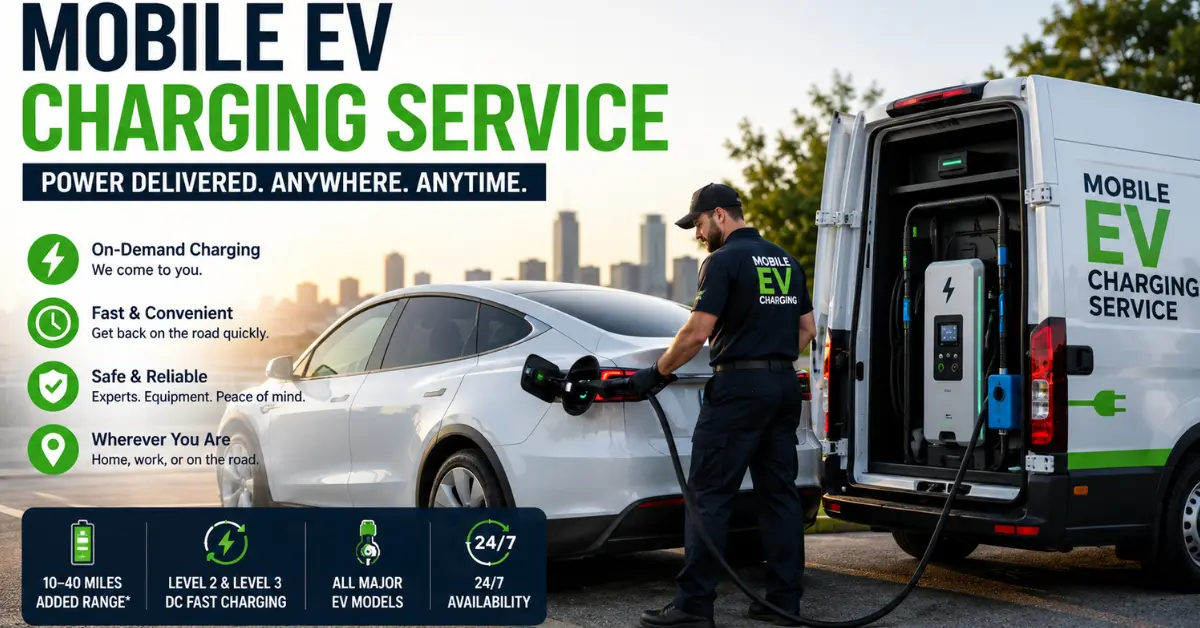
Imagine this: you’re stranded in a parking lot, a highway rest stop, or your own driveway — and your electric vehicle’s battery is completely dead. The nearest charging station is 12 miles away, and you have no way to get there. That’s the exact moment a mobile EV charging service earns its worth.
This guide covers everything you need to know: how it works, when to call one, what it actually costs, how to pick the right provider, and a few things most companies won’t tell you upfront. Whether you’re a first-time EV owner or a seasoned driver, understanding how to find a reliable mobile EV charging service could save you hours of frustration — and maybe even your day.
What Is a Mobile EV Charging Service?
A mobile EV charging service sends a technician directly to your location—whether you’re stranded on the side of the road, stuck in a parking garage, or simply ran low overnight at home—and charges your electric vehicle on the spot using a portable charging unit.
Think of it as a roadside assistance service, but purpose-built for electric vehicles. Unlike tow trucks (which can actually damage certain EVs when handled incorrectly), mobile chargers bring the power to you, get your battery to a safe level, and get you moving again—usually within 30 to 60 minutes.
How Does Mobile EV Charging Work?
The process is simpler than most people expect:
Step 1 — You Request a Charge
You contact the provider via phone, app, or website and share your location. Most services will confirm an ETA and send tracking updates by text or email.
Step 2 — A Technician Arrives
A trained technician (some providers use degreed engineers) arrives in a service vehicle carrying a portable battery charging unit. These units are pre-charged and ready to deliver power immediately.
Step 3 — They Connect to Your Vehicle
The technician connects the charging unit to your EV using a compatible connector. Most services support CCS (the most common standard), CHAdeMO, NACS (Tesla’s connector, now being adopted industry-wide), Type 1, and Type 2.
Step 4 — You Get Enough Power to Continue
A standard mobile charging session delivers roughly 10 to 40 miles of additional range—enough to reach the nearest public charging station, or your home charger. Some premium Level 3 (DC fast charge) mobile services can charge to 80% in 20 to 45 minutes.
Step 5 — You’re on Your Way
Once the charge is complete, the technician disconnects, you confirm the session, and you drive away. Some services also offer to escort you to the nearest fast charger if needed.
Types of Mobile EV Charging
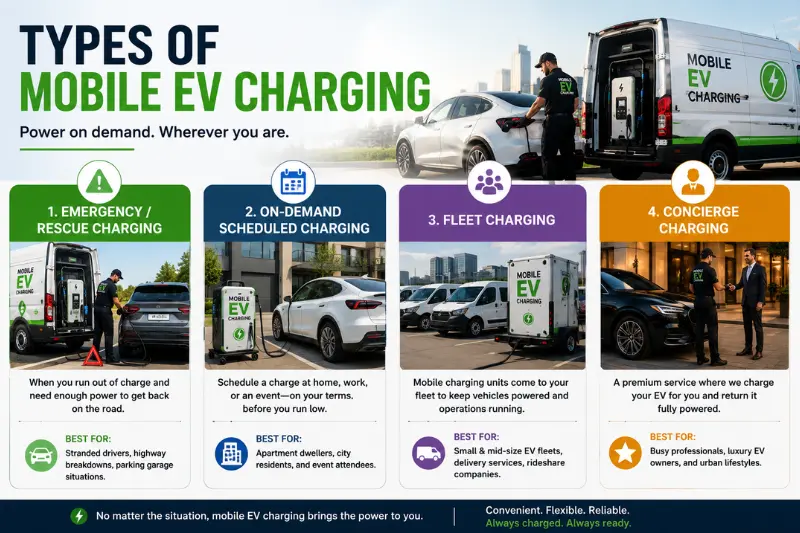
Not all mobile EV charging services are the same. Here’s what to know about the different approaches:
Emergency/Rescue Charging
This is the most common use case. You’ve run out of charge, you’re stranded, and you need just enough power to get going. The goal isn’t a full charge—it’s recovery. Rescue charging sessions typically add 10 to 30 miles of range.
Best for: Stranded drivers, highway breakdowns, parking garage situations.
On-Demand Scheduled Charging
You schedule a charger to come to you—at home, your office, an event—before you actually run out. You stay in control of when and where you charge, without depending on a public station.
Best for: Apartment dwellers without home chargers, EV owners in cities with limited charging infrastructure, event attendees.
Fleet Charging
Mobile charging units visit commercial vehicle fleets—delivery vans, rideshare cars, company cars—at a depot, parking lot, or job site. This eliminates downtime caused by drivers having to seek out public chargers between shifts.
Best for: Small and mid-size EV fleet operators, delivery companies, rideshare companies.
Concierge Charging
A premium service where the technician picks up your EV (or parks it for you), takes it to a charging station, charges it fully, and returns it. Less about rescue and more about convenience.
Best for: Busy professionals, luxury EV owners, people in dense urban environments.
When Should You Call a Mobile EV Charging Service?
Most people don’t think about mobile EV charging until they need it urgently. But there are actually several situations where calling ahead—or subscribing to a service—makes more sense than waiting until you’re stranded:
- You’re stranded with 0% battery — the most obvious case
- Your battery is too low to safely reach the nearest charger — you might have 8 miles of range but the charger is 10 miles away
- You parked somewhere and forgot to charge overnight — happens more than people admit
- You live in an apartment or condo with no home charger access
- Your building’s charger is broken or occupied
- You’re attending a long event and need a mid-day top-up
- Your company runs a small EV fleet without dedicated charging infrastructure
- You drive in an area with limited public charging coverage
One thing most services won’t tell you: If you’re below 5% battery, some EVs will lock you out of DC fast charging to protect the battery. A mobile Level 2 charge to get you to 10–15% first can unlock fast charging at a public station. A good technician will know this.
Mobile EV Charging vs. Towing: Why It Matters
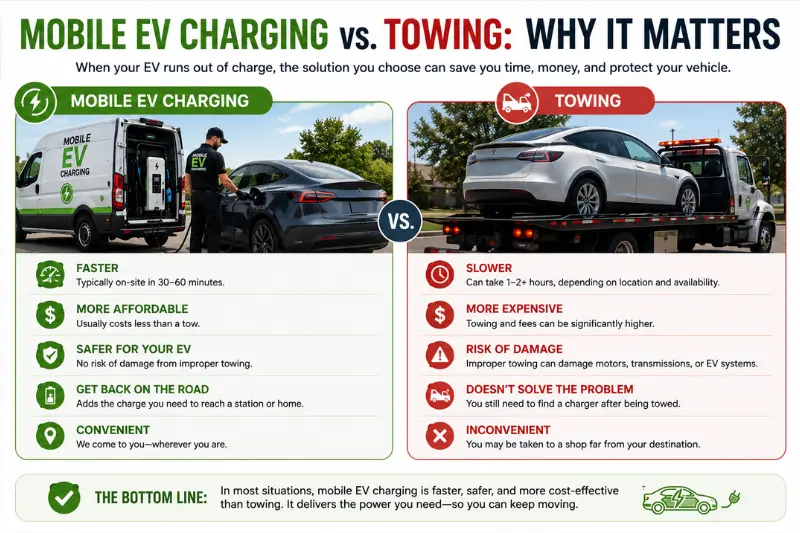
This comparison comes up frequently, and it’s worth addressing directly.
Towing an electric vehicle is not the same as towing a gas car. Many EVs (including certain Tesla models) should never be towed with wheels on the ground, as it can damage the motor or regenerative braking system. Even flatbed towing, while safer, can cost significantly more than a mobile charge—and takes longer.
Mobile charging is almost always faster, cheaper, and safer for your vehicle than a tow. If someone dispatches a tow truck to a stranded EV driver without first trying mobile charging, that’s a missed opportunity at best and a liability issue at worst.
How Much Does Mobile EV Charging Cost?
Pricing varies widely by provider, location, and type of service. Here’s a realistic breakdown based on current market rates:
| Service Type | Typical Cost |
|---|---|
| Emergency rescue charge (L2) | $79 – $150 per session |
| On-demand Level 3 DC fast charge | $150 – $250 per session |
| Monthly subscription (rescue coverage) | $15 – $25/month |
| Fleet charging (per vehicle, per session) | $50 – $120 depending on volume |
| Concierge charging (pick up + charge + return) | $79 – $120+ |
Factors that affect price:
- Distance the technician travels to reach you
- Time of day (after-hours and weekend rates are often higher)
- Type of charging (Level 2 vs. Level 3)
- Geographic market (urban vs. suburban or rural)
- Whether you’re a subscriber or a one-time customer
Is it worth it? Compare it to the alternative: a flatbed tow truck can run $150 to $300 or more. Add the time you’d spend at a tow yard, and a $109 mobile charge looks like a bargain.
Pro tip: If you’re a regular EV driver without guaranteed home charging access, a monthly subscription plan is almost always a better deal than paying per-incident.
What Connectors and EV Types Are Supported?
Most professional mobile EV charging services support all major connector types:
- CCS (Combined Charging System) — used by most US and European EVs (GM, Ford, Hyundai, BMW, Audi, VW, Rivian, and others)
- NACS (North American Charging Standard) — Tesla’s connector, now being adopted by most automakers
- CHAdeMO — used by older Nissan LEAFs and Mitsubishi Outlander PHEVs
- Type 2 — common in European EVs
- J1772 (Level 2) — nearly universal for Level 2 AC charging in the US
Always confirm connector compatibility before booking, especially if you drive an older vehicle or a less common brand. A reputable provider will ask about your make, model, and year when you call.
Mobile EV Charging and Range Anxiety: The Real Conversation
Range anxiety—the fear of running out of charge—is still one of the top reasons people hesitate to buy an EV. And it’s a legitimate concern, especially for:
- First-time EV owners still learning their vehicle’s real-world range
- Drivers in rural or suburban areas with sparse charging infrastructure
- People making longer trips than their usual commute
- Renters and apartment dwellers without home charger access
Mobile EV charging doesn’t eliminate range anxiety entirely, but it changes the stakes significantly. Knowing that a charger can come to you—even if you miscalculate your range—makes the EV experience much lower-stress for a lot of drivers.
Several providers now offer mobile charging subscriptions specifically marketed as “range anxiety protection.” For drivers who are new to EVs or who frequently travel in areas with limited public charging, this kind of safety net is genuinely useful.
Questions to Ask Before Choosing a Mobile EV Charging Provider
Not all services are equal. Before you sign up or call in an emergency, here are the questions that will tell you what you actually need to know:
1. What’s your average response time?
30 to 45 minutes is good. Over 90 minutes is a red flag for a “24/7” service.
2. Do you have technicians in my area, or are you a dispatch service?
Some companies list broad service areas but are actually dispatching contractors. Local technicians almost always arrive faster and provide better service.
3. What charging level do you offer?
Level 2 gives you 10–20 miles of range in 15–20 minutes. Level 3 DC fast charging can take you to 80% in 20–45 minutes. Know which you’re getting.
4. Which connectors do you carry?
Ask specifically about your vehicle’s connector type.
5. What is your flat-rate pricing? Are there hidden fees?
Watch out for “base rate + mileage + after-hours surcharge” pricing that turns a $79 call into a $200 bill.
6. Are your technicians trained for EV-specific safety?
EV high-voltage systems require specific safety knowledge. This isn’t the place to cut corners.
7. Do you offer a subscription or membership?
Regular EV drivers benefit from predictable monthly pricing rather than per-incident rates.
8. Are you insured and licensed?
For fleet or business customers especially, verify insurance and any required business licenses.
Mobile EV Charging for Apartments and Condos: A Growing Use Case
One of the most underserved groups in the EV world is apartment and condo residents. Installing a Level 2 home charger requires landlord approval, electrical upgrades, and often HOA sign-off—none of which are guaranteed.
For these drivers, mobile EV charging is becoming a practical charging strategy, not just an emergency backup. Scheduling a mobile charge once or twice a week can be a viable alternative to home charging, especially in urban areas where public charging stations are often occupied, out of service, or require an inconvenient detour.
Some providers are beginning to offer apartment-dweller specific plans—monthly subscriptions with a set number of charges per month delivered wherever the customer parks. This is a growing niche worth watching.
Mobile EV Charging for Small Fleets: What You Need to Know
If you operate a small commercial EV fleet—even just 3 to 10 vehicles—mobile charging is worth evaluating seriously alongside fixed infrastructure.
The case for mobile charging in fleets:
- No need to install (and maintain) charging infrastructure at a depot
- Vehicles can be charged wherever they’re parked—job sites, customer lots, on-street
- Flexible capacity: scale up or down without adding or removing hardware
- Faster to deploy than fixed infrastructure, which can take months to permit and install
The limitations:
- Cost per kWh is higher than fixed charging for high-volume users
- Not practical as the sole charging solution for large fleets (20+ vehicles)
- Availability may vary in less urban areas
For most small fleet operators, the ideal setup combines mobile charging for flexibility and emergency coverage with Level 2 fixed chargers at a central location for overnight top-ups.
The Future of Mobile EV Charging
The mobile EV charging industry is moving fast. A few trends worth watching:
Higher-powered portable units
Mobile chargers capable of delivering 150 to 360 kW are now commercially available, narrowing the gap between mobile and fixed fast charging significantly.
Autonomous and robot charging
Several companies are developing autonomous charging vehicles and robotic charging arms that can serve vehicles in parking lots without a human technician. Not mainstream yet, but coming.
V2X integration
Vehicle-to-grid (V2G) and vehicle-to-vehicle (V2V) technology will eventually allow EVs to charge each other in emergencies. Mobile charging providers are watching this space closely.
Charging as a subscription utility
The model is shifting from “pay per breakdown” to ongoing subscription services, especially for urban EV drivers and small fleet operators. This is better for providers (predictable revenue) and customers (predictable cost).
Summary: What to Remember
- Mobile EV charging brings a portable charging unit directly to your vehicle—no towing required.
- It’s available for emergency rescue, on-demand scheduling, fleet service, and concierge use cases.
- Level 2 mobile charging adds 10–20 miles in 15–20 minutes; Level 3 DC fast charging can charge to 80% in 20–45 minutes.
- A typical session costs $79 to $250; monthly subscriptions are available for regular users.
- Look for local technicians (not dispatched contractors), transparent flat-rate pricing, and multi-connector support.
- It’s almost always faster, cheaper, and safer for your EV than calling a tow truck.
- Apartment dwellers, urban drivers, and small fleet operators are emerging as the highest-value users of recurring mobile charging services.
FAQs About Mobile EV Charging Service
What is a mobile EV charging service?
A mobile EV charging service is an on-demand service that sends a technician with a portable charger to your location to recharge your electric vehicle when your battery is low or completely dead.
How does a mobile EV charging service work?
A mobile EV charging service works by locating your vehicle, dispatching a charging unit, connecting it to your EV, and providing enough power to help you reach your destination or the nearest charging station.
How much does a mobile EV charging service cost?
The cost of a mobile EV charging service typically ranges from $79 to $250 per session, depending on your location, charging speed, and the provider you choose.
How long does a mobile EV charging service take?
Most mobile EV charging service providers arrive within 30 to 60 minutes, and the charging session itself usually takes 15 to 45 minutes.
Can a mobile EV charging service fully charge my EV?
Some providers can fully charge your vehicle, but many mobile EV charging service companies provide enough energy to safely get you to a nearby charging station or your home.
Which electric vehicles are supported by a mobile EV charging service?
Most mobile EV charging service providers support popular EV brands, including Tesla, Ford, Hyundai, Kia, BMW, Volkswagen, Rivian, Nissan, and Chevrolet.
Is a mobile EV charging service better than towing?
Yes, in many situations a mobile EV charging service is faster, cheaper, and safer than towing because it delivers power directly to your vehicle without moving it.
Can I use a mobile EV charging service at home?
Yes. Many people use a mobile EV charging service at home, especially apartment residents or homeowners without a dedicated EV charger.
Is a mobile EV charging service available 24/7?
Many companies offer a mobile EV charging service 24 hours a day, 7 days a week, although availability depends on your city and provider.
Is a mobile EV charging service worth it?
Yes, a mobile EV charging service is worth considering if you frequently drive long distances, lack home charging access, or want extra peace of mind while driving an electric vehicle.
Conclusion
As electric vehicles become more common, having access to a mobile EV charging service is quickly turning from a luxury into a necessity. Whether you’re stranded with a dead battery, live in an apartment without a home charger, or manage a small EV fleet, these services provide a convenient and reliable solution that saves both time and stress.
A mobile EV charging service can often get you back on the road faster, safer, and at a lower cost than towing your vehicle. With 24/7 availability, flexible subscription plans, and expanding coverage areas, it’s becoming an essential part of the EV ecosystem.
If you own an electric vehicle, don’t wait until you’re stuck with 0% battery. Research a trusted mobile EV charging service in your area ahead of time so you’re prepared whenever you need emergency charging assistance. A little preparation today can give you peace of mind on every journey tomorrow.