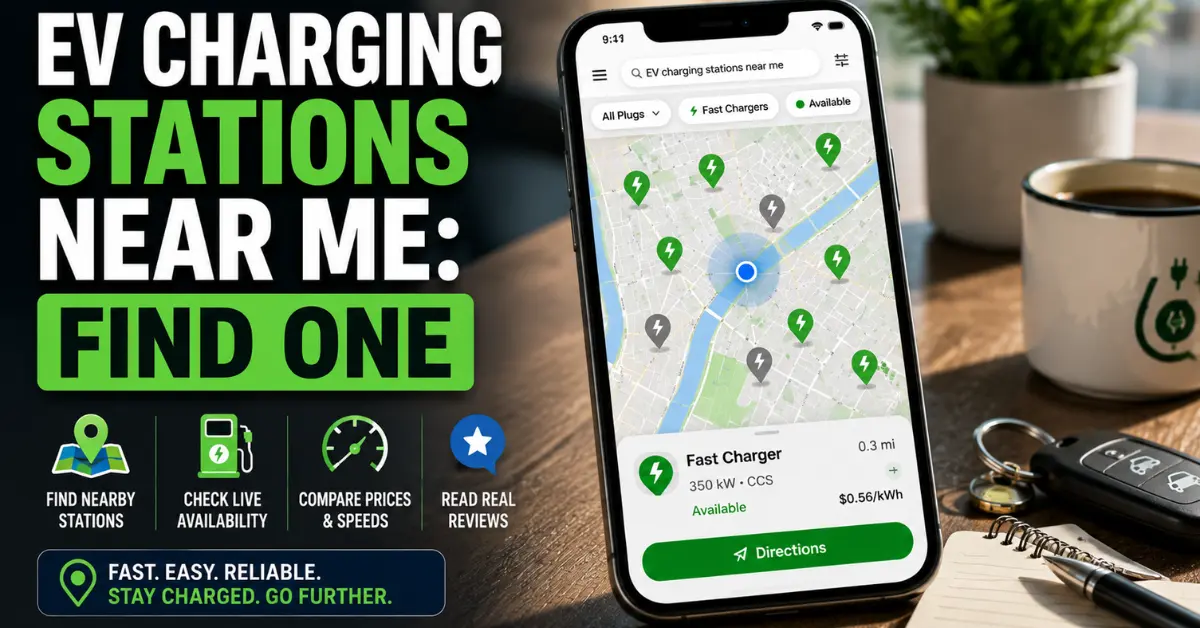
The fastest way to find ev charging stations near me right now is to skip your phone’s default maps app and open something that actually pulls from every network at once. Apps like Plug Share or Charge Point, or your car’s built-in navigation if you drive a Tesla or a newer EV, will drop live charger locations within a few miles of you, sorted by plug type and charging speed. Filter for your connector (CCS, NACS), check that the station shows “available” rather than “in use” or “unknown,” and you’ll usually have a working charger mapped out before you’ve finished reading this sentence.
Here’s a quick rundown of the tools worth keeping on your phone, based on testing them across several long road trips:
| Tool | Best For | Cost | Coverage |
|---|---|---|---|
| PlugShare | Cross-network search, driver reviews, reliability scores | Free | Global |
| ChargePoint app | Workplace and retail Level 2 charging | Free | North America |
| Tesla app / in-car map | Supercharger network | Free | Global (Tesla network) |
| Apple Maps / Google Maps | Quick glance while already driving | Free | Limited live status |
| AFDC.energy.gov | Government-verified station data | Free | US and Canada |
None of these tools alone gives you the complete picture and understanding why is the key to never getting stranded.
Why Finding EV Charging Stations Near Me Isn’t as Simple as It Sounds
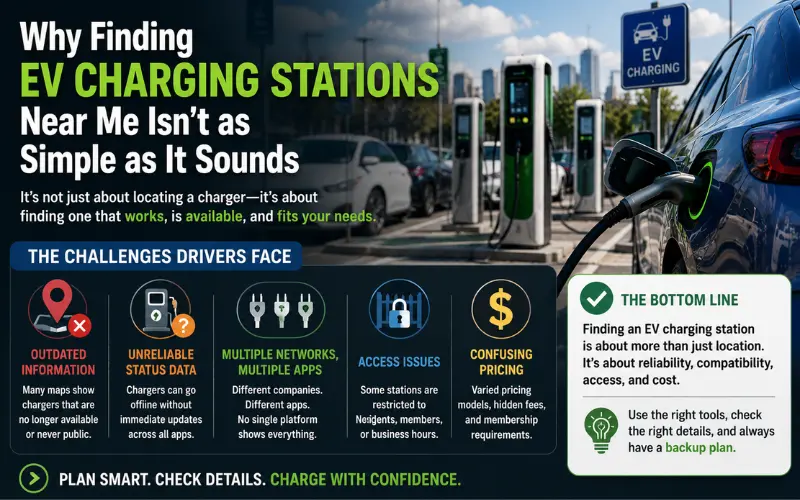
The honest answer is that the charging industry grew up fragmented. Tesla built its own Supercharger network, Electrify America and EVgo built separate fast-charging networks, Charge Point and Blink dominate workplace and retail Level 2 charging, and gas-station brands like Shell and BP added charging as an extra product line rather than a core one. Each of these companies runs its own app, its own map, and its own pricing — so no single company has full incentive to show you a competitor’s chargers. That’s exactly why a search for ev charging stations near me on a generic map often returns outdated pins, stations that have been removed, or chargers sitting behind a locked gate at an apartment complex that the public can’t actually use.
There’s also a data-freshness problem EV Charging Stations Near Me. A charger can go offline for maintenance, get vandalized, or simply have a payment terminal fail, and that status doesn’t always sync to every app instantly. Crowd sourced platforms like Plug Share solve part of this through driver check-ins and reviews, but even that depends on someone bothering to report the problem. Government databases such as the Department of Energy’s Alternative Fuels Data Center are accurate for where stations exist, but they’re not built to tell you in real time whether the charger is actually working right now.
It really work in japan.
How to Find EV Charging Stations Near Me: A Step-by-Step Walkthrough
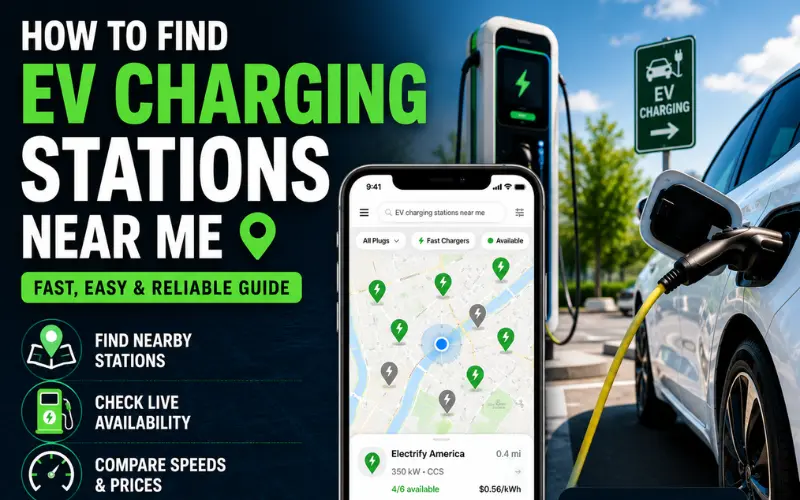
Confirm your connector type first
Most EV Charging Stations and EV charging cable Near Me sold in North America today use either CCS or the Tesla-originated NACS plug, while some older Nissan and Mitsubishi models use CHAdeMO. Knowing this before you search saves you from driving to a station you can’t physically plug into.
Open a cross-network app, not just your phone’s maps
Plug Share or Charge Point EV Charging Stations Near Me will show every brand of charger in your area, not just one company’s stations.
Filter by speed and plug type
Level 2 chargers add roughly 10–30 miles of range per hour, which is fine for a coffee stop but slow for a road trip. DC fast chargers add 60–200+ miles in 20–40 minutes and are what you want when you’re in a hurry.
Check real-time status before you commit to driving there
Look at the app’s live availability indicator and recent check-ins or reviews EV Charging Stations Near Me a station with three recent “broken” reports is a station to skip.
Map a backup option
Pick a second station within a reasonable detour in case your first choice is occupied or down when you arrive.
Use your vehicle’s native navigation as a second opinion
Built-in EV Charging Stations Near Me routing (Tesla, Ford, Rivian, GM, and others) often factors in your actual battery level and pre-conditions the battery for faster charging when you arrive something third-party apps can’t do.
Alternative Ways to Find EV Charging Near You
Beyond the obvious apps, there are a few sources most articles on this topic skip entirely. Many retailers now host charging as a customer perk rather than a standalone business Walmart, Target, and Kohl’s locations frequently have Electrify America or Charge Point stalls in the parking lot, and these are often less crowded than highway fast-charging corridors because shoppers, not road-trippers, are the primary users. Hotels increasingly list EV charging as an amenity on their own booking pages, which is worth checking directly rather than relying on a map app to surface it. If you’re searching for ev charging stations near me that won’t cost you anything, look specifically at shopping centers, municipal parking garages, and some libraries Level 2 chargers in these spots are frequently free or validated with a purchase, while DC fast chargers almost always charge by the kWh or by the minute.
Utility companies in many states also run their own charger locators tied to EV Charging Stations Near Me incentive programs, and these sometimes list stations that haven’t yet been indexed by the bigger apps. And if you want the single most authoritative, ad-free, and unbiased source, the federal government’s AFDC locator (and its newer companion site, DriveElectric.gov) pulls from verified station data without trying to sell you a membership.
What to Check Before You Plug In
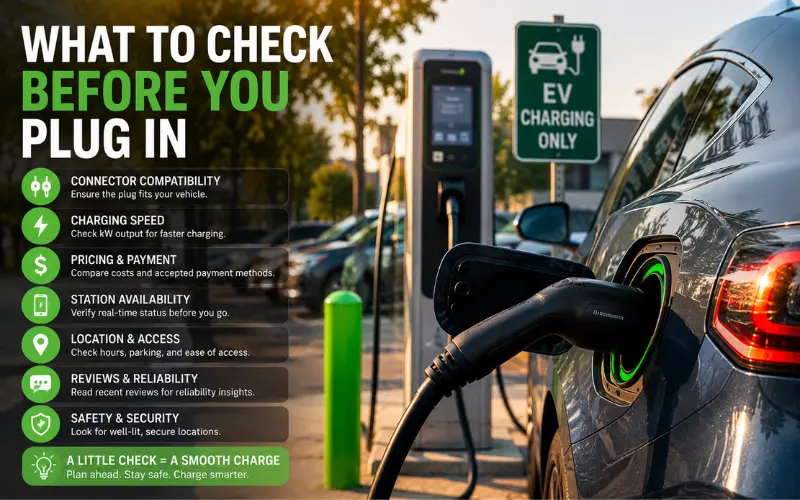
A few details separate a smooth charging stop from a frustrating one. Charging speed is the big one — Level 1 (a standard household outlet) is realistically an overnight-only option, Level 2 is the everyday workhorse for home and workplace charging, and DC fast charging is what road trips depend on, though your car’s actual charging curve (how fast it accepts power as the battery fills) matters more than the charger’s advertised maximum. Pricing also varies more than people expect: some networks charge a flat per-minute rate, others bill per kWh and adjust by time of day, and almost all of them charge an idle fee if you leave your car plugged in after it’s finished charging — so don’t wander too far from the car. Membership programs through Electrify America, EV Charging Stations Near Me go, or Charge Point EV Charging Stations Near Me can meaningfully lower your per-session cost if you charge often enough to justify the monthly fee. And a small courtesy that keeps the whole system working: once you’re charged, move your car promptly, especially at fast chargers where someone else may be waiting.
- Check connector compatibility twice
Even if the app shows the station, confirm it matches your plug type (CCS, NACS, CHAdeMO) before driving in. Some stations list multiple connectors but not all may be active. - Look at real-time availability, not just location
A station showing up on the map might still be full or temporarily offline. Prioritize “Available” status and recent successful check-ins. - Scan recent user reviews or check-ins
Feedback like “only one charger working” or “payment system down” is often more accurate than the live status indicator. - Check charging speed per stall, not just the network name
Some locations labeled as “fast charging” may still have slower shared output or limited high-speed stalls. - Confirm pricing before starting the session
Rates can vary by time of day, membership status, or power output (kWh vs per-minute billing). Unexpected pricing is a common issue. - Watch for parking restrictions or fees
Some chargers are inside paid parking lots, hotels, or garages where parking costs more than the charging itself. - Check number of active stalls at the location
A site with 8 chargers might only have 2 working or accessible if others are reserved, offline, or blocked. - Make sure your payment method/app is ready
Some networks require their own app, RFID card, or preloaded payment method before the charger will even activate.
Frequently Asked Questions
1. How do I find free EV charging stations near me?
Check shopping center parking lots, municipal garages, and some hotels Level 2 chargers in these locations are often free or included with a purchase. Free DC fast charging is rare outside of manufacturer promotions.
2. What’s the real difference between Level 2 and DC fast charging?
Level 2 uses AC power and typically adds 10–30 miles of range per hour, suited for overnight or all-day parking. DC fast charging delivers power directly to the battery and can add 60–200+ miles in 20–40 minutes.
3. Can I use any EV charging station with my car?
Only if the connector matches. Most current EVs use CCS or NACS; older Nissan Leaf and Mitsubishi models use CHAdeMO. Adapters exist for some combinations but aren’t universal.
4. Why does an app show a charger that turns out to be broken or missing?
Charger status doesn’t always sync in real time across every platform. Crowd sourced apps like Plug Share rely on driver check-ins, so a station with no recent reports may simply be unverified rather than confirmed working.
5. Are EV charging stations near me open 24 hours a day?
Most standalone fast-charging stations EV Charging Stations Near Me and those at 24-hour retailers are accessible around the clock. Stations inside parking garages, malls, or hotels typically follow that property’s operating hours.
6. How much does it typically cost to charge at a public station?
DC fast charging generally runs higher than Level 2, often billed by the kWh or minute and varying by network, location, and time of day. Membership tiers can lower the per-session rate noticeably.
7. Do I need a separate app for every charging network?
Not necessarily for finding stations cross-network apps like Plug Share cover most networks in one map but you may still need each network’s own app or RFID card to actually start a charging session and pay.
8. What is NACS and why does it matter when searching for stations?
NACS is the Tesla-developed connector that most major automakers have now adopted as the new North American standard, gradually replacing CCS. It matters because it determines which stations your specific vehicle can physically use without an adapter.
9. Is it safe to charge an EV in the rain?
Yes. Public charging connectors and stations are designed and sealed to handle wet weather; the connection won’t engage properly if it’s not seated correctly, which is itself a safety feature.
10. How can I plan a long road trip around EV charging stations?
Use your vehicle’s native trip planner if it has one, since it accounts for your actual battery level and elevation changes, then cross-check with Plug Share for backup stations and recent reliability reviews along the same route.
Final Thoughts
There isn’t one perfect app that solves the search for ev charging stations near me and probably won’t be until the industry finishes consolidating around NACS and charger reporting becomes more standardized. Until then, the most reliable approach is the layered one: start with a cross-network app for the full picture, lean on your car’s native routing for trip-specific accuracy, and keep a backup station in mind any time you’re running low. Treat the government’s AFDC data as your tie-breaker when two apps disagree, and don’t ignore recent driver reviews a station with three “broken charger” reports from this week is telling you something an outdated map pin never will.